Champions | 2000-2009
-
![]()
Yankee Paco
-
![]()
Scarlet Knight
-
![]()
Chip Chip Hooray
-
![]()
Amigo Hall
-
![]()
Windsong's Legacy
-
![]()
Vivid Photo
-
![]()
Glidemaster
-
![]()
Donato Hanover
-
![]()
Deweycheatumnhowe
-
![]()
Muscle Hill
One For Canada
August 5, 2000
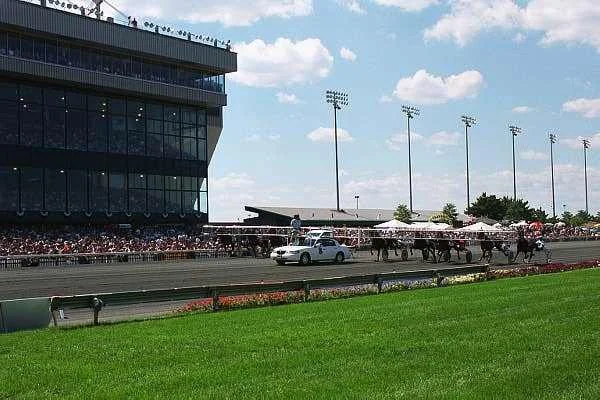
East Rutherford, NJ
The MeadowLands
Purse $1,000,ooo
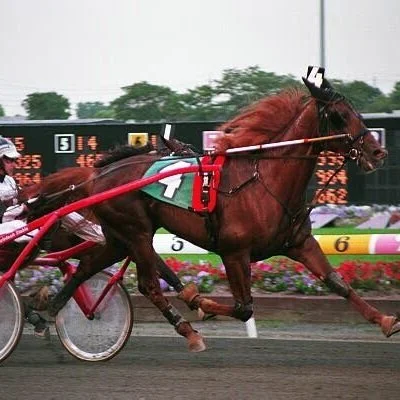
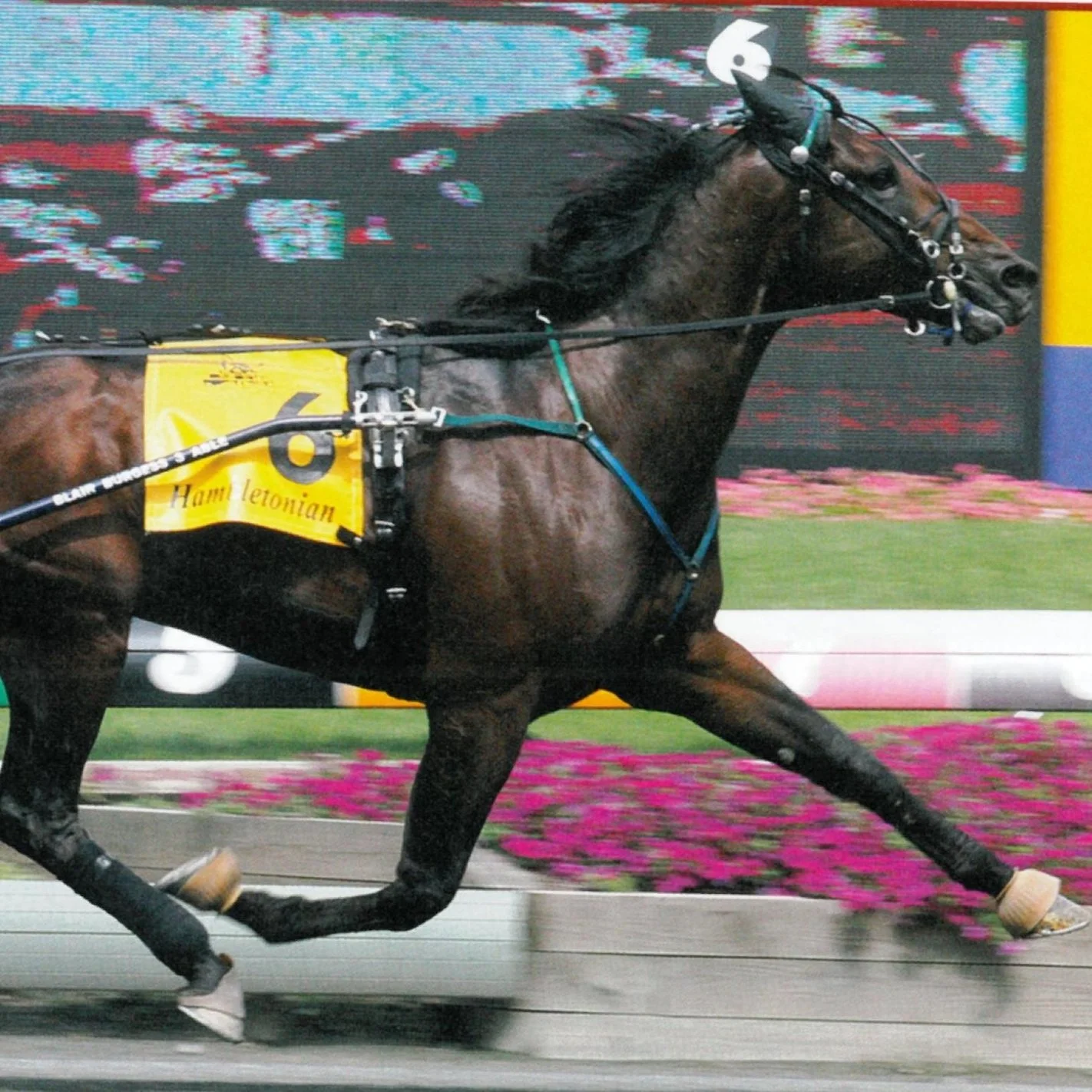
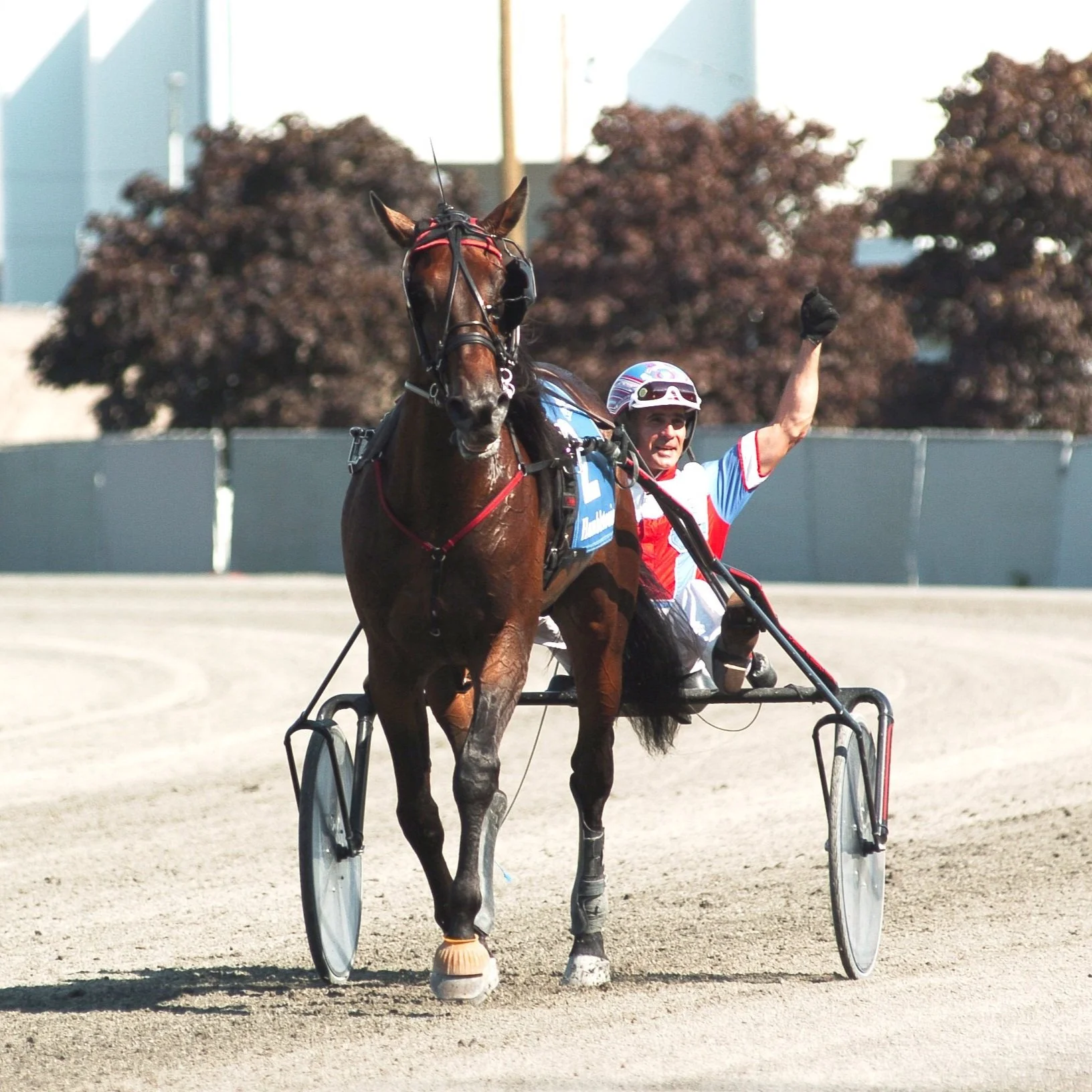
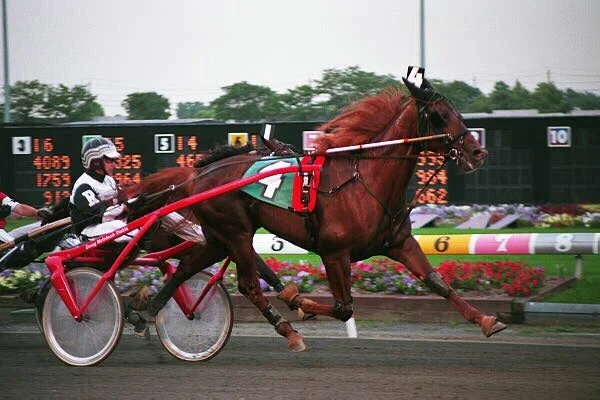
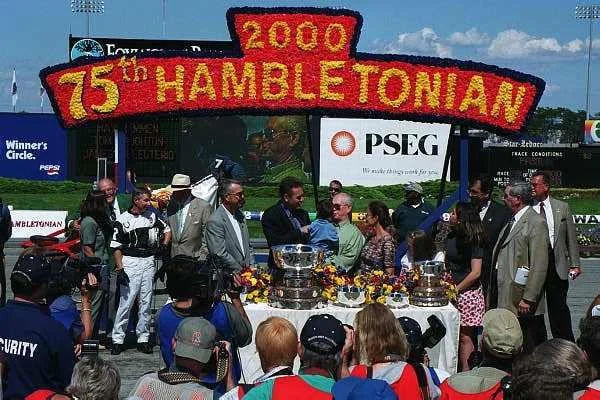
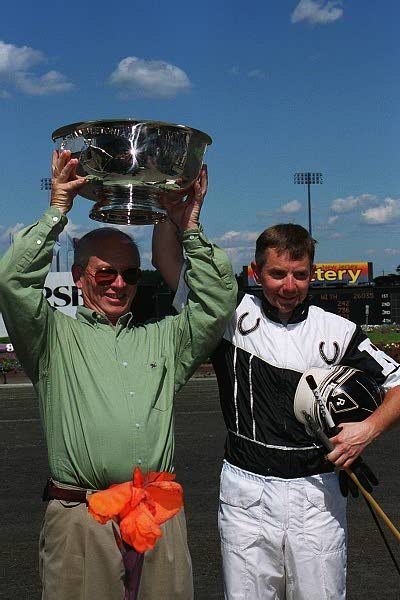
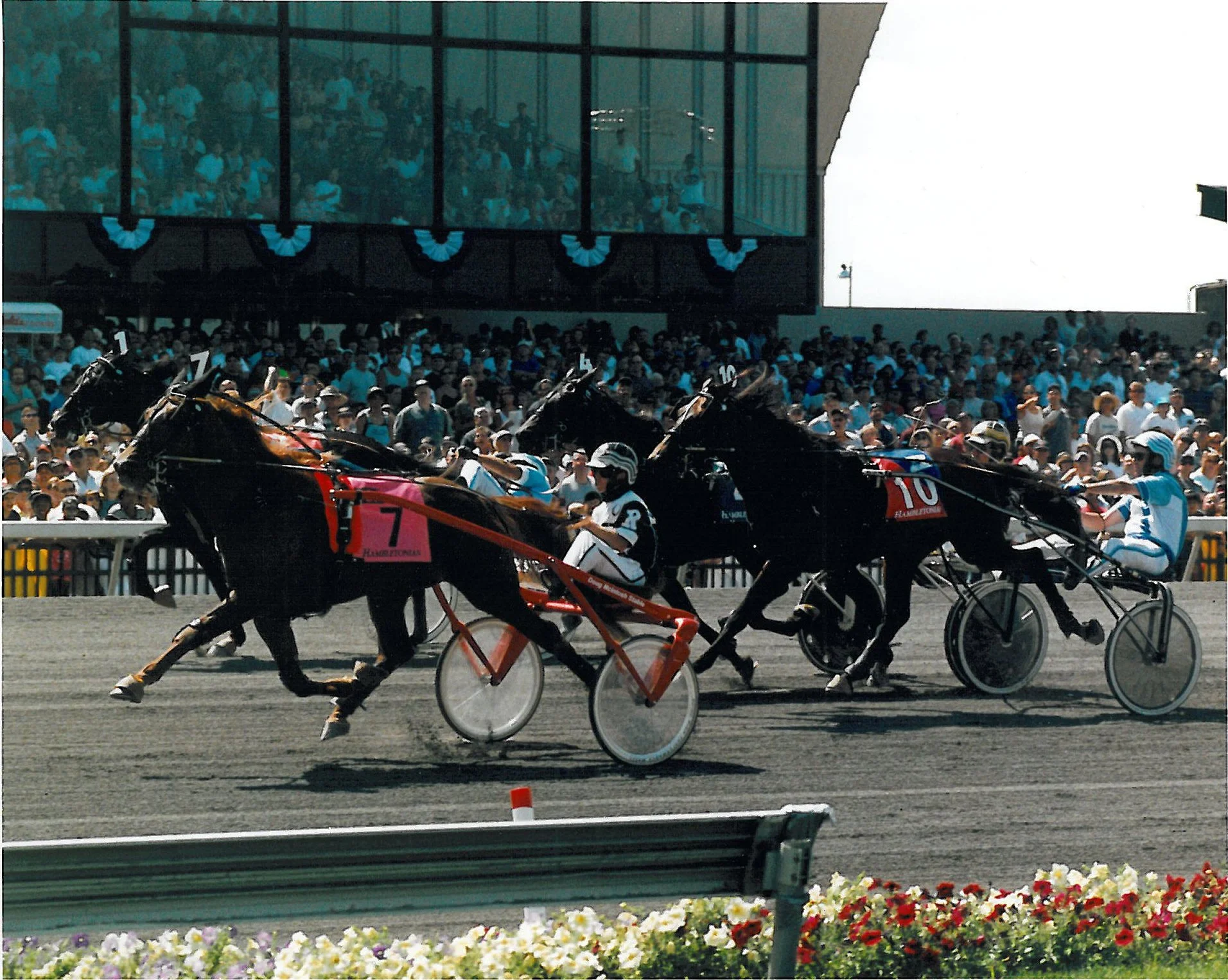
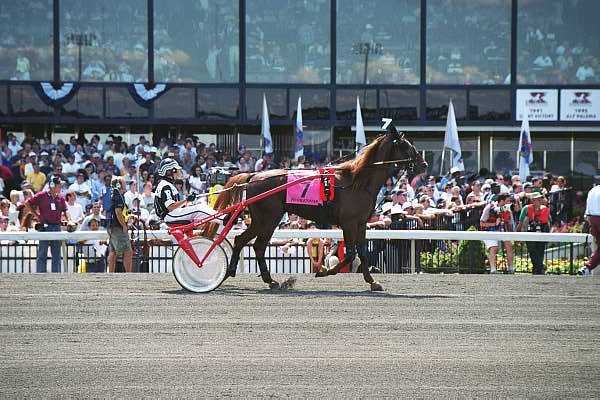
The 75th anniversary of the Hambletonian was a celebration of the rich history and tradition of trotting's greatest race, but there was nothing conventional about the colt and trainer who brought home the 2000 trophy. While many trainers believe the only way to prep for the Hambletonian is to race at the Meadowlands, Doug McIntosh opted for the road less traveled with his striking chestnut colt Yankee Paco. The Wheatley, Ontario native prepped Yankee Paco for the Hambletonian in rather unusual fashion staying in Ontario for Sire Stakes competition. Yankee Paco did not see the Meadowlands surface until he arrived for the eliminations on July 29. The son of Canadian sire Balanced Image entered the Hambletonian eliminations with a four-race win streak, and made it five straight under the patient hands of driver Trevor Ritchie in the second of the three eliminations. The victory was particularly speical for McIntosh and his wife, Carrie, as it came on their son Dylan's second birthday. "The birth of our son was the greatest thing in my life," said McIntosh just before the eliminations. "Winning the Hambletonian is the only thing I can think of that would come close." A week later, McIntosh could compare the two feelings as Yankee Paco became the first Canadian sired horse to win the Hambletonian, bringing him the highlight of his career at age 57. "It's a great thing for my career and a great thing for Canada," he said. The 1:53.2 mile was a season record for a three-year-old colt and Yankee Paco's mile was all the more impressive by the fact that, leaving from post position seven, he was parked out the entire race, first-over after the half in 55.2. It was probably the first time a horse had won the Hambletonian without seeing the rail at any point in the mile. When Legendary Lover K cleared the lead along the backstretch, Yankee Paco was suddenly left uncovered. In a display of gritty determination, Ritchie and Yankee Paco pulled away midstretch. Mike Farrell of The Record wrote, "For any standardbred, that represents the moment of truth, leading to two options: press on for the glory, or fold and try again another day. On a glorious sun-splashed afternoon, Yankee Paco opted to fight." In many ways, Doug McIntosh has been a man ahead of his time in the harness racing industry. The older brother of more heralded conditioner Bob McIntosh, Doug was a pioneer in communicating with owners and prospective owners. He advertised his services when that was considered "taboo" by the old guard. He was one of the first to publish a monthly newsletter, detailing the accomplishments and progress of his equine pupils. He hopped aboard the Internet explosion in the early stages, developing a comprehensive website and using e-mail to communicate with his clients. Yankee Paco was a modest $30,000 yearling purchase by McIntosh from the Yankeeland Farm consignment at the 1998 Kentucky Standardbred Sale at Fasig-Tipton in Lexington on behalf of longtime clients Harry Ivey, a retired pharmacist, and his son, Dr. Tom Ivey, a heart surgeon.
Yankee Paco was the easiest of winners in his elimination by a length and a quarter. In each of the four years since the eliminations were scheduled the previous week, the winner of the Hambletonian also won his elimination. Yankee Paco is only the second chestnut to win the Hambletonian; Blaze Hanover (1960) was the first. Doug McIntosh may be the first Canadian-based trainer to win the Hambletonian. His brother Bob also had a horse in the final, Berndt Hanover, but was pulled up and did not finish the race. A number of Canadian horseman (such as Nat Ray, Ben White, Ralph Baldwin and Joe O'Brien) have trained the winner over the years but after they had emigrated to the U.S. Trevor Ritchie may also be the first Canadian-based driver to win. It was Ritchie's first drive in the Hambletonian. To date he is the 16th (including Nat Ray who won the first edition) to win the race in this first try. That list includes: Bill Leese, Dick McMahon, Will Canton, Lee Smith Harrison Hoyt, Harry Harvey, Ned Bower, Flave Nipe, Howard Beissinger, John Simpson Jr, Ray Remmen, Ulf Thoresen, Bill Fahy, Jack Moiseyev. It was also the first Hambletonian drive for Dave Magee, who finished fifth with the favorite Dreamaster. It was noteworthy in that Magee had driven in more than 48,000 races, winning more than 8,300, but had never driven in the Hambletonian. He said it was an opportunity that he had dreamed of since growing up in Illinois while the race was at DuQuoin. Of the 10 horses in the final: 14 out of the 25 individual owners were in their first Hambletonian; six of the 10 trainers and five of the 10 drivers were also making their first Hambletonian appearance. It was the second Hambletonian winner in three years bred by Yankeeland Farm. Operated by Charles E. Keller III and his family, Yankeeland was founded by Keller's father, baseball and harness racing hall-of-famer Charlie-Keller, who played for the N.Y. Yankees from 1937 to 1952. Keller was a member of one of the Bronx bombers' greatest outfields with Joe DiMaggio and Tommy Henrich. Yankee Paco was the ninth Hambletonian winner in 16 years (1983-1998) sold as a yearling by Kentucky Standardbred Sale Co. John Campbell drove in his 18th consecutive Hambletonian. The 10 horses in the final were by 10 different stallions: American Winner, Armbro Goal, Balanced Image, Chief Litigator, Garland Lobell, Incredible Abe, Pine Chip, SJ's Photo, Valley Victory and Victory Dream. Not since 1931 - a six-horse field bested by Calumet Butler - were all the horses in the final heat by different stallions. Yankee Paco is the fist Canadian-sired winner of the Hambletonian. He is the first by an Ontario sire. Just five states were responsible for the sires of all the other winners: Kentucky (31), Pennsylvania (30), New Jersey (10), New York (3) and Michigan (1). Speedy Crown got his sixth broodmare credit and tied Peter The Great as the leading broodmare sire of Hambletonian winners. The last dam of a winner by Peter The Great was Elizabeth, the dame of Yankee maid (1944). She also produced Greyhound (1935). All six of Speedy Crown's credits are from different mares. Thirty-one winners, including Yankee Paco, traced their paternal line directly to Volomite (second to Walter Dear in the 1929 Hambletonian). Volotmite was the great-great-great-grandson of Hambletonian 10. Yankee Paco was the 63rd of the 76 winners to trace their paternal line directly to Peter The Great, a great-grandson of Hambletonian 10. DeWayne Minor, the driver of Legendary Lover K (finishing 6th), was the first African-American to drive a horse in the Hambletonian. From 1926 through 2000, 1,088 horse have declared in the entry box for the Hambletonian. With 10 scratched, 1,078 horses have started the first heat or in their elimination. This includes 161 fillies that have faced the starter. Only one filly started in 2000, Ava, who finished 6th in her elimination. She is the first filly to have started since Continentalvictory in 1996.
Media
Champions | 2000-2009
-
![]()
Yankee Paco
-
![]()
Scarlet Knight
-
![]()
Chip Chip Hooray
-
![]()
Amigo Hall
-
![]()
Windsong's Legacy
-
![]()
Vivid Photo
-
![]()
Glidemaster
-
![]()
Donato Hanover
-
![]()
Deweycheatumnhowe
-
![]()
Muscle Hill
Smile For The Camera
August 4, 2001
East Rutherford, NJ
The MeadowLands
Purse $1,000,ooo
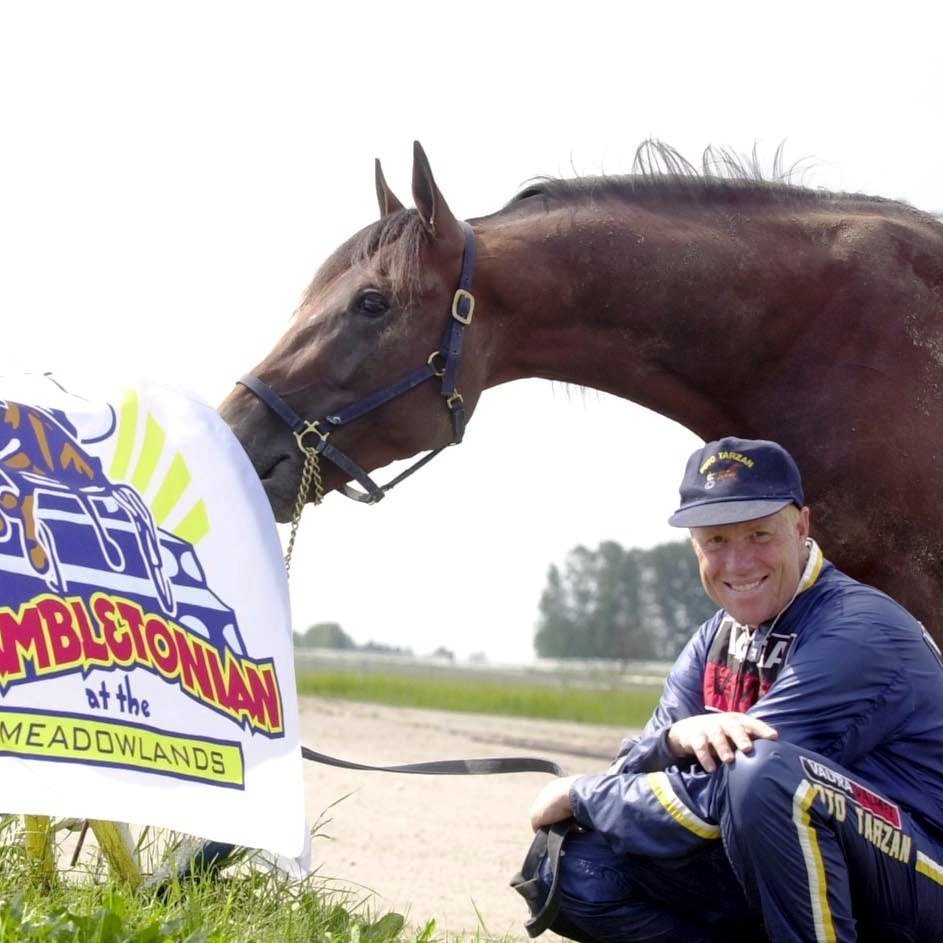
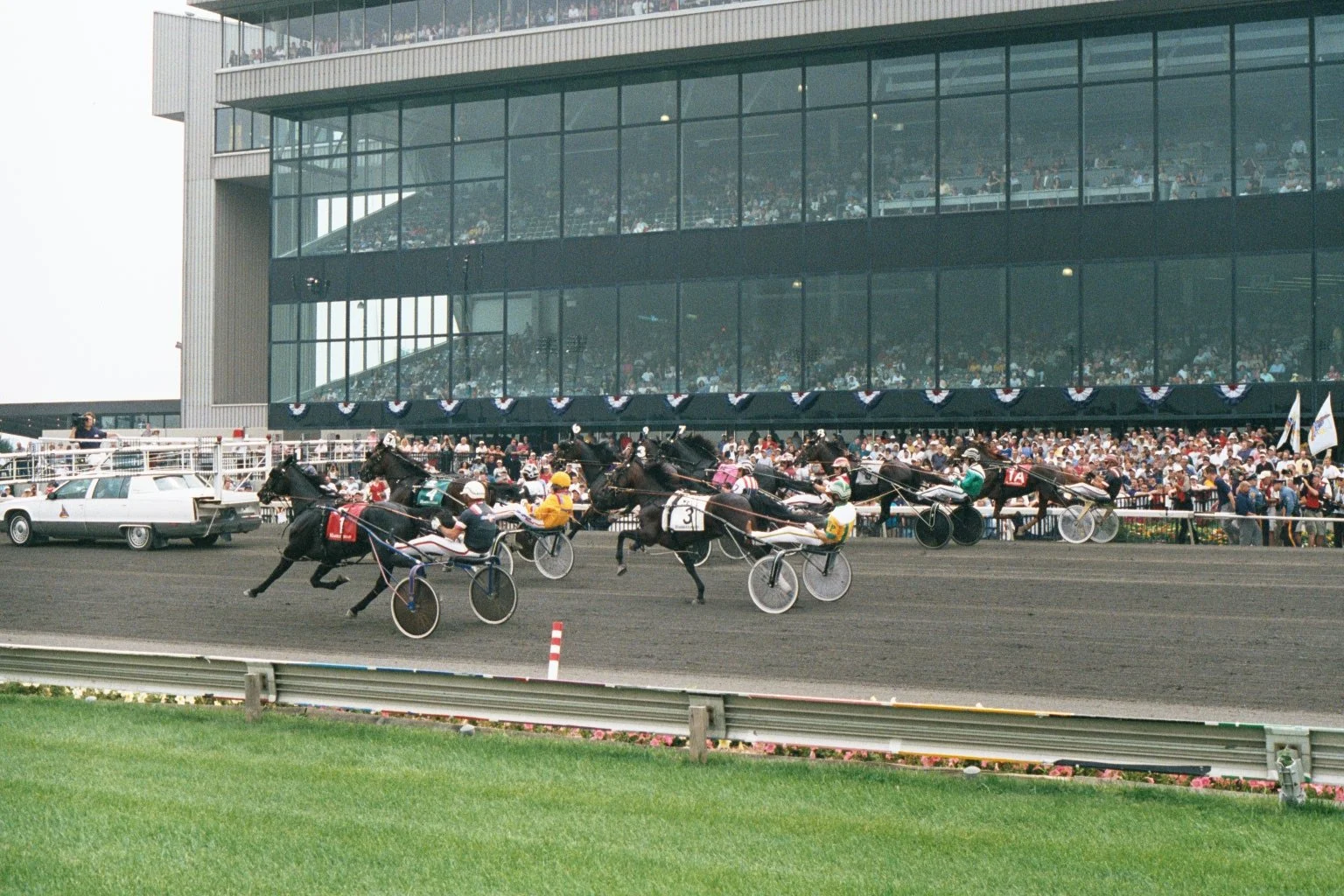
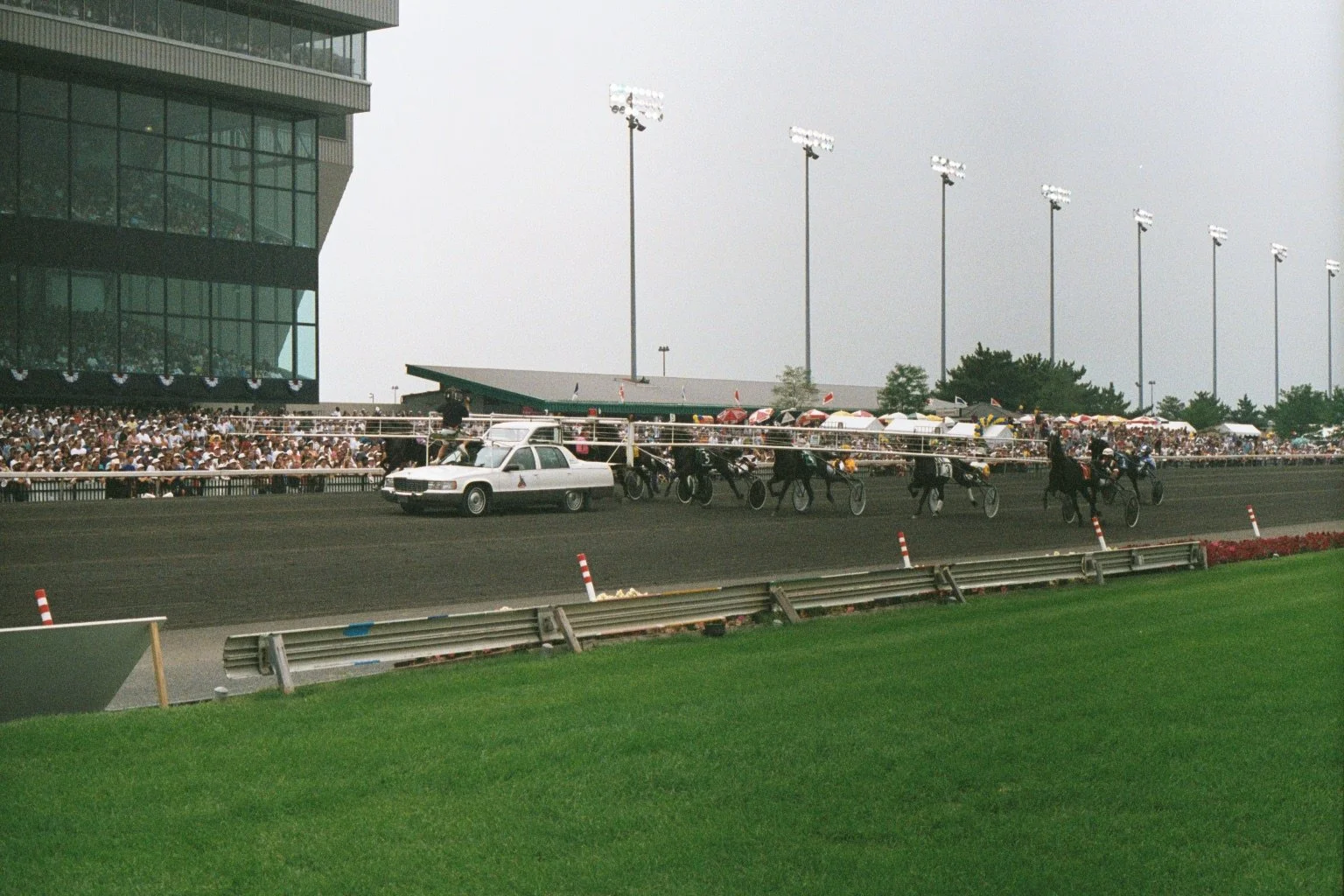
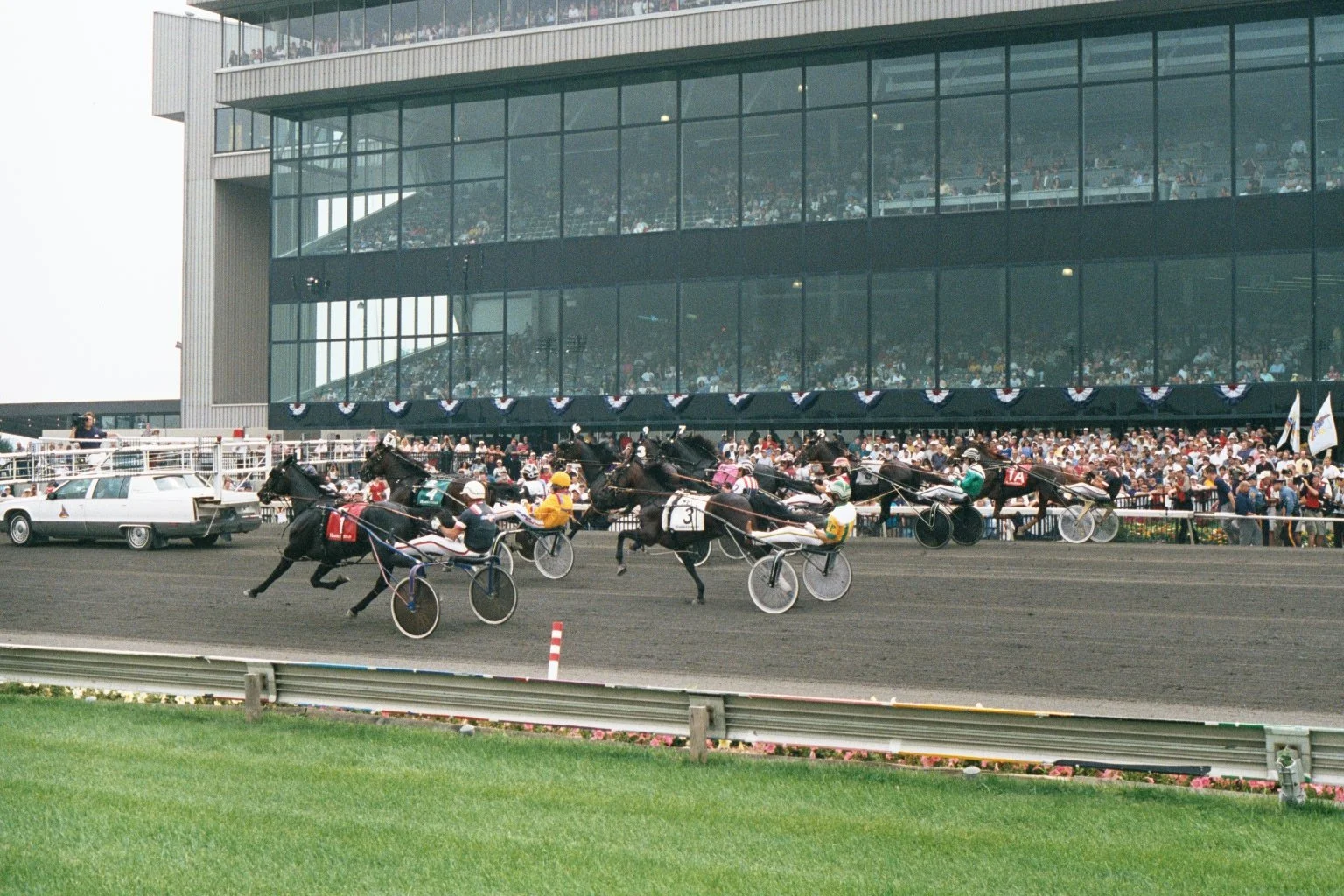
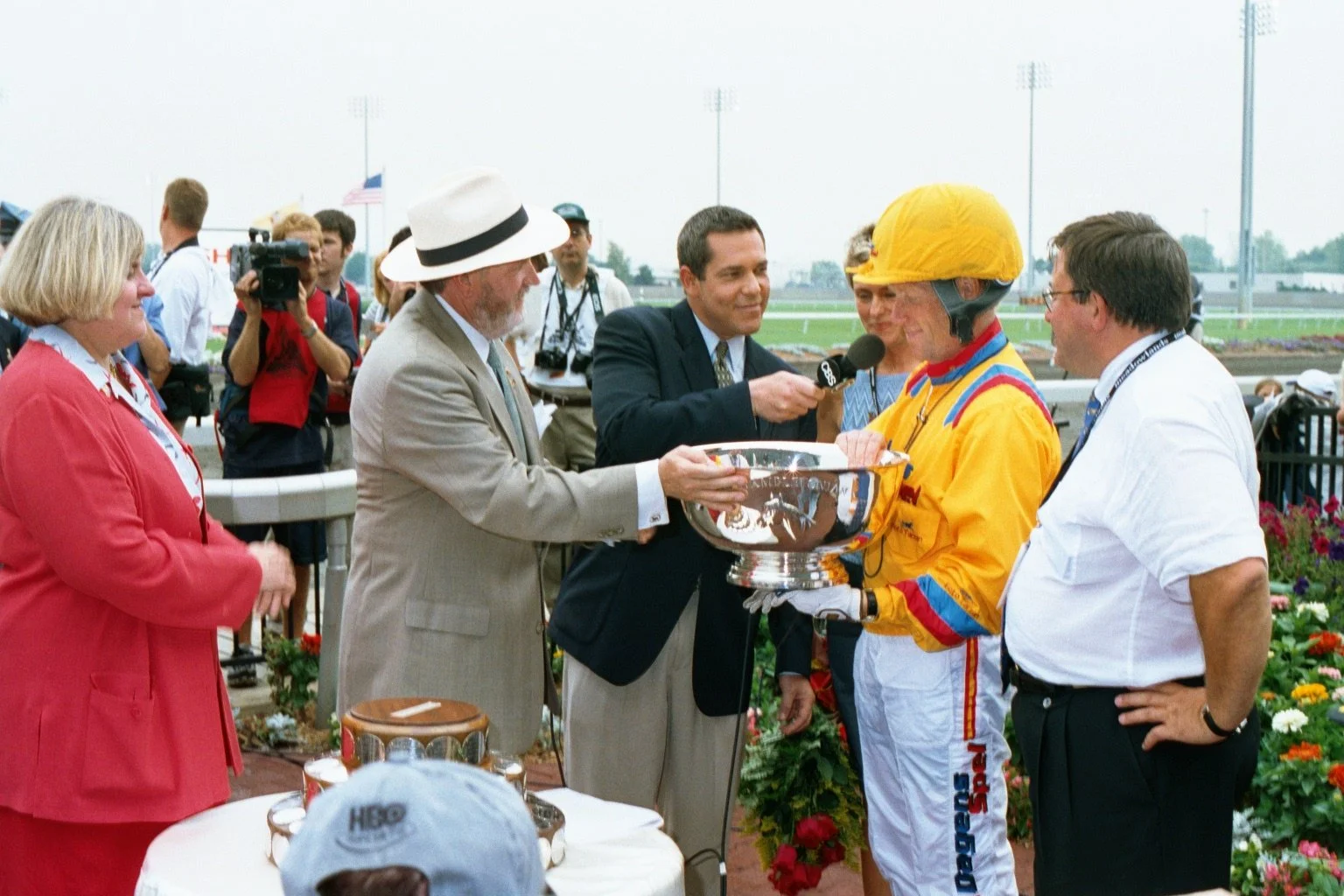
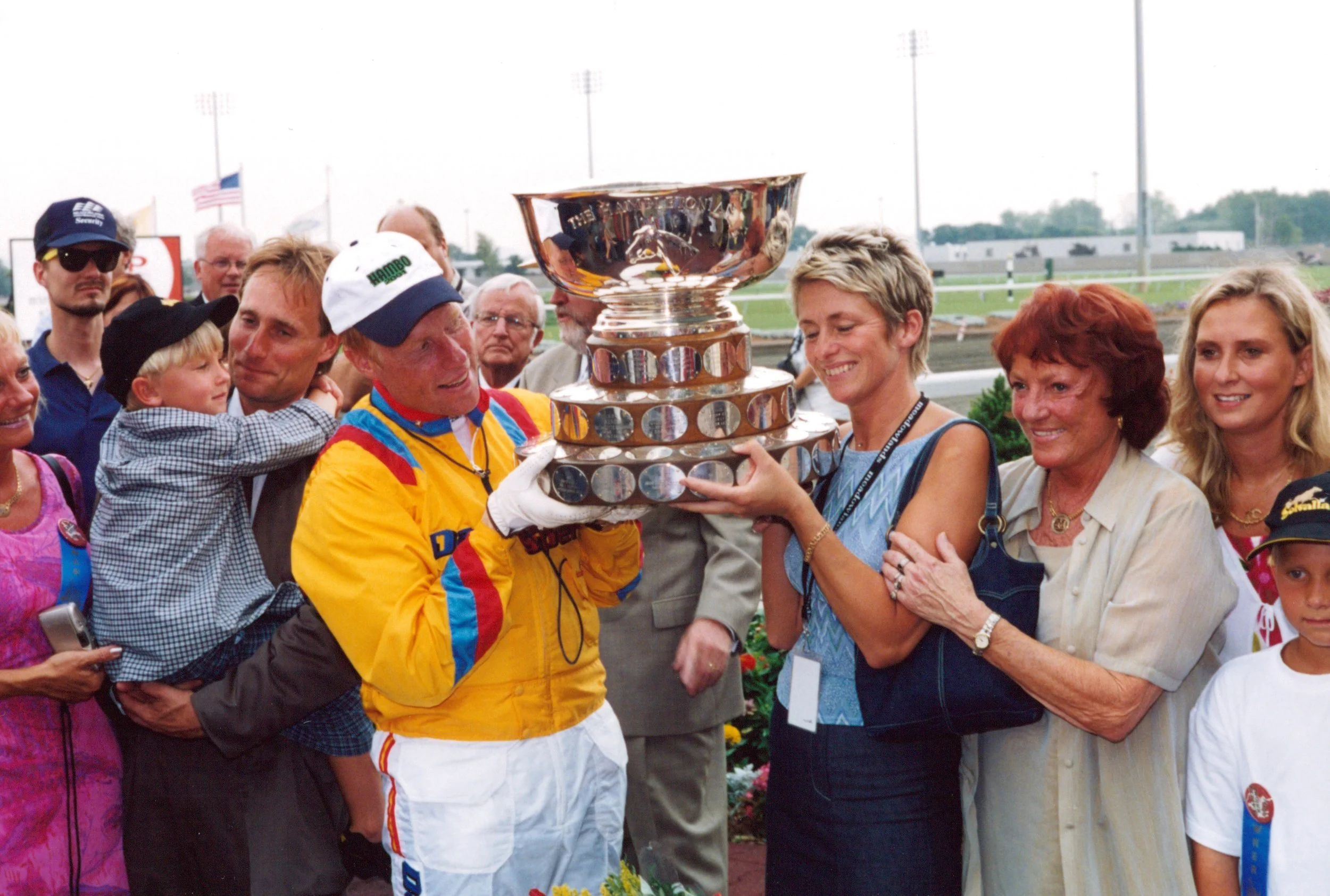
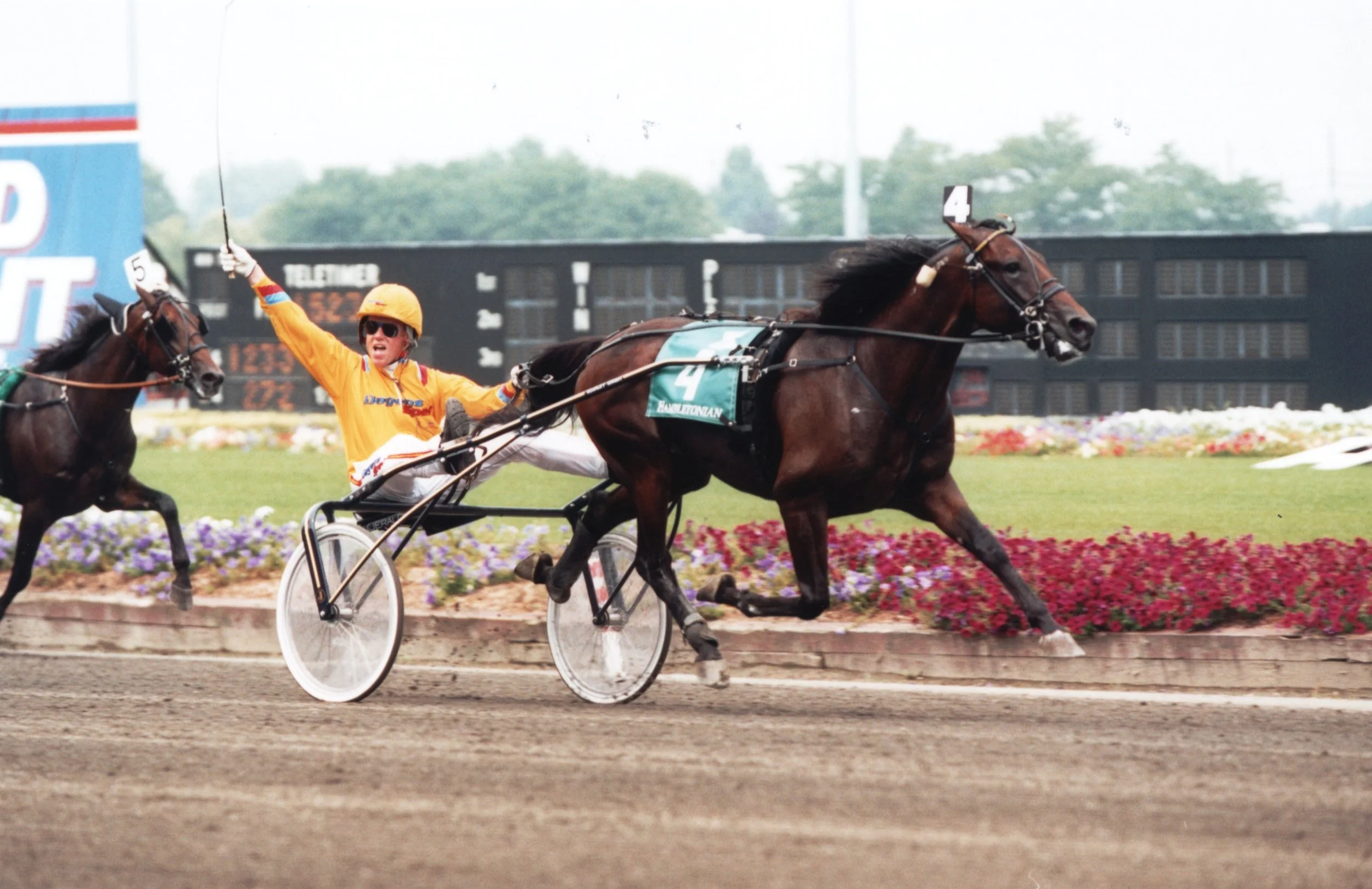
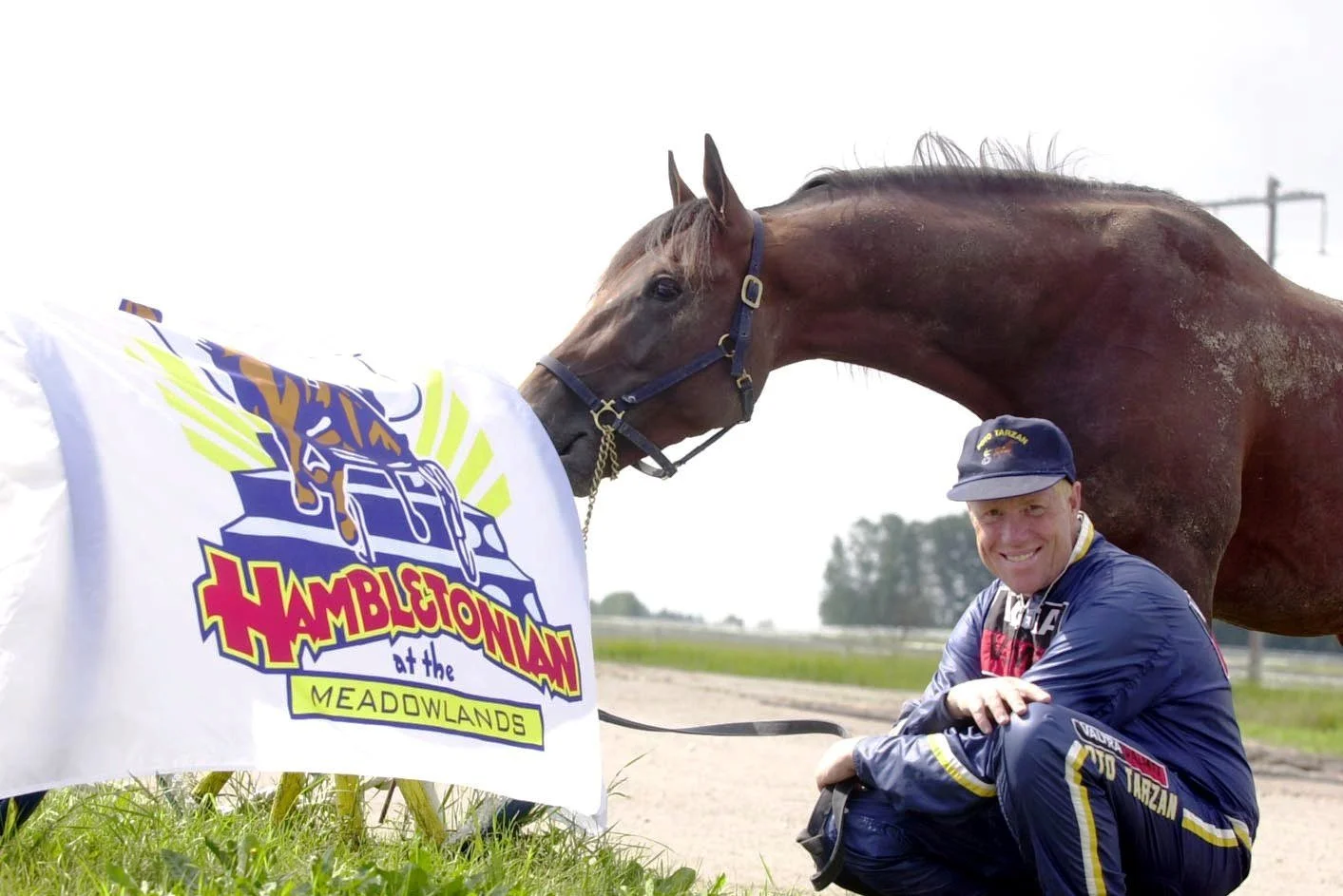
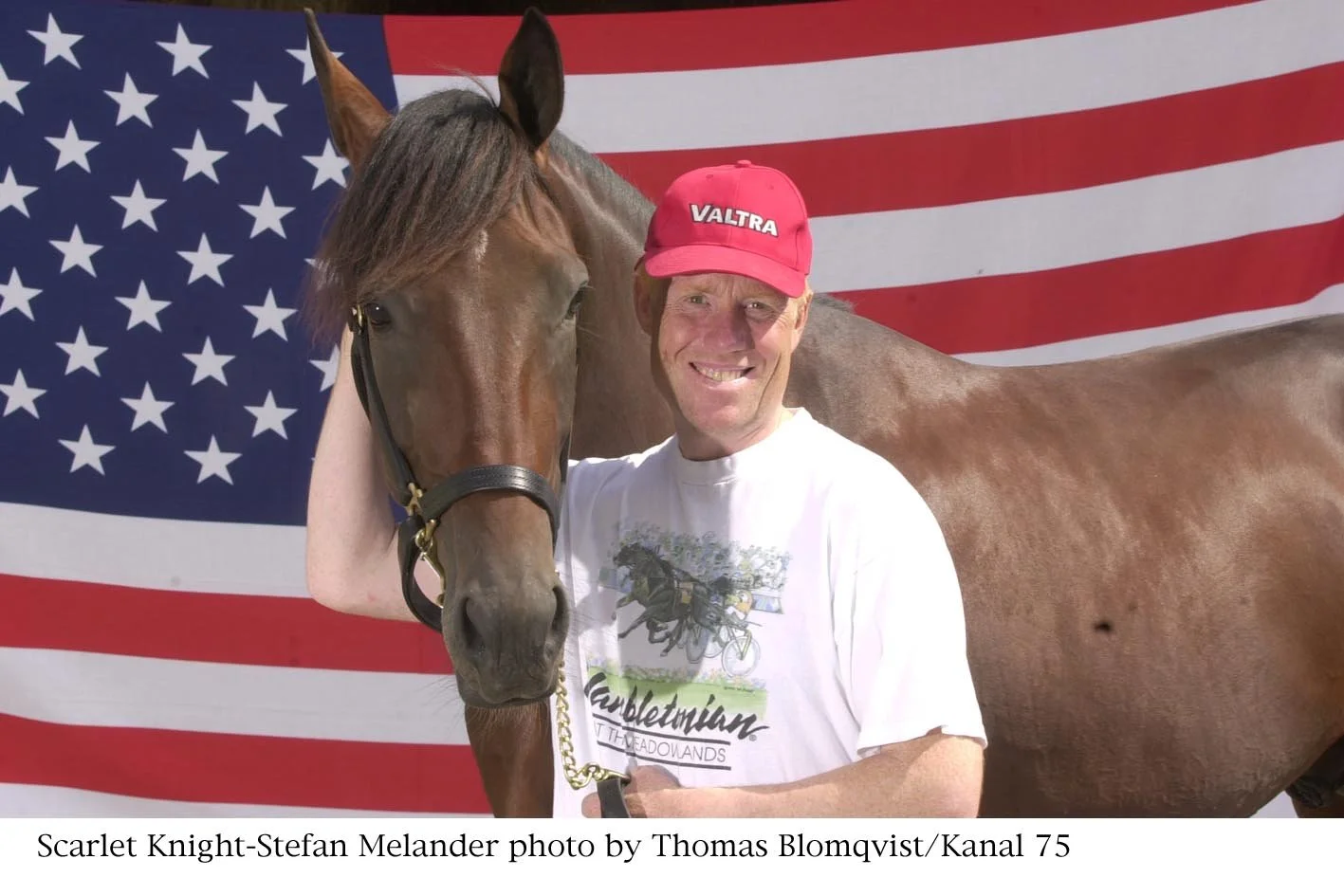
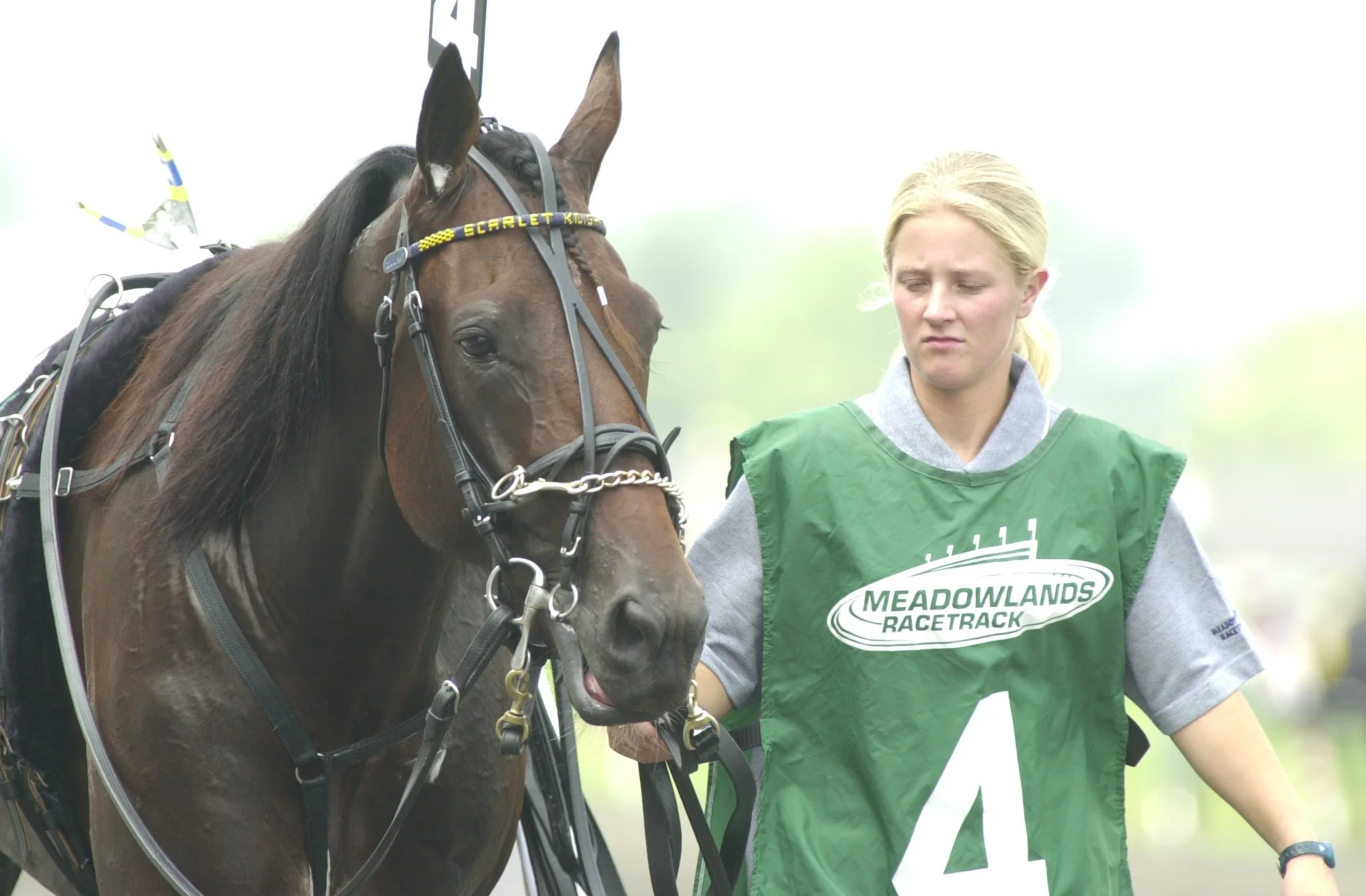
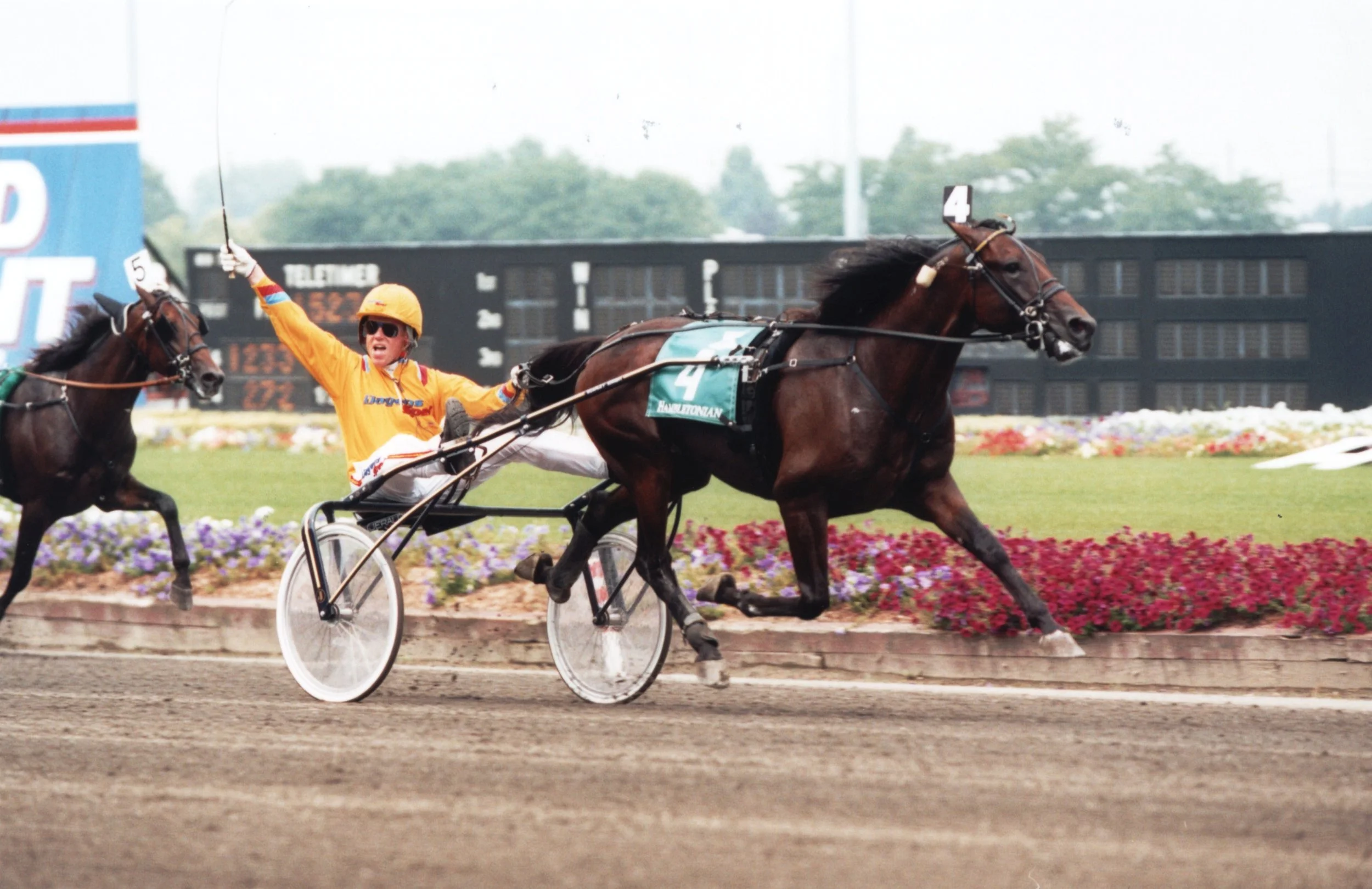
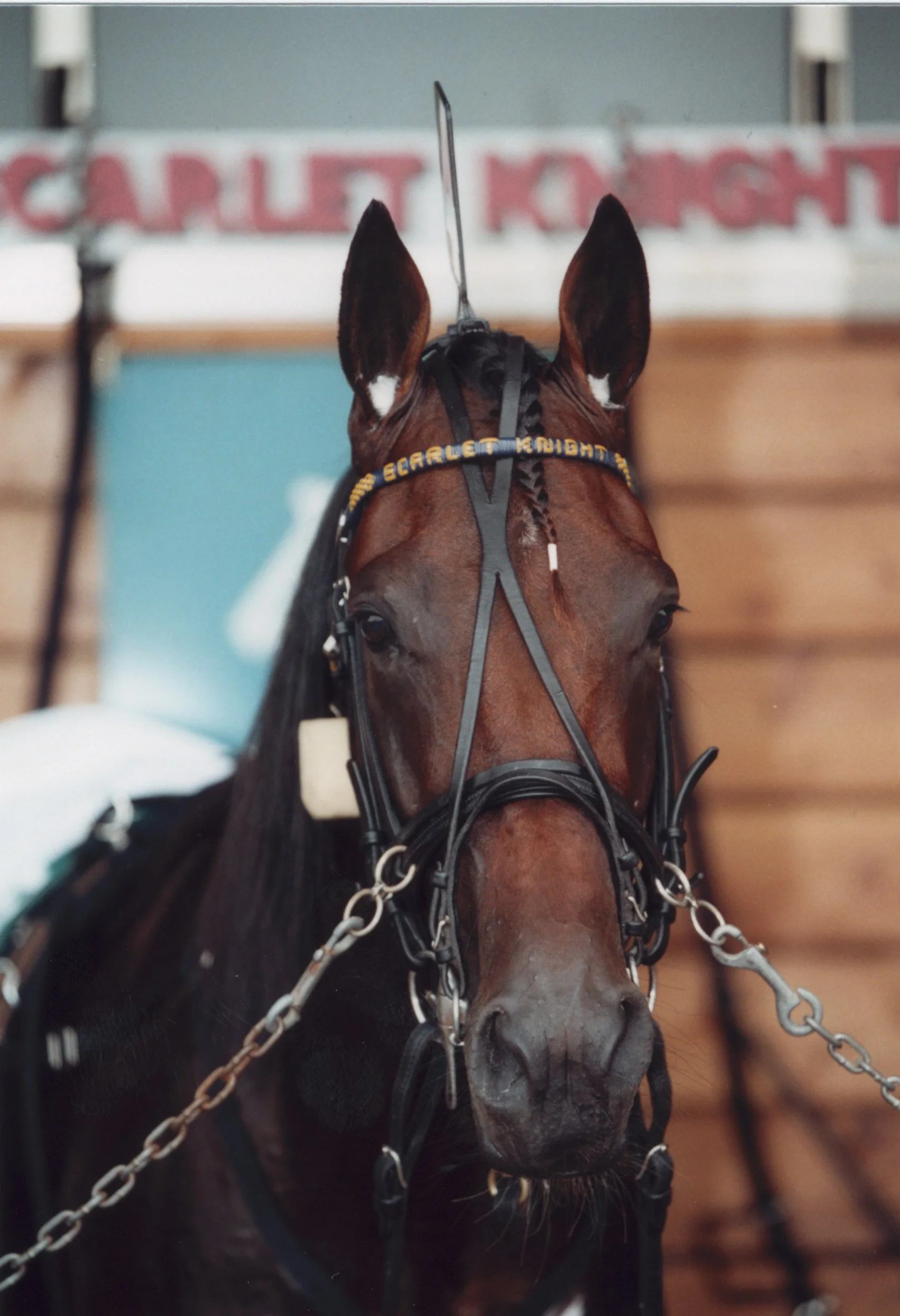
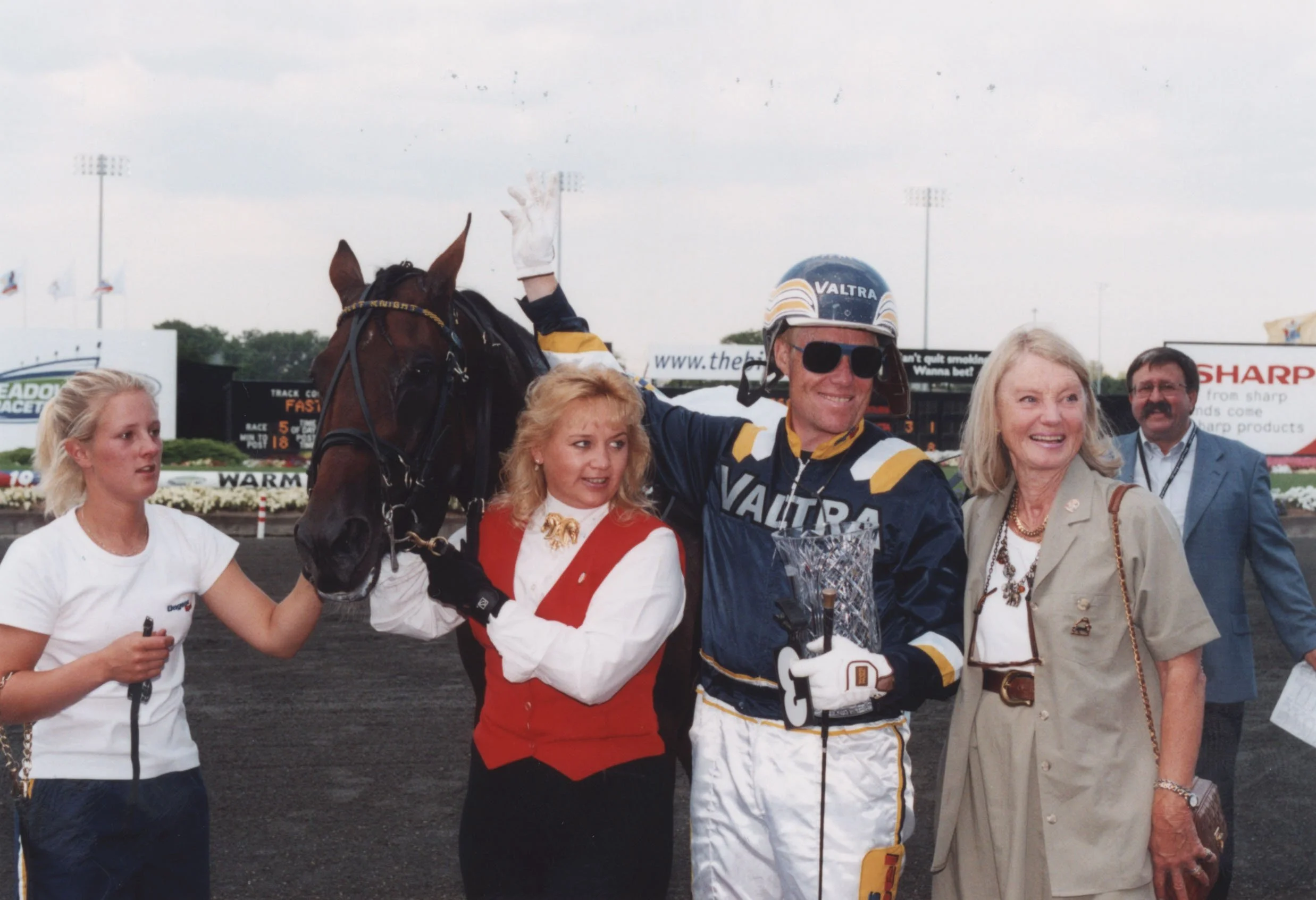
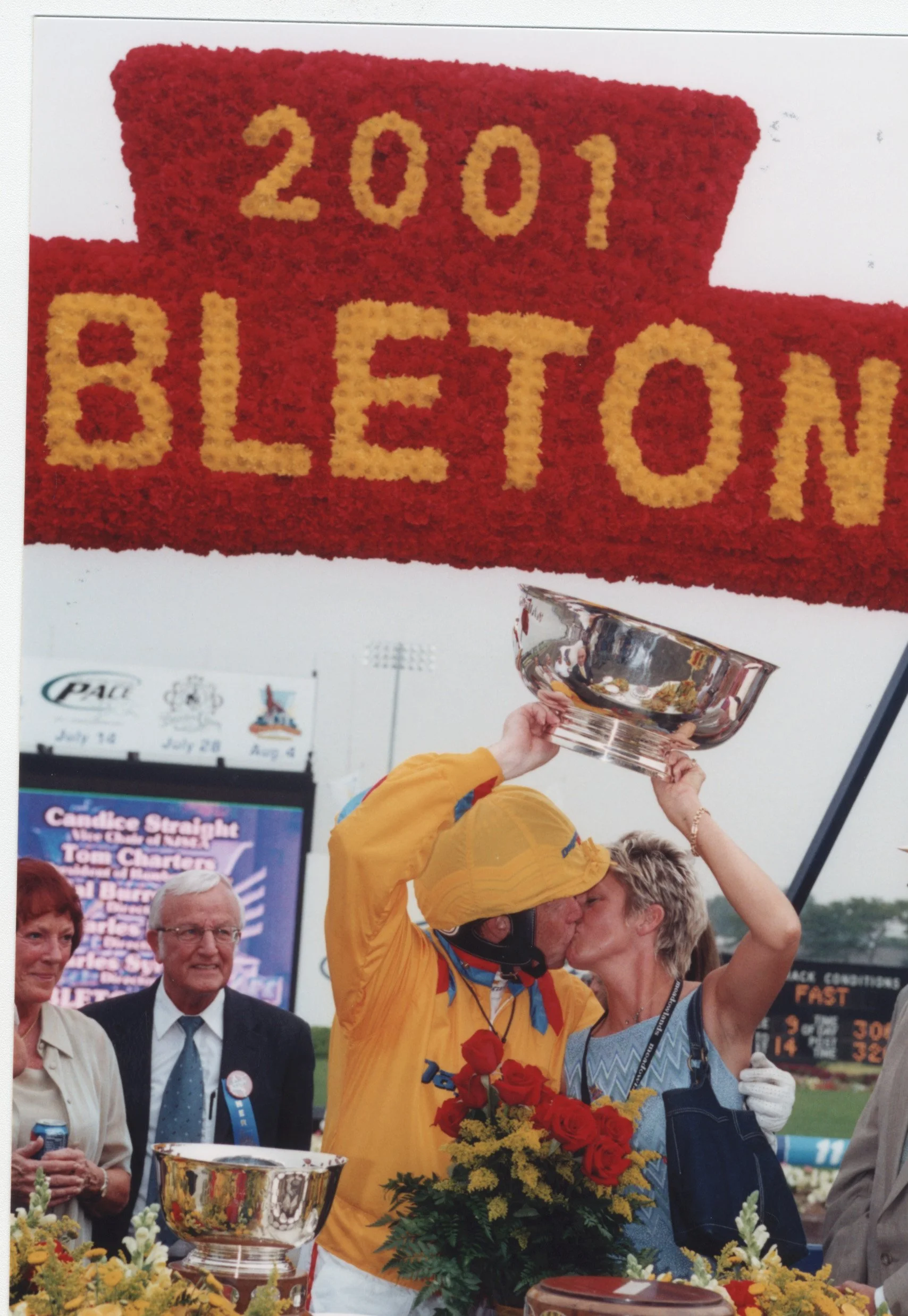
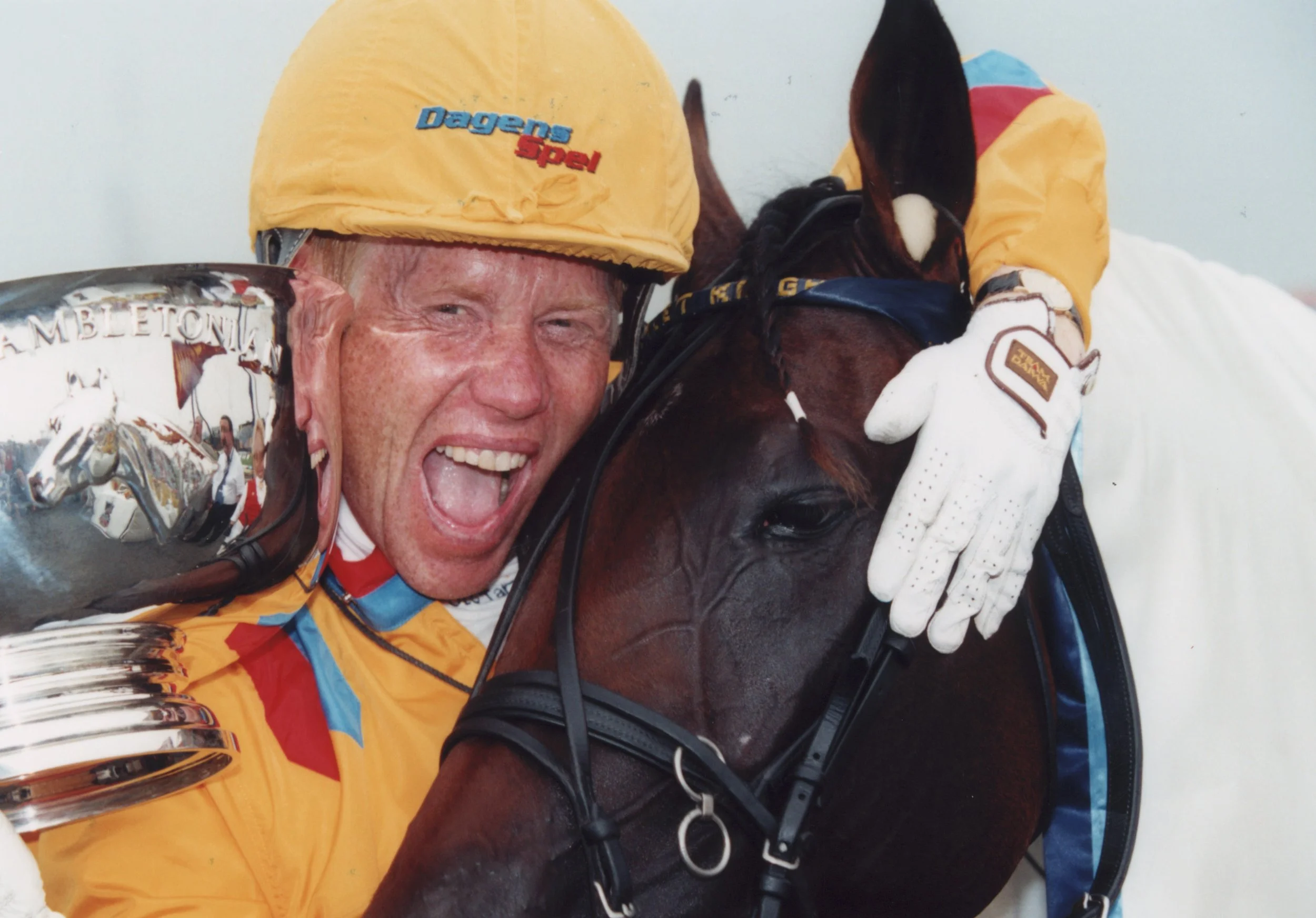
Hollywood's best scribes could not have written a more fitting conclusion to the 2001 Meadowlands harness meet as renowned Swedish Swedish racing photographer Stefan Melander fulfilled a lifelong dream of winning the Hambletonian with Scarlet Knight. After 20 years of capturing the sport's most prestigious events on film, Melander, known as "Foto Tarzan" around the world, was finally on the other side of the camera in the winner's circle on Hambletonian Day, August 4. The colt's trainer, driver and owner, Melander made the trek from his home in Enkoping, Sweden, overcoming the obstacles of distance, climate and time, to give Scarlet Knight the chance to prove himself as the world's top three-year-old trotter. And the son of Pine Chip, who entered the race undefeated in eight starts, lived up to his reputation. After Banker Hall took the field to the three-quarter pole, Melander and Scarlet Knight roared to the front and muscled their way to the lead and a one and three-quarter length winning margin, timed in 1:53.4. Melander turned to face the cameras as he crossed the finish line, his whip raised in victory. Every summer Melander makes the trek from his home in Sweden to the Meadowlands Racetrack for the Hambletonian, but his 2001 journey was quite different as he brought three-year-old trotting colt Scarlet Knight with him. Scarlet Knight was simply dominant in his U.S. debut as he cut the mile and drew off to a six-length victory in 1:54.1, the fastest of the three Hambletonian eliminations, with Melander in the sulky. And shortly after the race was over, Melander was back in the winner's circle snapping photos of the other Hambletonian eliminations and Breeders Crown events. Scarlet Knight entered the Hambletonian with a perfect eight-for-eight season record, posting victories in Sweden, Norway and the United States. Melander purchased Scarlet Knight for $17,000 in November 1999, but was unable to train him until January 2000 because of quarantine requirements, making his accomplishment even more remarkable. "It took a long time before I got him to Sweden," he said, "and I thought I wouldn't have enough time to get him ready. Normally, under the circumstances, Swedish trainers don't have enough time to prepare horses for the Hambletonian because of the long winter. I think it's amazing to be in this race. It is nearly impossible for a Swedish-trained horse to make it." Melander grew up near the Solvalla racetrack in Stockholm and began hanging around the stables where he became friends with veteran conditioners Hakan Wallner and Berndt Lindstedt. His passion for trotters led to his involvement in many aspects of the sport, including charting the races at Solvalla and selling handicapping tip sheets. Melander is known as "Foto Tarzan," a nickname given to him by Wallner, who combined Melander's interest in photography with his tendency to swing from job to job. Melander started his own photography business in 1980 that has prospered over the past two decades. He is also a racing columnist for Expressen, a top tier daily newspaper in Sweden. In 1990, he began to devote more of his time to training horses and took on more employees to help with the photography. Melander is assisted by his girlfriend, Catarina Lundstrom, a respected trainer in Scandinavia. They bought a training center in Enkoping and their stable has grown to be one of the most fruitful in Scandinavia. Melander is the first horseman to bring a U.S.-brd trotter trained and developed in Europe to the U.S. and win the Hambletonian. Two horses have tried before, the Italian-owned Top Hanover in 1971 (finished sixth and eight in the first two heats) and the Swedish-owned Easy Lover in 1995 (finished seventh in elim).
Exported as a yearling, raised developed and trained in Europe, Scarlet Knight is the first U.S.-bred trotter to come back to win the Hambletonian. Melander was the first driver-trainer-owner to win the Hambletonian since Stanley Dancer did it in 1975 with Bonefish. Melander was the first driver-trainer to win it since Dancer won with Duenna in 1983. Melander trains some 70 horses with partner Catarina Lundstrom. He rarely reads the pedigree page but instead measures yearlings and enters all pertinent info in a detailed data base, consisting of over 60,000 horses he's measured. The Hambletonian Final was Melander's third drive in the U.S. He won the 1995 Yonkers International with His Majesty and his Hambo elim a week prior to the final. In each of the five years since multiple heats were replaced by eliminations the previous week, the eventual winner of the Hambletonian has also won his elimination. Scarlet Knight is only the fifth Hambletonian winner (since 1945) to come into the race with an unblemished record as a 3-year-old. The other four: Titan Hanover (1945), Sharp Note (1952), Mack Lobell (1987) and Malabar Man (1997). Scarlet Knight flew over and back on the same plane as international trotting superstar Varenne. The two returned to Europe having won the only two $1 million races for trotters offered in the world. Scarlet Knight was the fourth European-conditioned horse to take a shot at the Hambletonian: Shatter Way (1966), Top Hanover (1971), Easy Lover (1995). Scarlet Knight was probably the 40th favorite or co-favorite to win in the 76 years of the Hambletonian. Remarkably six out of the last nine years, the public's choice has prevailed. The three beaten favorites were: Lindy Lane (1996), CR Kay Suzie (1995), and Dreamaster (2000). Scarlet Knight is the 28th winner who paternal line traces directly to Scotland (third to Spencer in 1928). Scotland was a grandson of Peter The Great whose prodigy has won 63 of the 76 Hambletonians, including both dead-heat winners in 1989. Scarlet Knight was the 13th Hambletonian winner sold as a yearling by Standardbred Horse Sale Co. in Harrisburg, PA., since it offered Ashley Hanover (later renamed Bill Gallon) in its initial 1939 session. It was the Harrisburg sale's 1st winner since 1989 which now equals Tattersalls' record as the leader in that category. Additionally one more winner, Green Speed (1977), was catalogued at Harrisburg but withdrawn prior to his sale. Scarlet Knight, was the 32nd winner sired by a Kentucky stallion, a record by a state breeding program. The winners of the first 15 consecutive Hambletonians (1926 to 1940) were by Kentucky stallions. He was the 8th Hambletonian winner produced by a Castleton Farm stallion. His sire Pine Chip was exported to Sweden in 2000 when Castleton was disperssed. Five of the 10 starters were trained by Swedish trainers; four driven by Swedish reinsmen. To add to the Scandinavian flavor, a sixth was trained by a Norwegian. Brooke Nickells was the first female trainer to advance to the Hambletonian final with Lavecster. Both Anna-Lena Ljunggren (Baltic Baby, 1993) and Ann Wheeler (Speedy Big Boy, 1994) started in the eliminations but did not go forward to the final. Lavecster finished fourth in the final. Total harness handle was $8,028,480, the highest handle in the history of the sport, breaking the previous record for the 3rd consecutive year on Hambletonian Day. On-track attendance was $26,569 a record for the Meadowlands season. On-track harness wagering was $3,675,779, the highest at The Meadowlands since 1995.
Media
Champions | 2000-2009
-
![]()
Yankee Paco
-
![]()
Scarlet Knight
-
![]()
Chip Chip Hooray
-
![]()
Amigo Hall
-
![]()
Windsong's Legacy
-
![]()
Vivid Photo
-
![]()
Glidemaster
-
![]()
Donato Hanover
-
![]()
Deweycheatumnhowe
-
![]()
Muscle Hill

Three Cheers!
August 3, 2002
East Rutherford, NJ
The MeadowLands
Purse $1,288,000
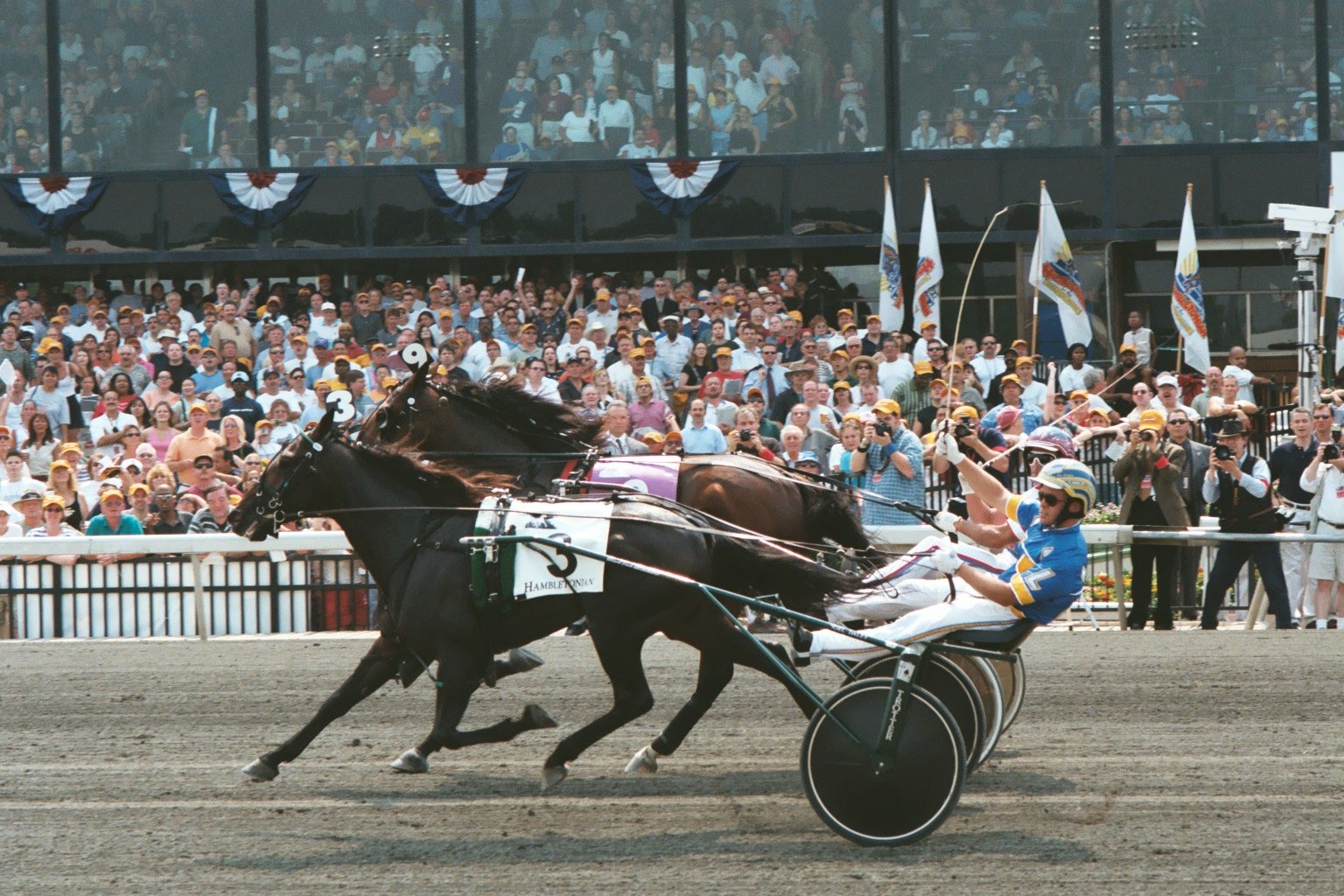
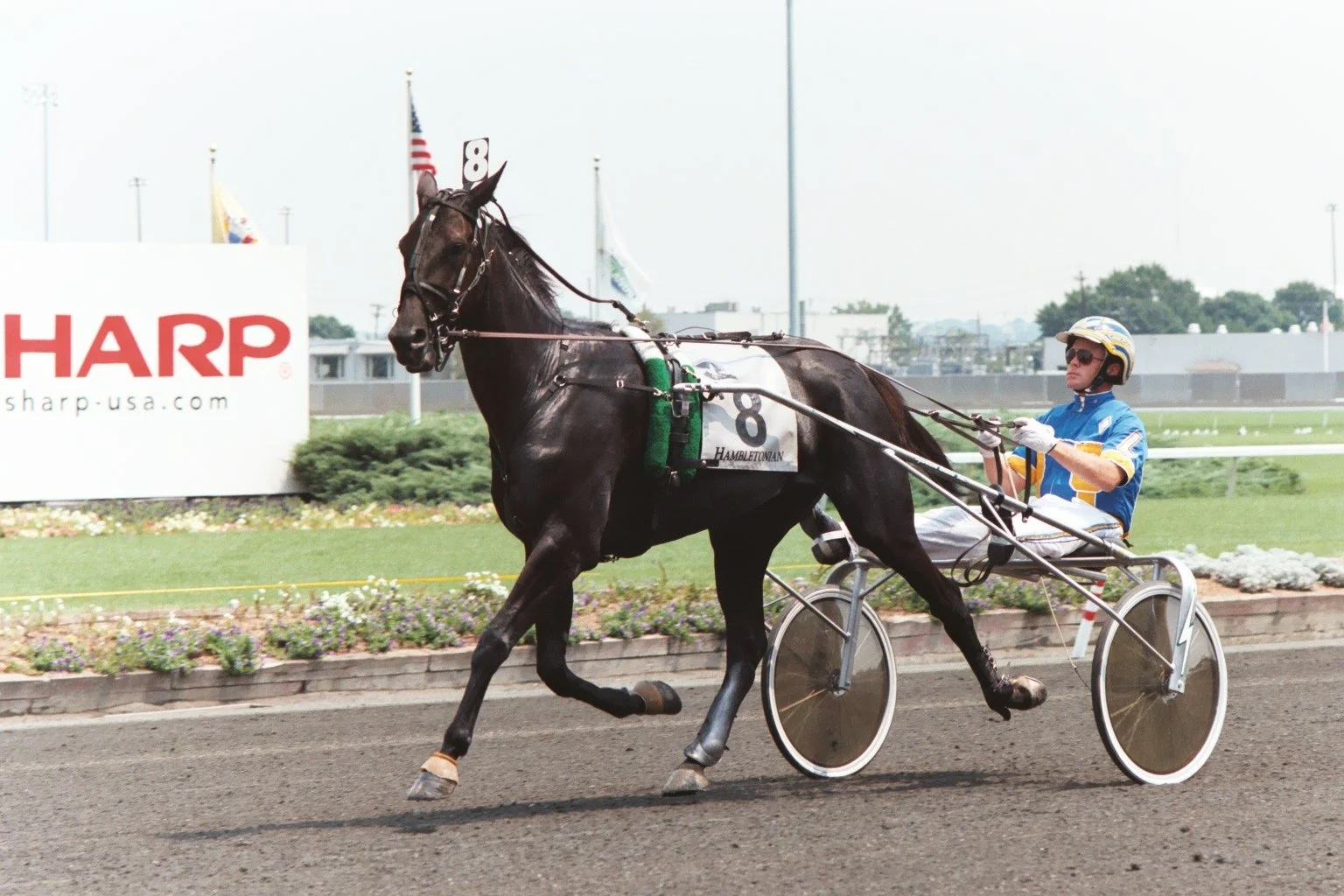
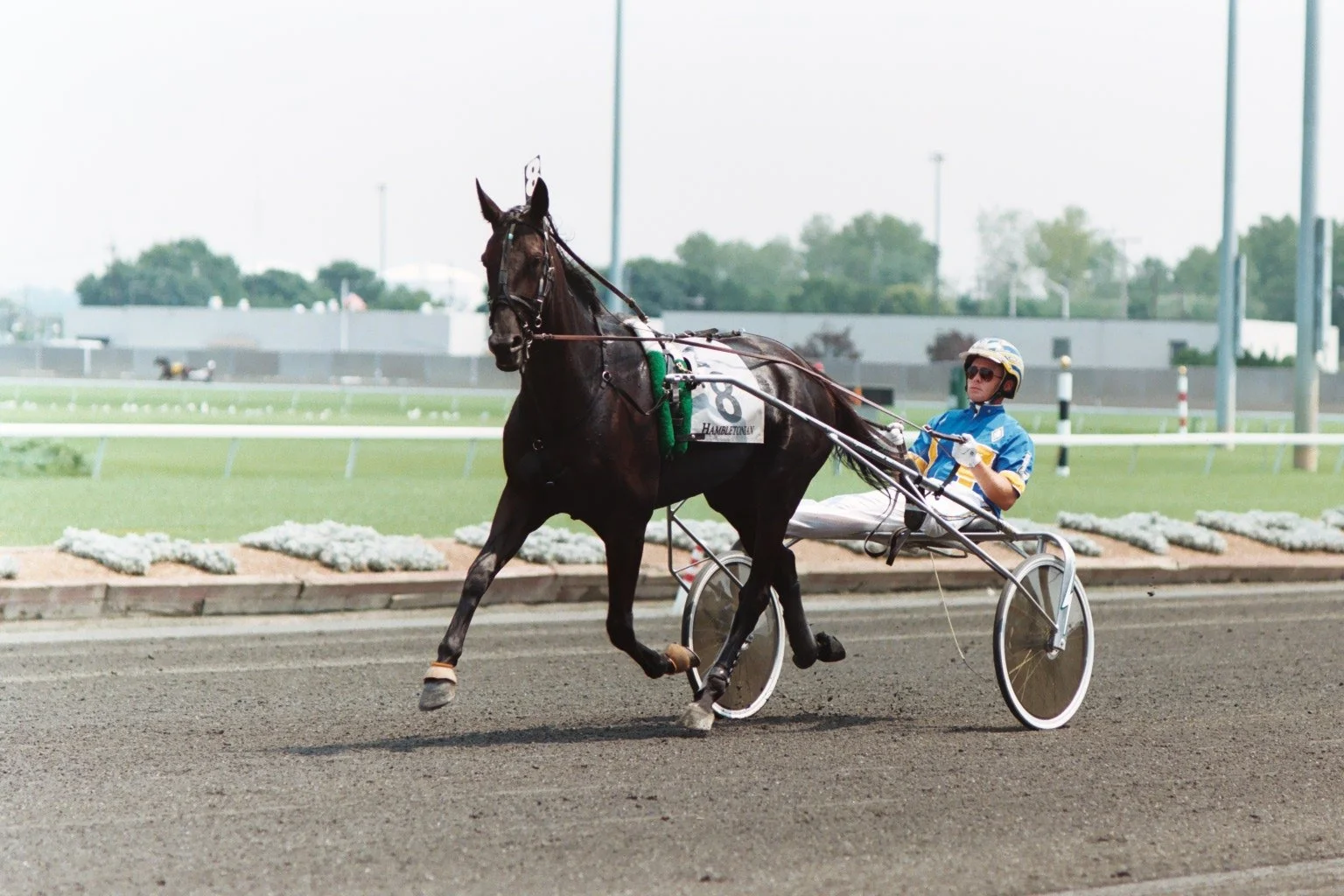
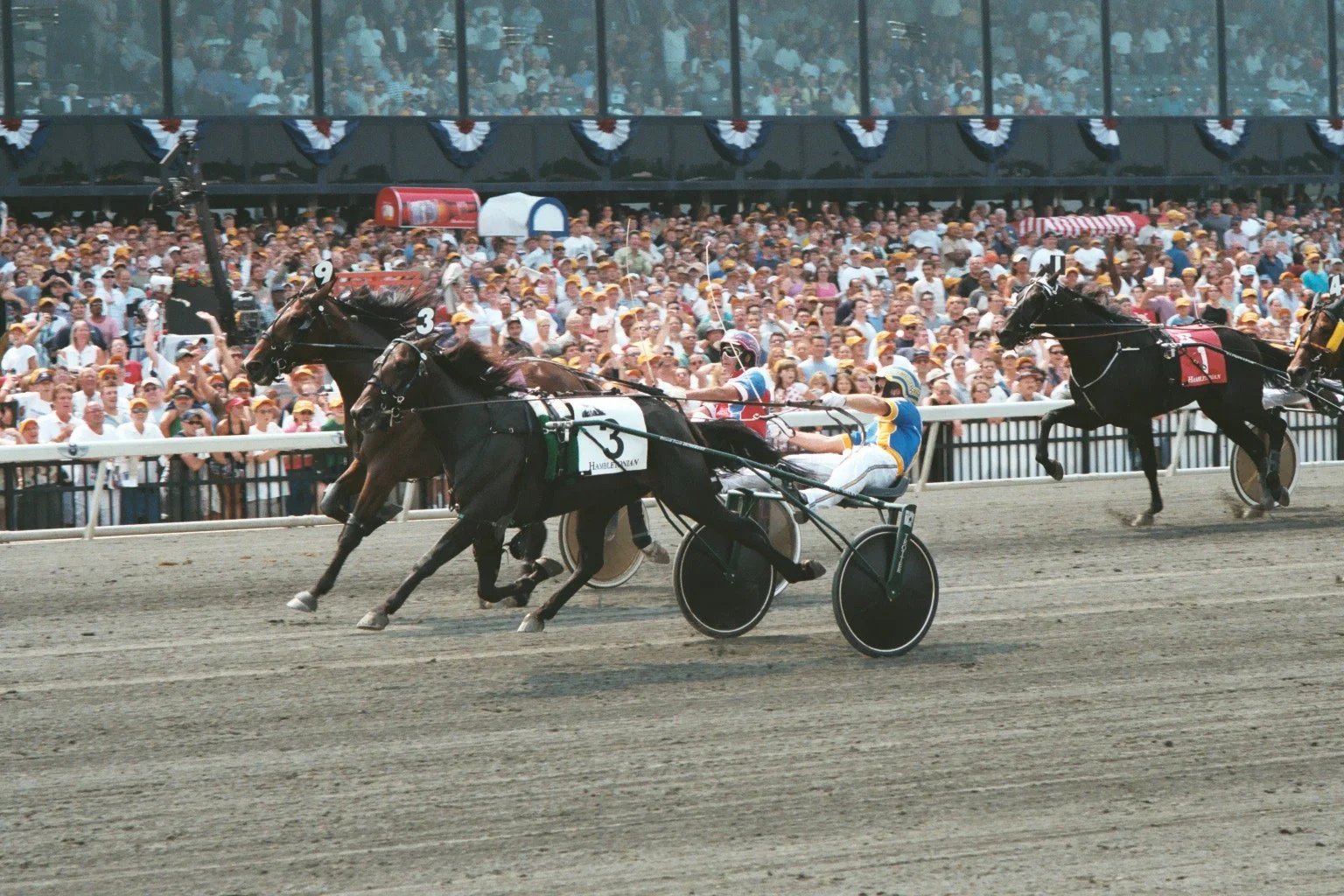
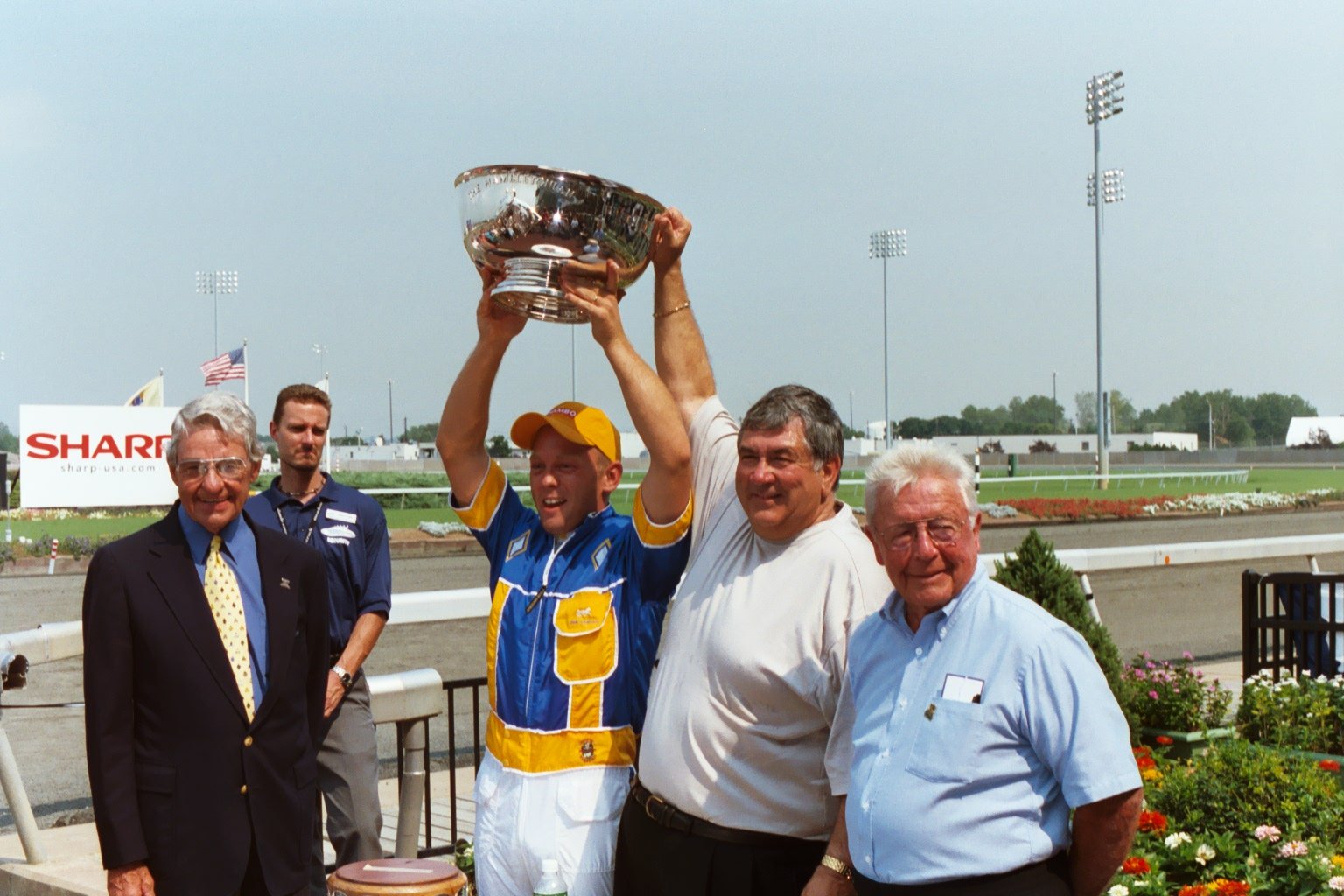
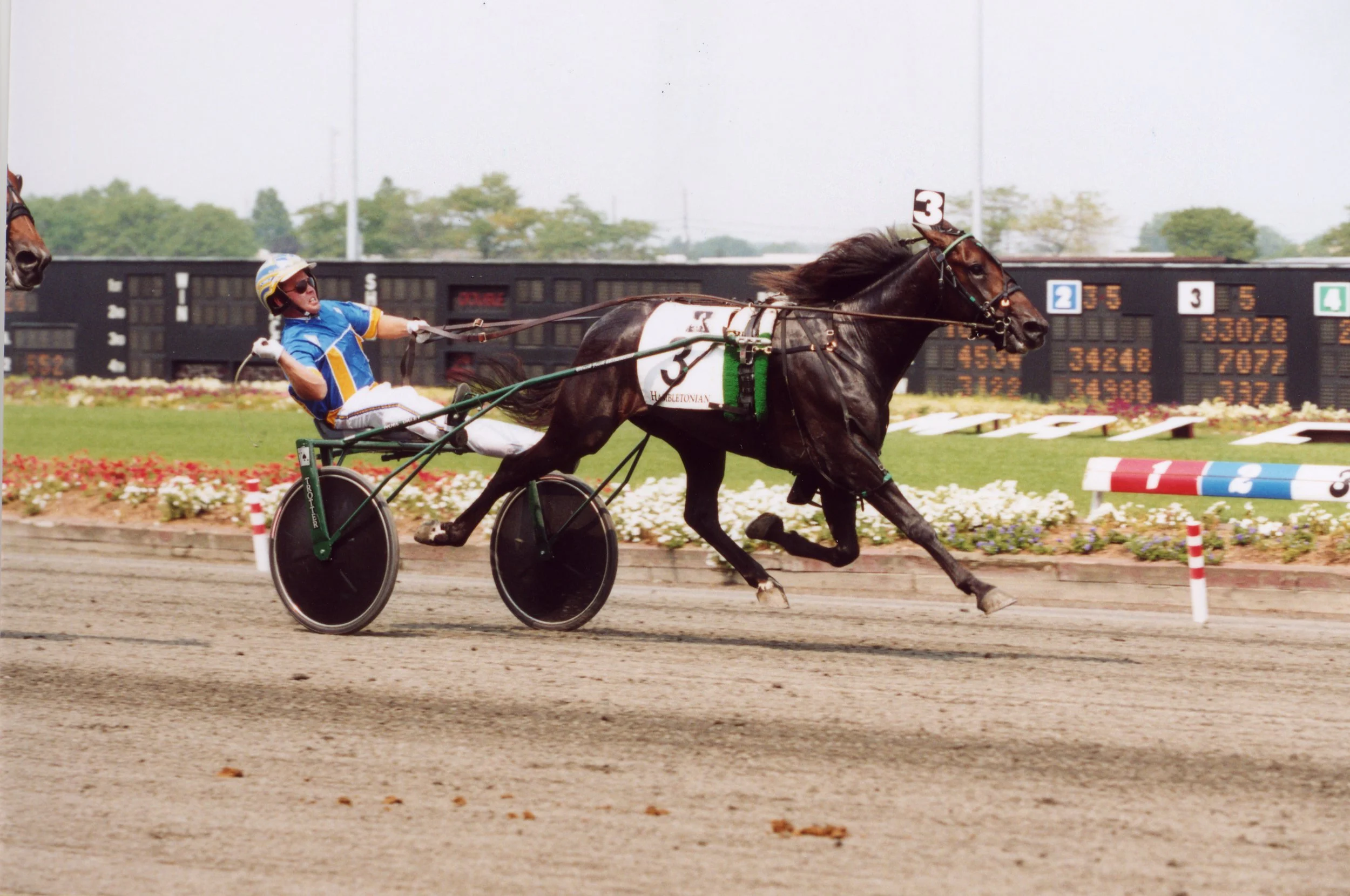
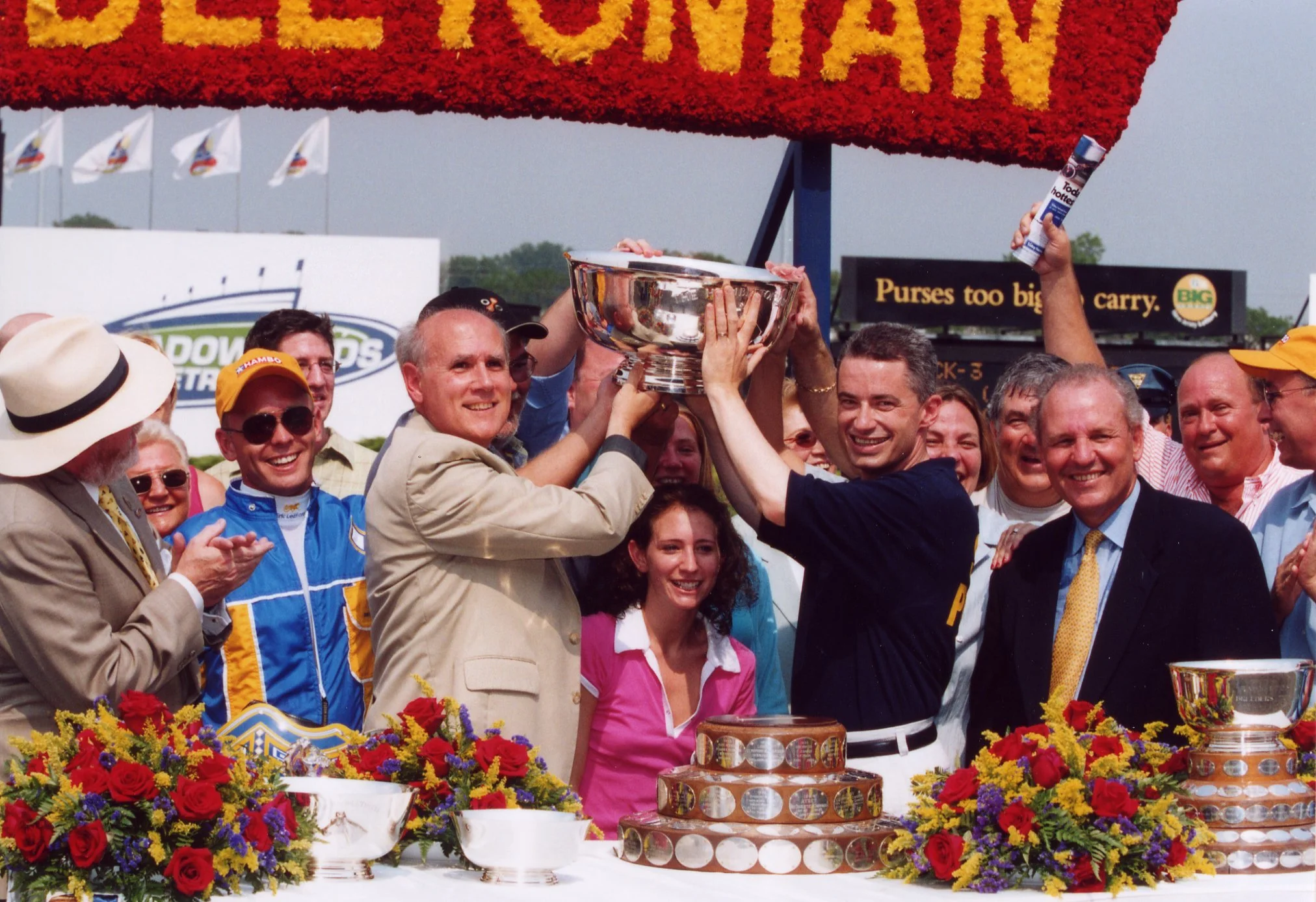
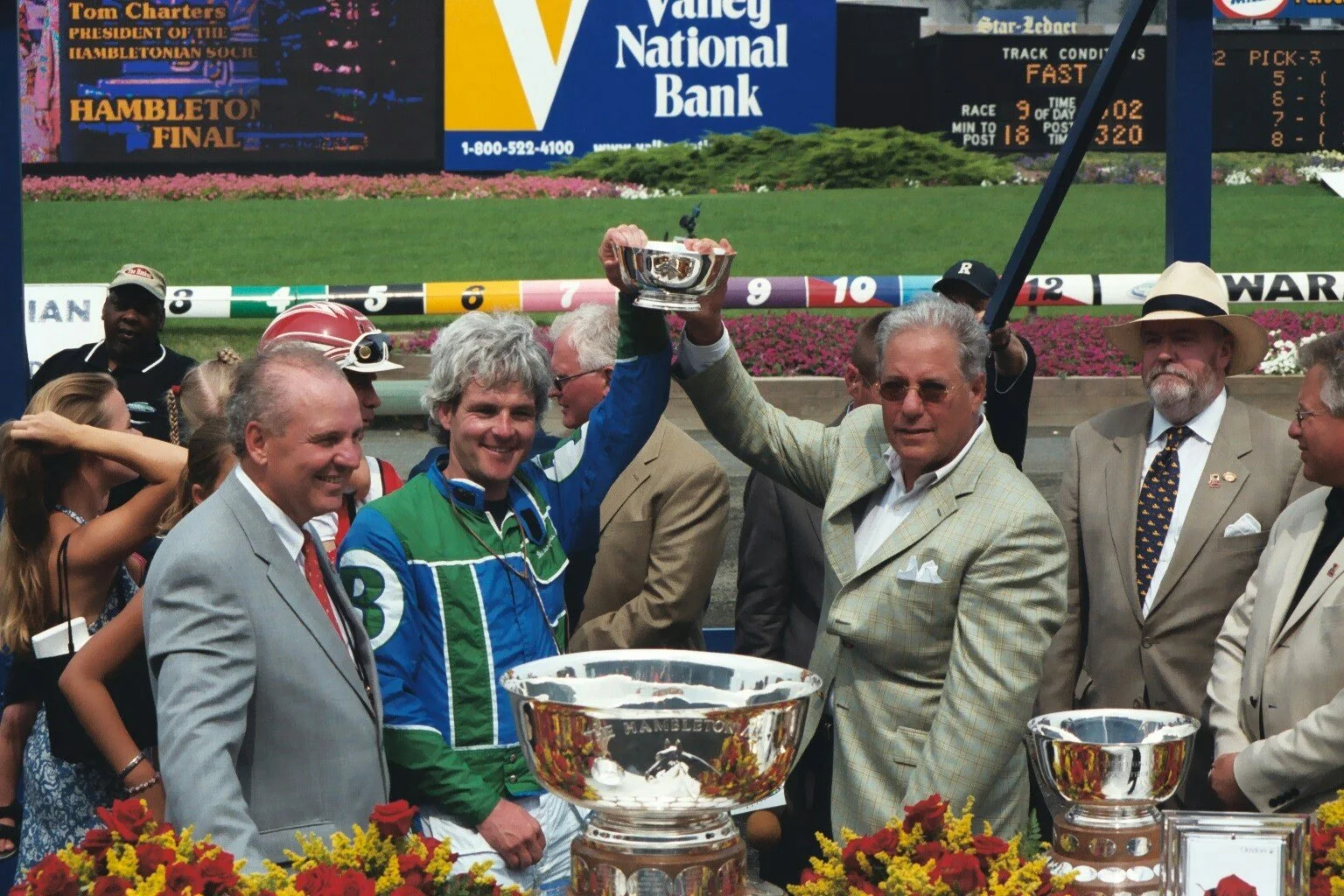
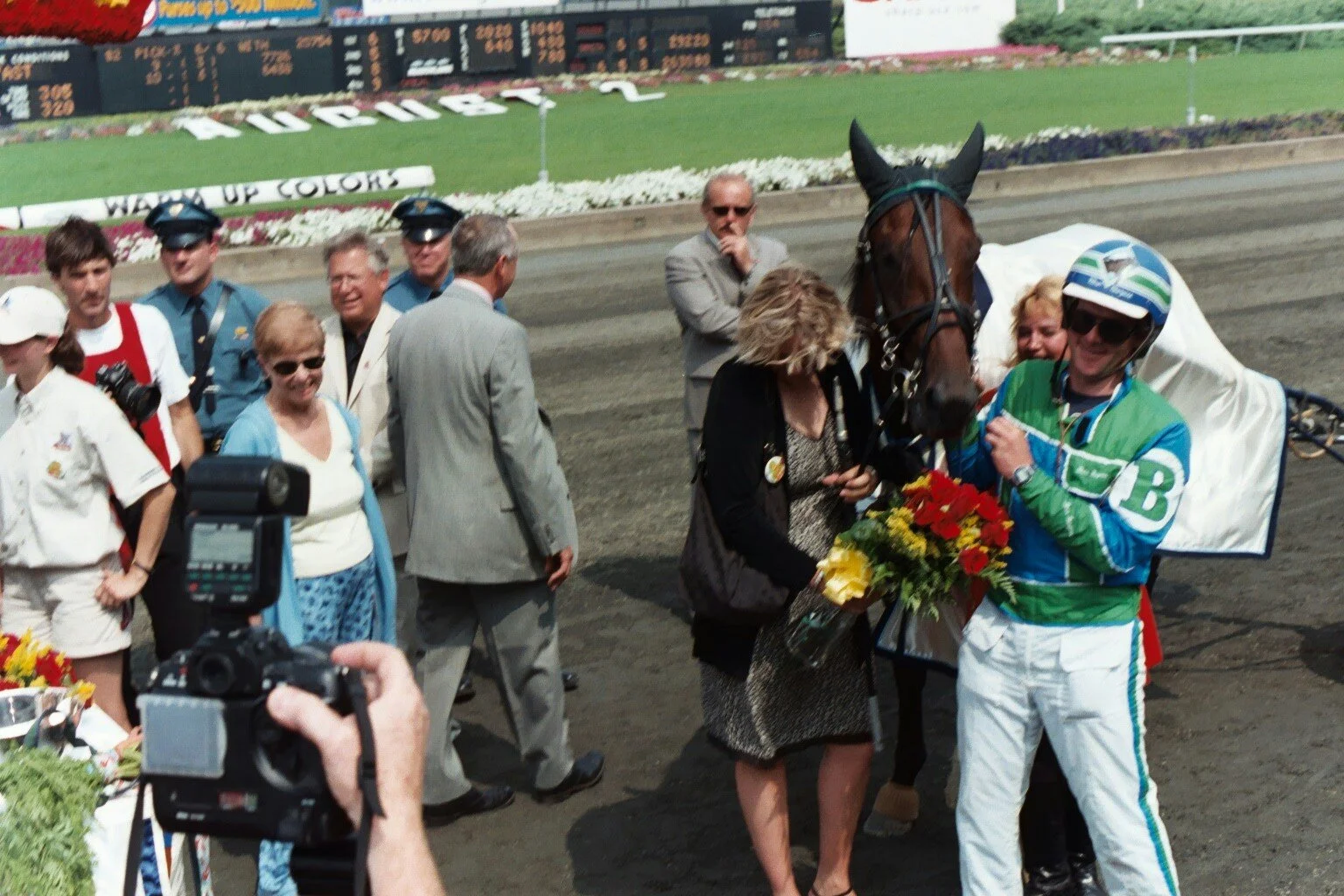
Chip Chip Hooray, a pint-sized colt with a big engine, delivered $1 million worth of Hambletonian cheer to a seasoned Hall of Famer and a young gun when he won the 2002 edition of trotting's most prestigious event. It was the fourth Hambletonian victory for veteran trainer Chuck Sylvester and the first for driver Eric Ledford, who was making his debut in harness racings most prestigious event. The weeks leading up to the Hambletonian were frustrating for Sylvester as he made a series of equipment changes trying to get the colt just right before the eliminations. Bridles, boots, shoes and sulkies were switched, and Sylvester knew he had hit upon the right combination when the colt came first-up to win his Hambletonian elimination over Andover Hall in 1:54.1, the fastest he had been asked to trot to that point. Benefiting from the luck of the draw, Chip Chip Hooray and Andover Hall started side by side in the final, the former from post two and the latter from the rail. But post one was the only relief Andover Hall got. The 3-5 Hambletonian favorite made a break after briefly colliding with Likely Lad around the first turn and pulled up before the finish with a cut on his hind leg. Meanwhile, Chip Chip Hooray got away fourth and tipped to the outside behind ENS Snapshot past the half. After maneuvering past that one, he put away the pacesetter Taurus Dream at the top of the stretch. He held off the late rally of Like A Prayer for a neck victory, trotting the mile in a career best 1:53.3. "I really didn't give it a whole lot of thought before the race," said Eric Ledford, one of the youngest reinsman ever to reach the Hambletonian Final. "Andover was the horse I wanted to follow but it didn't work out that way. I wound up fourth, but a distanced fourth. They were eating it up pretty good out front so we just bided our time back there and let them race it out, which they did, and we were fortunate enough to pick up the pieces. At the top of the stretch, I moved him three high. He exploded off cover. He showed true ability and true guts and the true champion that he is." "People don't realize how much luck and coordination got into this one day," said Sylvester, who made it to the Hambletonian winner's circle despite battling a bad case of bursitis. "It takes so much luck to win this race. He just wasn't himself three weeks in-a-row. We changed his bridle to an open bridle and pulled his hind shoes. He trained super so I decided to go with that. I was surprised that they made Andover Hall such a favorite. I thought we went a big race last week." The victory was especially sweet for Sylvester as he trained the colt's sire, Pine Chip, who finished second to American Winner int he 1993 Hambletonian. Chip Chip Hooray concluded his sophomore season, and career, with 12 victories from 24 starts and earnings of $1,095,001.
Since the eliminatiosn were moved to the previous week in 1998, Chip Chip Hooray is the fifth elimination winner in as many years to win the final. His 1:54.1 victory was the fastest elim of the day, and he defeated favored Andover Hall by a head. His mile in the final was a career best 1:53.3. Chip Chip Hooray represented Chuck Sylvester's 4th Hambletonian winner, as the Ohio native scored previous victories with Mack Lobell (1987), Park Avenue Joe (dh 1989) and Muscles Yankee (1998). Only Billy Haughton, Stanley Dancer and Ben White have won more Hambletonian titles, as each won five times. It was Castleton Farm's sixth, and probably final, Hambletonian Breeders trophy. Chip Chip Hooray was offered in Castleton's last yearling consignment before the farm closed its doors in 2000. Chip Chip Hooray was owned in part by Ed and Nancy Iacobucci - and was their first standardbred purchase. Another partner, Mike Prakas, saw his namesake, Prakas, win the 1985 Hambletonian. Pine Chip also sired 2001 winner Scarlet Knight, making him the first stallion since the legendary Star's Pride to sire back-to-back winners (1968-1969). It was winning dirver Eric Ledford's first start in the Hambletonian. The 30-year-old driver became the 17th (including Nat Ray who won the first edition) to win the race in his first try. Others are: Bill Leese, Dick McMahon, Will Caton, Lee Smith, Harrison Hoyt, Harry Harvey, Ned Bower, Flave Nipe, Howard Beissinger, John Simpson Jr, Ray Remmen, Ulf Thoresen, Bill Fahy, Jack Moiseyev and Trevor Ritchie. Chip Chip Hooray is the 29th winner whose parternal line traces directly to Scotland (third to Spencer in 1928). Scotland was a grandson of Peter The Great whose prodigy has won 64 of 77 Hambletonians, including both dead-heat winners in 1989. Peter The Great was a great-grandson of Hambletonian 10. Chip Chip Hooray was the 14th Hambletonian winner sold as a yearling by Tattersalls, the most by any sale company. Standardbred Horse Sale is runner-up for those honors with 13. Chip Chip Hooray, was the 33rd winner sired by a Kentucky stallion, a record for a state breeding program. The winners of the first 15 consecutive Hambletonians (1926 to 1940) were Kentucky stallions. He was the 9th Hambletonian winner produced by a Castleton Farm stallion. His sire Pine Chip was exported to Sweden in 2000 when the Castleton holdings were dispersed. John Campbell drove in his 20th consecutive Hambletonian. Favored Andover Hall went offstride in the first turn, dashing the defending divisional champ's hopes of becoming just the third colt to take freshman honors and win the Hambletonian. The Hambletonian Day card also featured the world's fastest trotting mile of all time after Sweden's Victory Tilly, driven by Stig Johansson, won the Nat Ray in a time of 1:50.4. One of the owners proposed in the winner's circle to his fiancee. She accepted. The Hambletonian crowd numbered 28,969 - the largest since 2000 and the third largest since 1991. Those in attendance wagered $3,344,540 on-track. The total North American handle of $8,819,235 set a Meadowlands and harness racing industry record. The Meadowlands distributed a record $4,387,500 in purse money for the 17-race card, which included the Sweetheart and Woodrow Wilson for two-year-old pacers, which had to be raced on the Hambletonian Day card when dangerous lightning and heavy rainstorms the night before necessitated their postponement after a lengthy delay. Eventual divisional champion and Trotter of the Year Kadabra was not eligible to the Hambletonian, which does not allow supplements.

Media
Champions | 2000-2009
-
![]()
Yankee Paco
-
![]()
Scarlet Knight
-
![]()
Chip Chip Hooray
-
![]()
Amigo Hall
-
![]()
Windsong's Legacy
-
![]()
Vivid Photo
-
![]()
Glidemaster
-
![]()
Donato Hanover
-
![]()
Deweycheatumnhowe
-
![]()
Muscle Hill
The grand Slam
August 2, 2003
East Rutherford, NJ
The MeadowLands
Purse $1,000,ooo
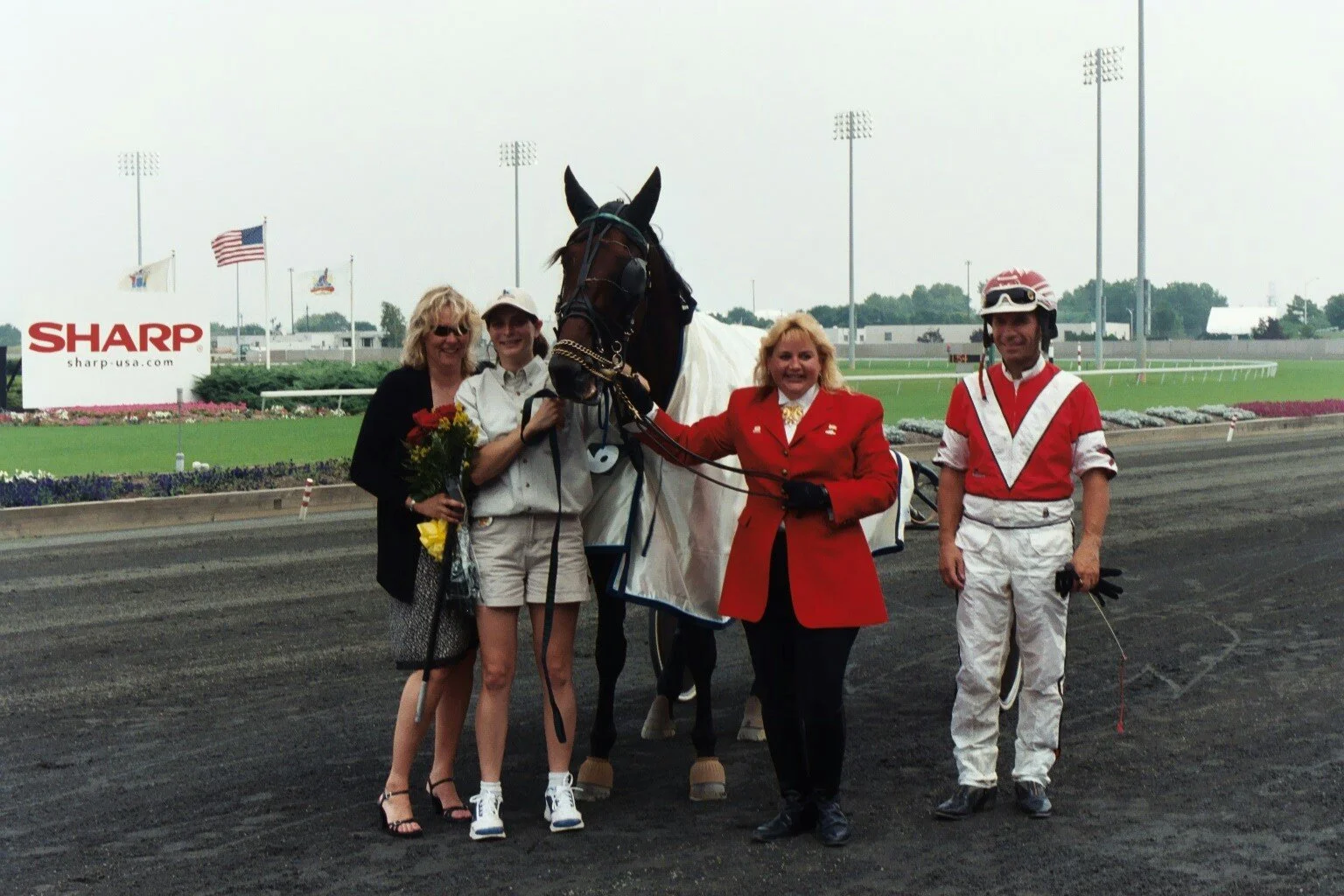
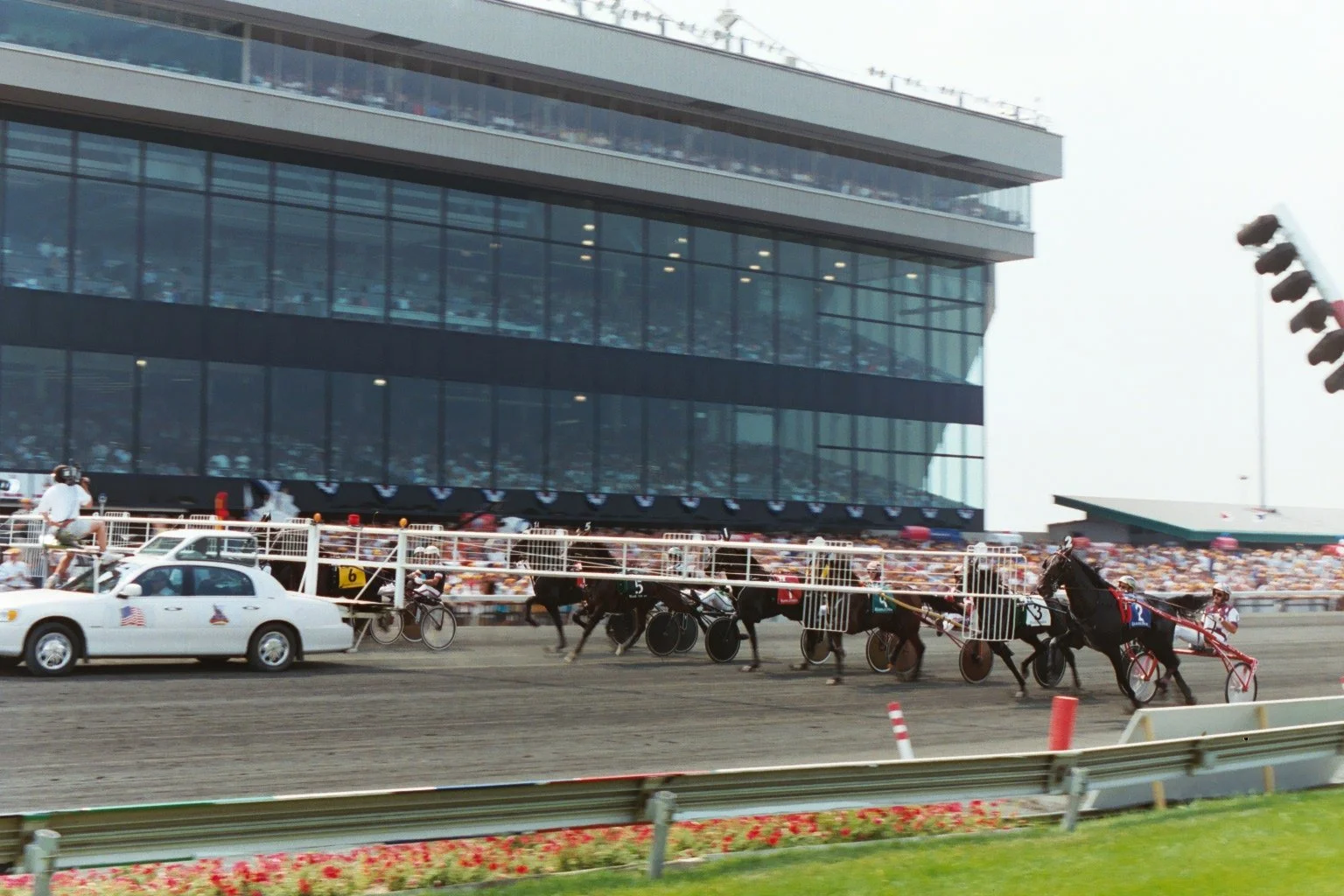
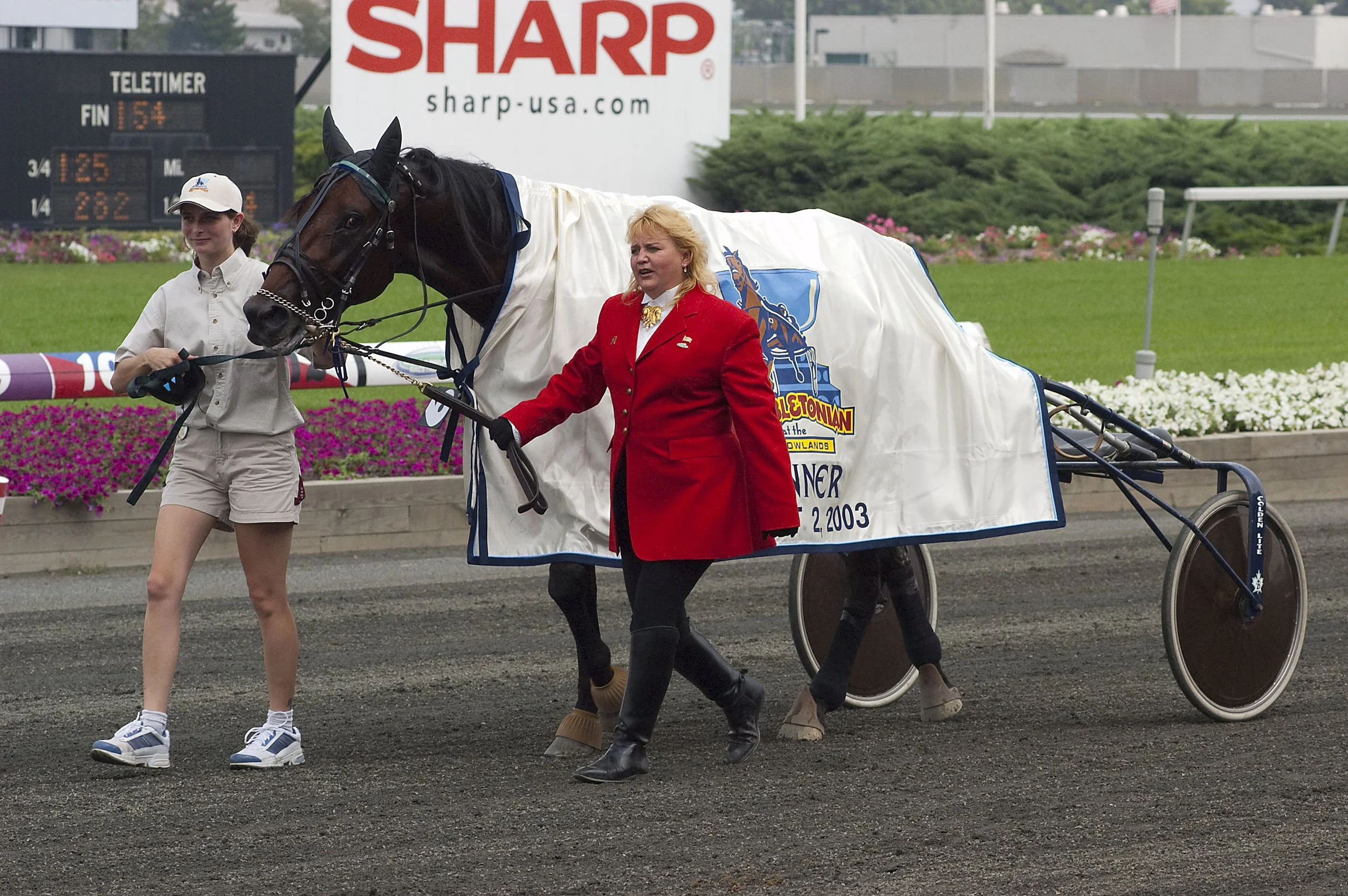
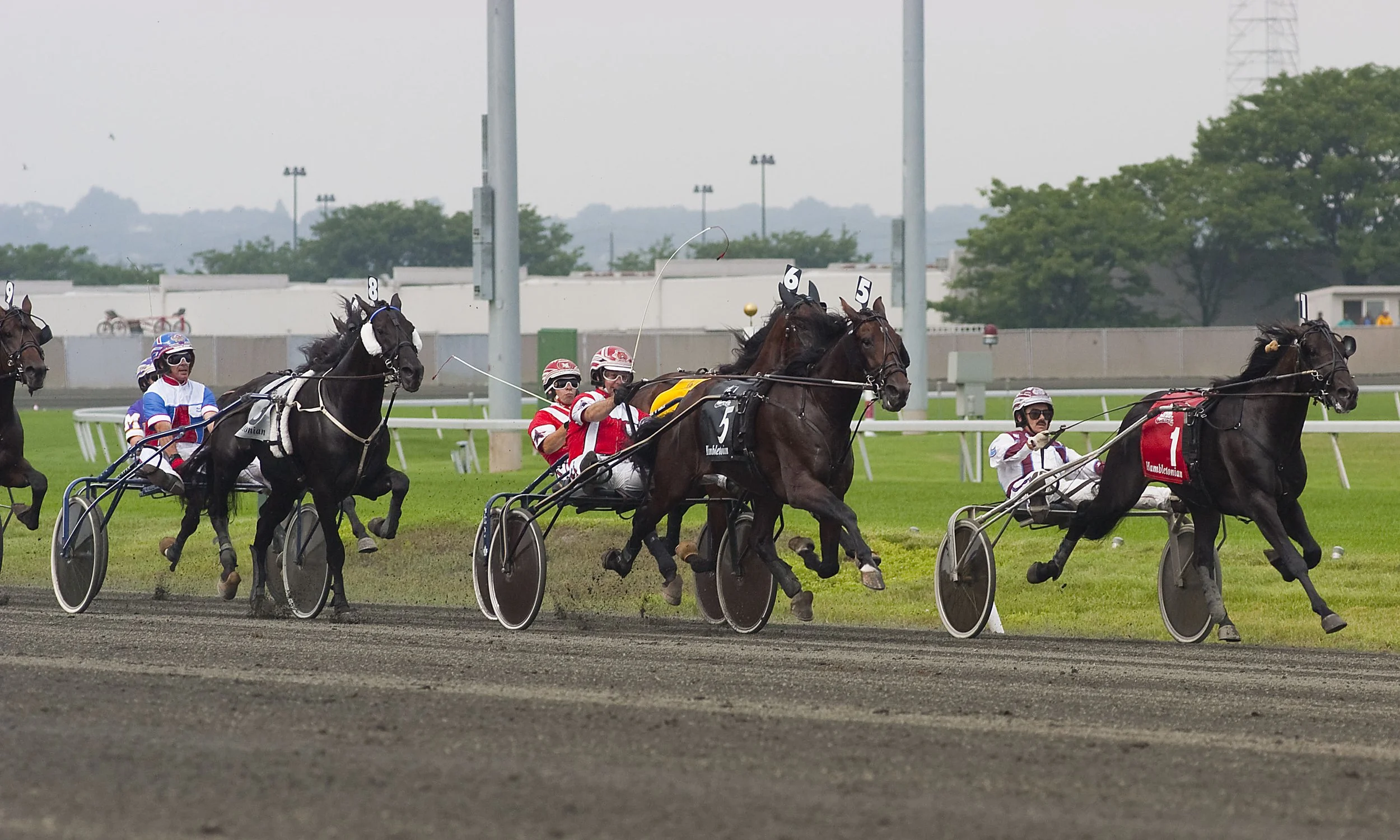
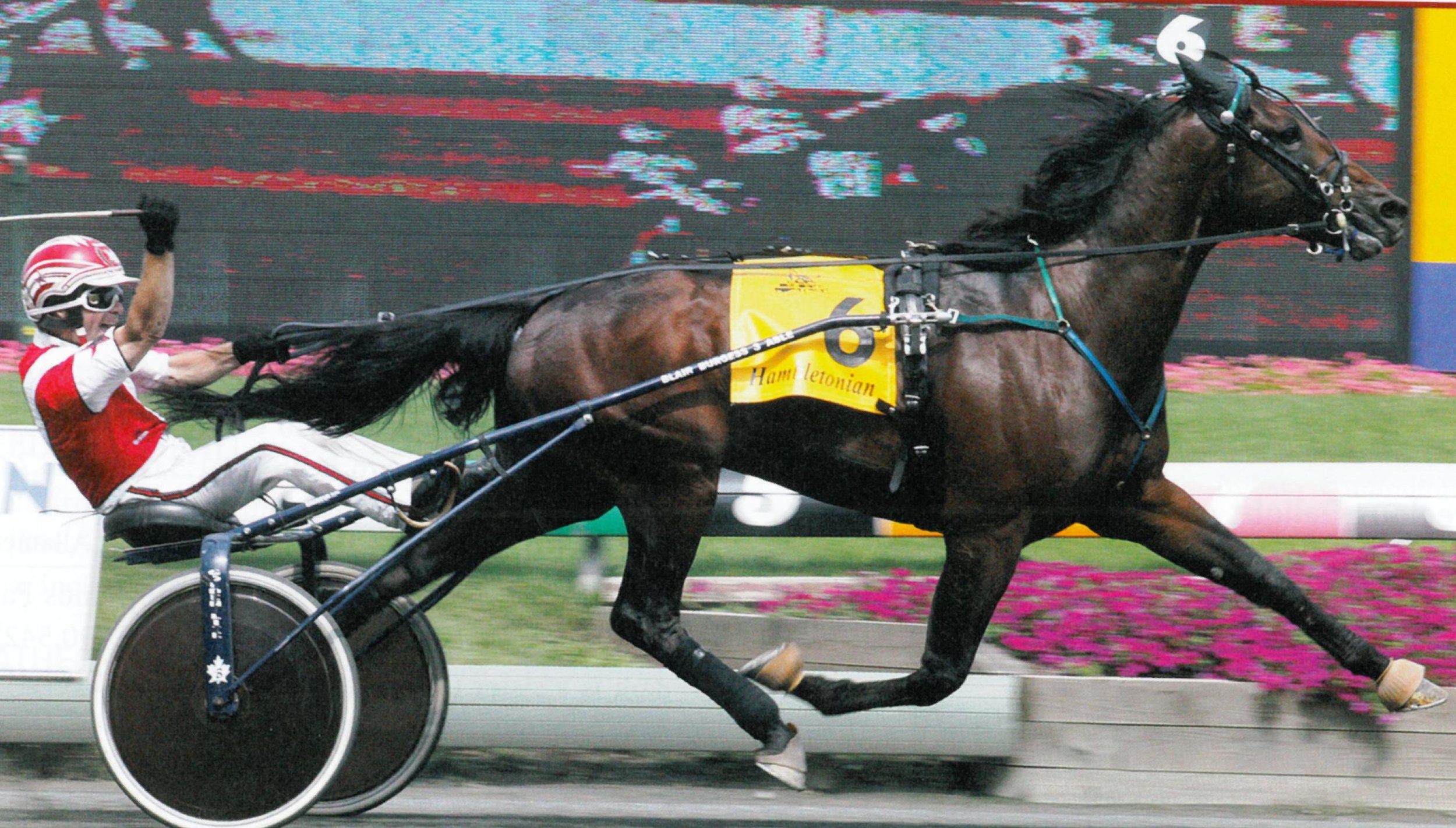
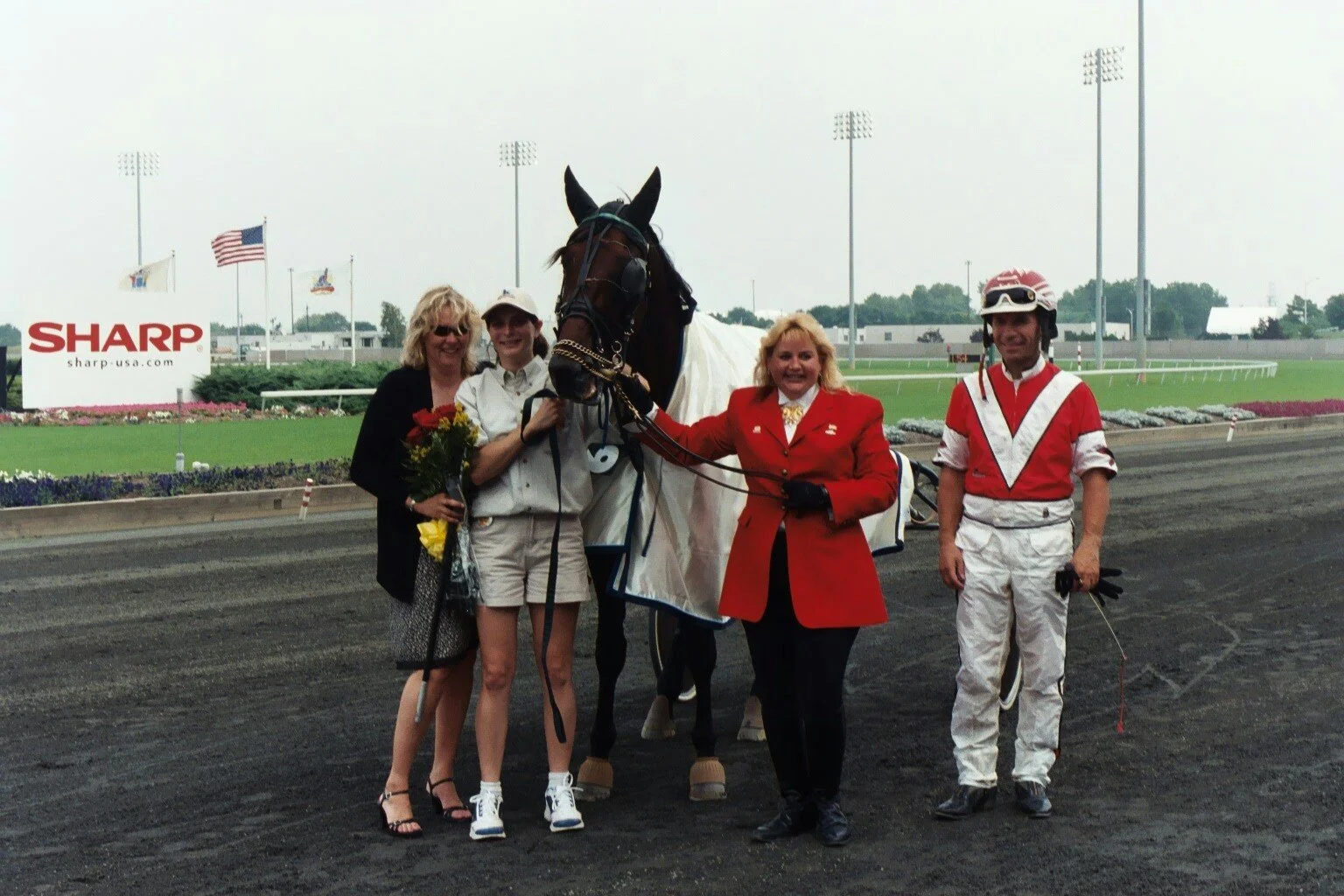
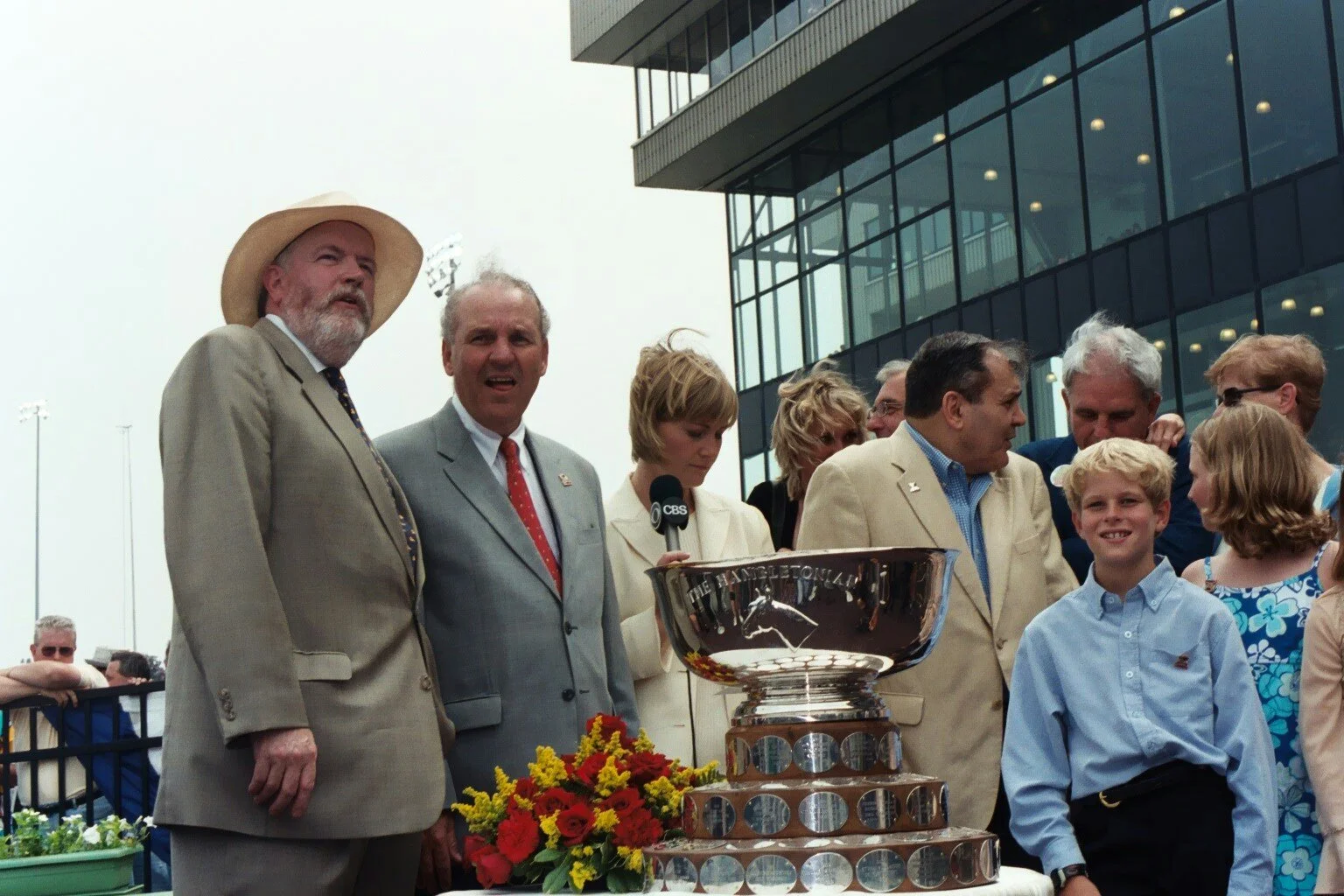
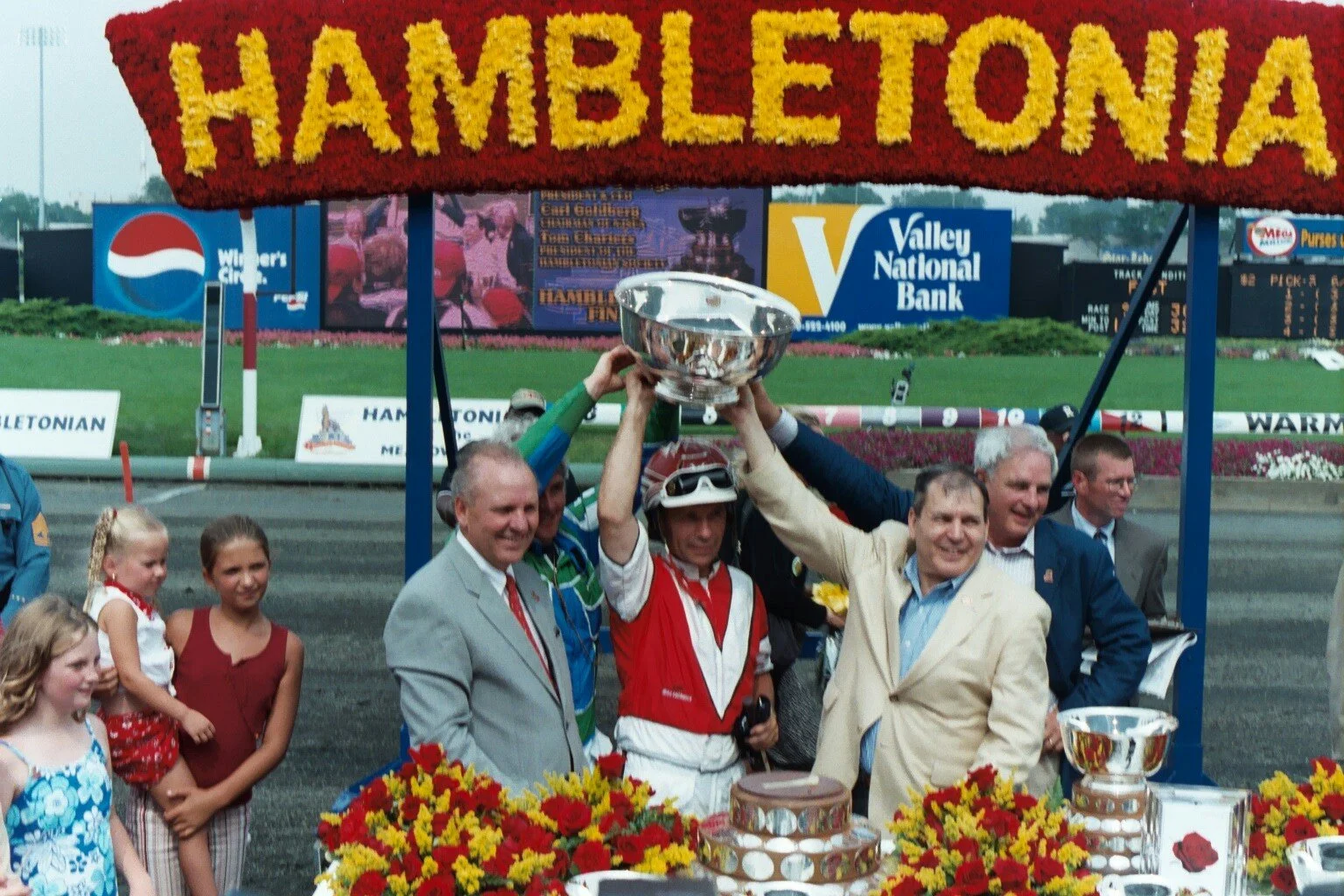
Amigo Hall Gives Hall of Famer A Grand Slam Amigo Hall's 27-1 upset in the Hambletonian was a fitting end to the 2003 Meadowlands meet for Hall of Fam driver Mike Lachance. In what might be the twilight of some careers, Lachance, at age 52, experienced a spectacular season that included victories in both of the Meadowlands' million-dollar events, the Hambletonian and the Meadowlands Pace. Ironically, Lachance qualified neither Amigo Hall nor his Meadowlands Pace winner, Allamerican Theory, for their spots in their respective $1 million finals. Both were opportunities that opened up when others opted off them for other drives. Lachance received the call when John Campbell chose Power To Charm, who won the slowest of the Hambletonian eliminations, over Amigo Hall, who had finished third in his elimination. When elimination winner Bebop broke stride at the start of the final, Lachance made a key decision to take Amigo Hall to the top. The quarter-mile was reached in 28.2 seconds, when the favorite, Power To Charm, went to the top an dled the field to the half-mile in 55.4. They remained in command to the three-quarter marker, but it quickly became apparent the favorite was not going to be his best that day. It also appeared that Amigo Hall was going to be an also-ran as well, as he was sitting along the pylons in fourth without any room to maneuver. Sugar Trader, the second choice, was brought into contention at the top of the stretch and appeared strongest as he assumed the lead, but inside the seven-eights pole a narrow lane opened and Lachance and Amigo Hall exploded through it. The mile went in 1:54, well off the stakes, track, and world record of 1:51.3. Sugar Trader and Mac's Crown K were second and third, respectively. The victory margin was one length and a neck separated the place and show finishers. Amigo Hall returned %57 to win, the longest price in a Hambletonian final. "I knew (Power To Charm) had to work hard and my horse was feeling fresh," said Lachance, "It may have been good luck, but I got out and when it's your day, it's your day." Power To Charm, who had won his last three starts, including the Stanley Dancer Trot, finished fifth. It was Lachance's fourth Hambletonian win - and the first behind a horse not trained by Ron Gurfein. The colt's trainer, Blair Burgess, was making his Hambletonian debut. Although it was not his first million-dollar victory - he won the Meadowlands Pace in 1987 with Frugal Gourmet and 2001 with Real Desire, Burgess was a man not generally regarded as a top "trotting trainer." "I'm not usually good with trotters," Burgess laughed, "But, he's been a lot of fun and has been a surprise. I don't like to talk about the problems of other horses, but when Bebop broke at the start Mike was able to use his gate speed and take him to the top. That helped us." Amigo Hall was a $32,000 yearling, but didn't bring his reverse at auction, missing by $1,000, and his breeder, Alan Leavitt of Walnut Hall, Ltd., bought him back and later sold a one-half interest in the colt to Bob Burgess, the father of the trainer, and to the trainer's wife, Karin Olsson-Burgess.
Amigo Hall is the longest priced Hambletonian winner in history, going postward at 27-1. He finished third in his elimination int he previous week at 7-1. In 1984, Delvin G Hanover won his elim at 62-1 and was second in the final at 5-2. Abundance (1995) won his elim at 51-1 then was second in the final at 13-1. The Ambassador (1942) was 33-1 when he won the second of three heats; he then won the final, the third heat, paying $3.40 on the dollar. Since the requirement of winning two heats was dropped in 1992, the highest winning $2.00 payoff in the final prior to 2003 have been Alf Palema (1992), $8.40, and Chip Chip Hooray (2002), $12.60. Since the eliminations were moved to the previous week in 1998, Amigo Hall is the first Hambletonian winner not to win his elimination. He was third, beaten four and a half lengths by Bebop and timed in 1:54.4. His mile in the final was career best 1:54. Since the open draw for the final was inaugurated in 1992, Amigo Hall is only the second horse (Muscles Yankee, 1998) to win from post position six. ONly Yankee Paco (2000) and Windsong's legacy (2004) have won from further out, post seven. The win was Hall of Fame driver Mike Lachance's fourth. His previous three victories were all behind Ron Gurfein - trained horses: Victory Dream (1994), Continentalvictory (1996) and Self Possessed (1999). He joined Ben White, Bill Haughton and Stanley Dancer, who all have four Hambletonain wins. The record for the most number of Hambletonian victories is held by John Campbell (five). In fact, Campbell qualified Amigo Hall for the final but was committed to drive eventual race favorite Power To Charm. Amigo Hall represented the first breeder's credit for Walnut Hall Ltd. which was founded in the 1990s, although historic Walnut Hall Farm, operated by Meg Leavitt's family, had eight: The Marchioness (1932), Lord Jim (1934), Peter Astra (1939), The Ambassador (1942), Volo Song (1943), Lusty Song (1950), Sharp Note (1952) and The Intruder (1956). Only Hanover Shoe Farm has more, nine. In addition to Victory Dream (1994), which Walnut Hall Ltd. syndicated prior to the Hambletonian, owner Alan Leavitt stood in the winner's circle as a partner on Speedy Somolli (1978). His Lana Lobell Farms of New Jersey also bred Mack Lobell (1987). Stallions standing at Leavitt's farms over the years have sired eight winners: Speedy Somolli (1978), Prakas (1985), Nuclear Kosmos (1986), Mack Lobell (1987), Park Avenue Joe (1989), Alf Palema (1992) and Self Possessed (1999). Amigo Hall had a definite Canadian connection: he was sired by an Ontario stallion, owned in part and trained by residents of that province and driven by a native Quebec. He was Balanced Image's second winner in four years. Balanced Image remains the only Canadian sire to produce a Hambletonian winner. His first was Yankee Paco in 2000. Thirty-three winners, including Amigo Hall, trace their paternal line directly to Volomite, who finished second in the 1929 Hambletonian to Walter Dear. Volomite, considered one of the most influential sires in the sport, stood at Walnut Hall Farm for 20 years, and was a great-great-great-grandson of Hambletonian 10. A record five horses made a break before the 1/8 pole in the 2003 final. The field included Malabar Millennium, who possessed an all-Hambletonian pedigree. He was by 1997 Hambletonian winner Malabar Man out of 1994 Hambletonian Oaks winner Gleam, and both were owned and driven by amateur driver Malvern Burroughs. No Hambletonian winner has ever sired a winner out of a mare that won the Hambletonian or the Oaks. However, Armbro Goal (1988) is by Speedy Crown (1971) out of Armbro Flight (second to Egyptian Candor in 1965) and Park Avenue Joe (1989) is by Speedy Somolli out of Delmonica Hanover (2nd to Super Bowl in 1972). Though winless in 10 lifetime starts prior to the Hambletonian elims, Malabar Millennium's elim victory made him the first maiden since Calumet Butler to win either a heat or an elimination in the Hambletonian. The inaugural Hambletonian Parade took place on the streets of Rutherford, New Jersey on the morning of the eliminations. Bagpipers, horse units, retired and racing standardbreds and Hambletonian himself led by William Rysdyck headlined the event.


Media
Champions | 2000-2009
-
![]()
Yankee Paco
-
![]()
Scarlet Knight
-
![]()
Chip Chip Hooray
-
![]()
Amigo Hall
-
![]()
Windsong's Legacy
-
![]()
Vivid Photo
-
![]()
Glidemaster
-
![]()
Donato Hanover
-
![]()
Deweycheatumnhowe
-
![]()
Muscle Hill

Smedshammer’s Legacy Begins
August 7, 2004
East Rutherford, NJ
The MeadowLands
Purse $1,000,ooo
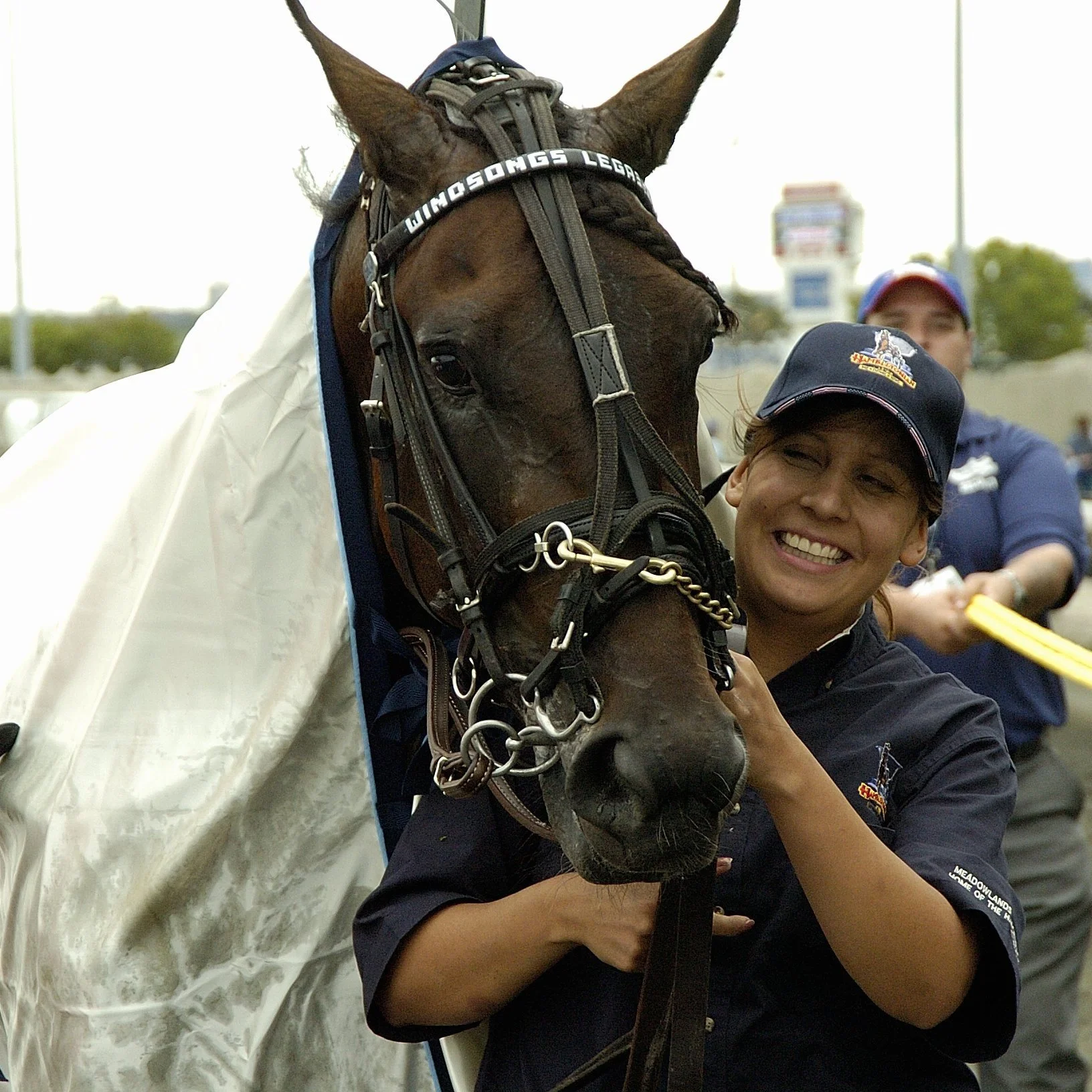
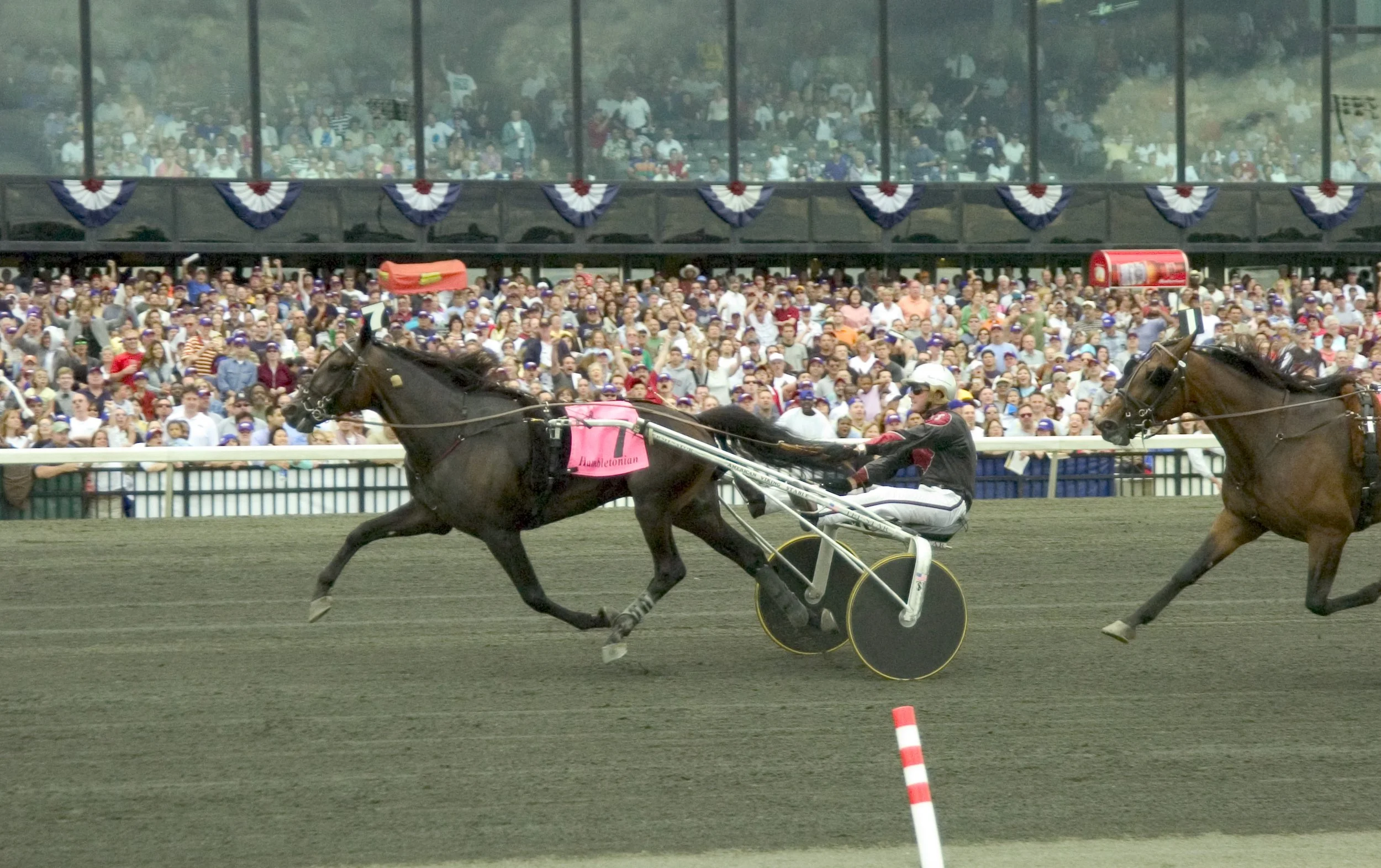
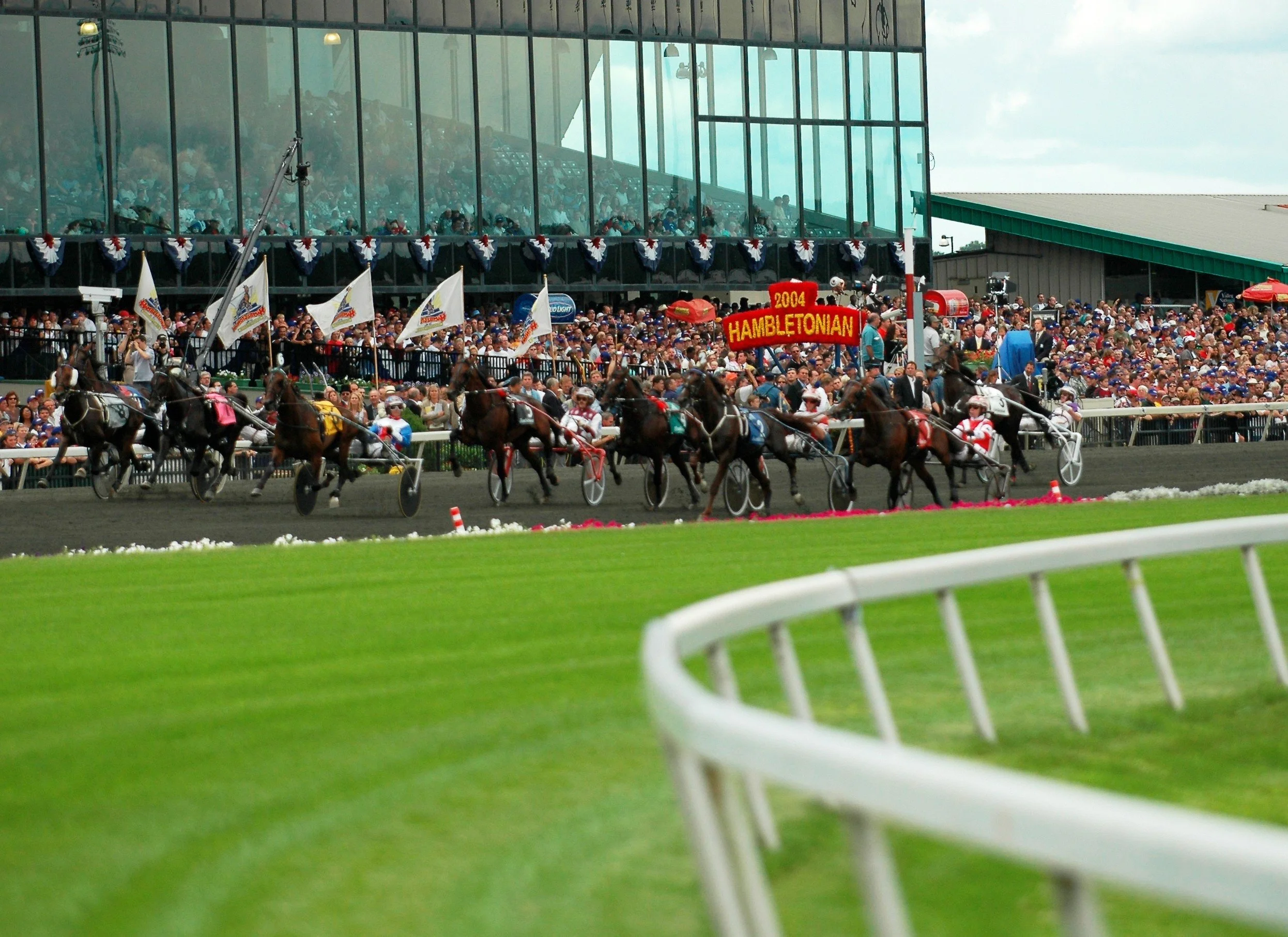
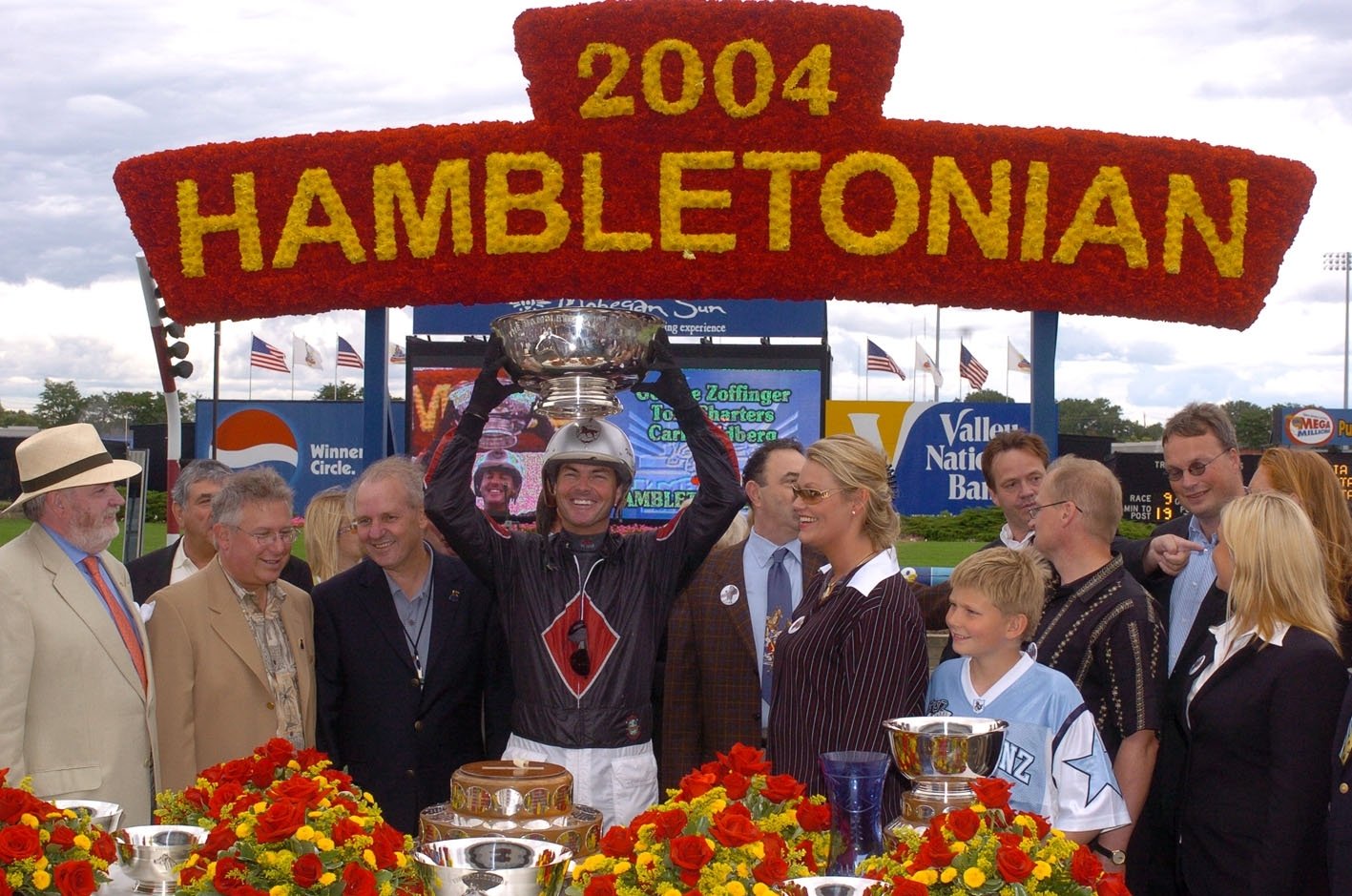
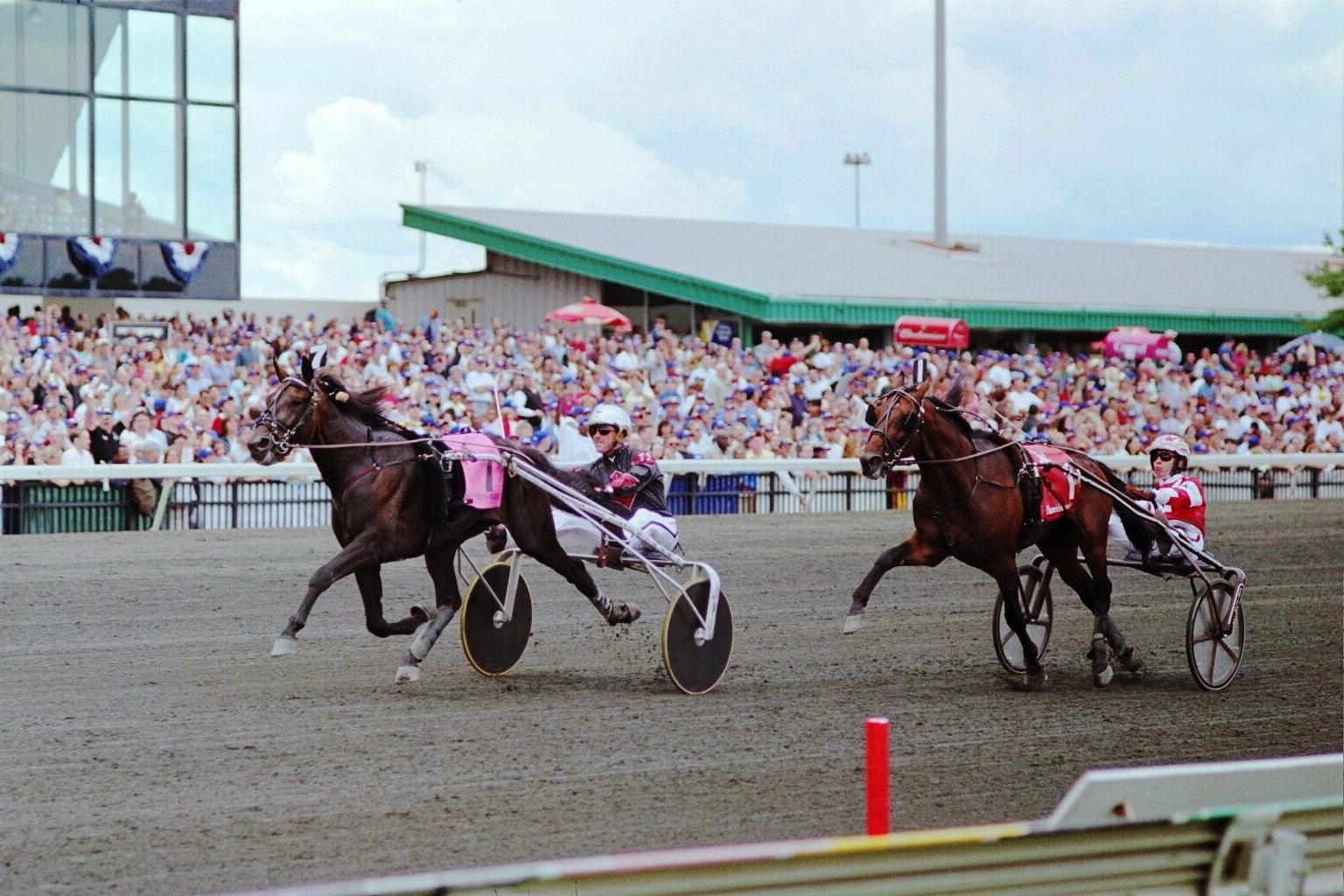
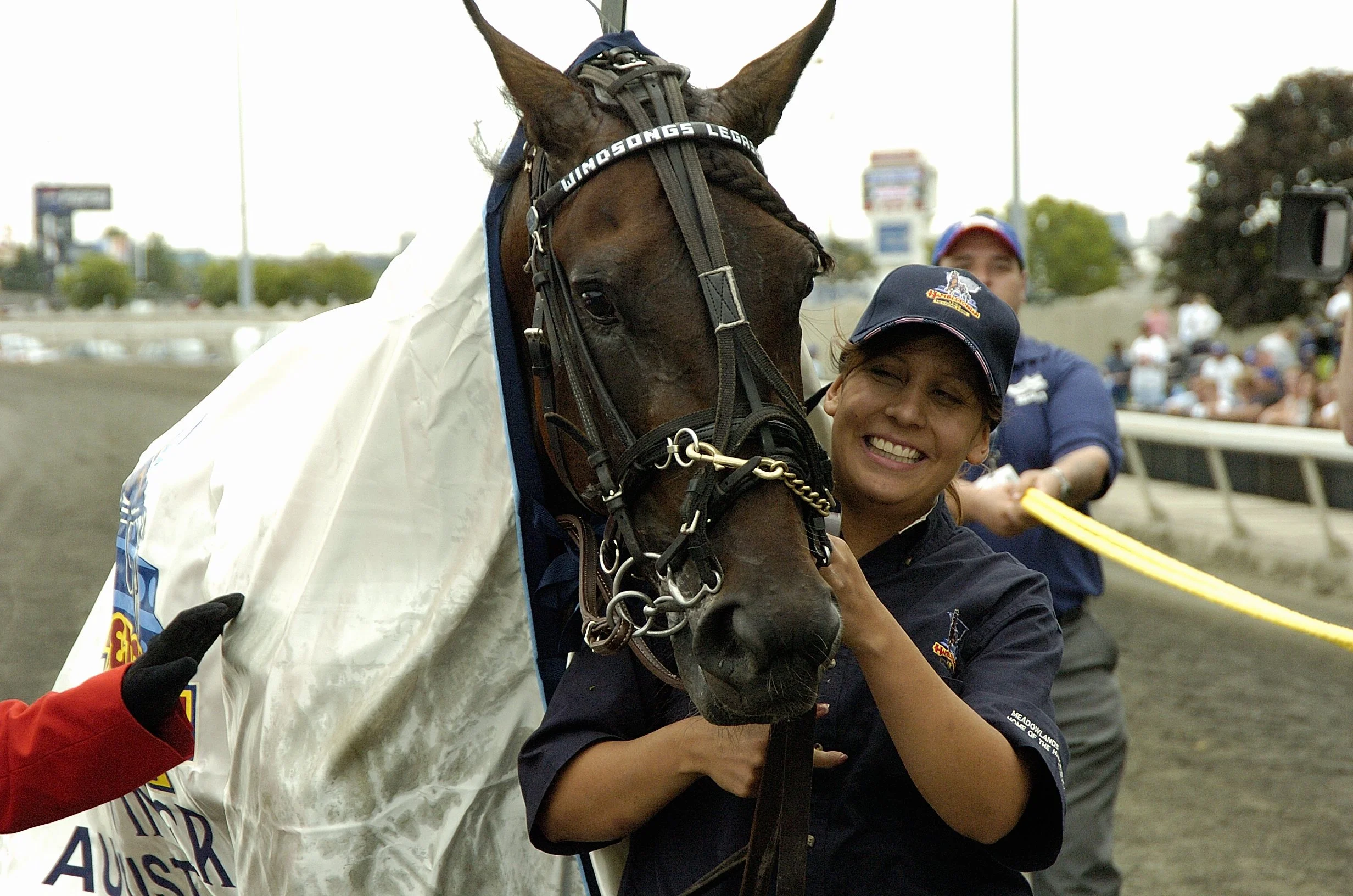
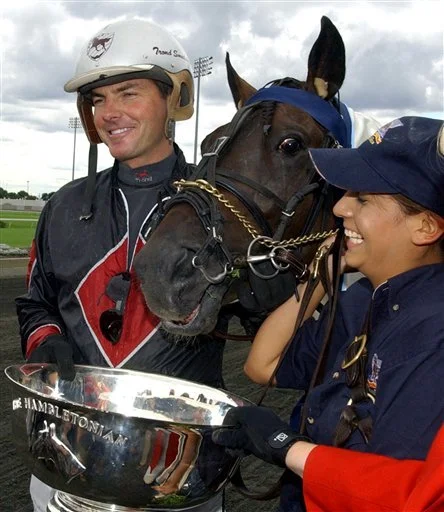
Triple Crown Winner For trainer-driver Trond Smedshammer, his victory in the 2004 Hambletonian with Windsong's Legacy was gratifying on many levels. Not only had the Norwegian-born horseman realized the culmination of years of hard work and avenged his loss with the race favorite the previous year, but Smedshammer raised $25,000 for the American Cancer Society in memory of his father, Lars, and owner Patricia Spinelli's husband, Ron, each of whom lost his battle with lung cancer. After Windsong's Legacy advanced from the eliminations, Smedshammer and the ownership of the colt pledged five percent of his earnings in the Hambletonian Final to the American Cancer Society. Smedshammer had lost his father, Lars, a year earlier, while Ron Spinelli had succumbed to cancer only the week before the race. Just the year before, Smedshammer looked to be in perfect position to take home his first Hambletonian trophy with the race favorite Power To Charm, but that prospect dimmed quickly as Power To Charm faded on the lead past the half and finished fifth. This time, Smedshammer would be the fourth choice in the race, despite his colt's victory in the Stanley Dancer two weeks prior. In fact, the odds of Windsong's Legacy reaching the Hambletonian were not his favor form the beginning. The modestly priced yearling was orphaned at two months old when his dam, Yankee Windsong, died from complications of colic. Angels may have been smiling on horse and driver as the wings of the starting gate folded. Smedshammer elected to follow Cash Hall and ended up with a perfect second-over trip as Cash Hall was left to race uncovered while challenging the favorite, Tom Ridge, through soft opening fractions. Despite the leisurely pace, Tom Ridge was unable to sustain his drive and just as Cash Hall finally pushed past Tom Ridge at the three-quarter marker, Smedshammer tipped Windsong's Legacy three-wide and swept past the field for a length victory in 1:54.1. Windsong's Legacy would go on to win the Yonkers Trot and Kentucky Futurity, completing the Triple Crown, the first horse to do so since Super Bowl in 1972. Smedshammer would be named the United States Harness Writers Association's Trainer of the Year for his achievements with Windsong's Legacy, named the Three-Year-Old Trotter of the Year and Trotter of the Year, and his other divisional trotting champions, three-year-old trotting filly Housethatruthbuilt and older trotting mare Stroke Play. Windsong's Legacy, who raced in then name of Ann Brannvoll of Suedsmo, Norway; Ted Gewertz of New York City and Patricia Spinelli of Oyster Bay Cover, New York, was retired to stud duty at Perretti Farms in Cream Ridge, New Jersey.
The last Triple Crown winner was Super Bowl in 1972, and ironically, who when bred to Yankee Windsong, the dam of Windsong's Legacy, produced Moonlight G, a hard-knocking trotter that the Spears family kept and still raced at age seven. Winsong's Legacy was her fourth foal, and Yankee Windsong died of colic complications when her colt was eight weeks old. He was named in her honor and cared for by Hanover Shoe Farms top yearling man, Dennis King. The late Yankee Windsong was voted 2004 trotting Broodmare of the Year by the U.S. Harness Writers Assocation as her three racing sons gave her an annual earnings total of $1,727,100. His sire, Conway Hall was fourth in the 1998 Hambletonian won by Muscles Yankee. Windsong's Legacy gives Conway Hall is a first-crop Hambletonian credit. He stands at the State University of New York's Morrisville Colleg, which features a hands-on standardbred equine racing and breeding program. His stud fee , originally $5,000, has increased to $20,000 as of 2005; the highest in New York in 20 years. Windsong's Legacy was sold at the 2002 Harrisburg Sale for $27,000. Second and third-place finishers Cantab Hall and Cash Hall sold for $310,000 and $300,000 respectively. Windsong's Legacy joins 2003 winner Amigo Hall as the only two Hambletonian champions since 1997 (when eliminations were moved to the week prior) not to win their elims. Windsong's Legacy set a single seasons earning record in 2004 of $1.7 million displacing two other Hambletonian winners: Malabar Man ($1,679,862 - with foreign earnings) and Prakas ($1,610,608 - all domestic). Smedshammer and co-owner Patricia Spinelli encouraged the owners to donate five percent of the horse's winnings of $500,000 to the American Cancer Society; Smedshammer lost his father, Lars, to lung cancer and Spinelli's husband, Ron, an original partner in Windsong's Legacy died a week prior to the Hambletonian, also of lung cancer. They presented a check for $25,000 to the American Cancer Society. Windsong's Legacy eventually won all six finals in which he was entered in 2004, adding the Goodtimes, Stanley Dancer Trot and Canadian Trotting Classic to his Triple Crown triumphs. The win was the first in the Hambletonian for Ann Branvoll and Patricia Spinelli. Ted Gewertz had previously won in 1991 with Giant Victory in partnership with Stan and Steve Robins. He has never failed to earn a check in the big race as his Giant Hit was third in 1993, while both Giant Chill (1995) and Power To Charm (2003) were fifth. Windsong's Legacy was voted divisional champion and Trotter of the Year. Horse of the Year went to sophomore pacing filly Rainbow Blue. Windsong's Legacy never finished worese than third in 2004 with a summary of 12 starts, 9 wins, 2 seconds, and one third for $1,713,806 in purse money, and a mark of 1:53. In 17 lifetime starts, the only time he finished off the board was a fourth place finish as a two-year-old in Lexington. Walnut Hall could not claim a winner's credit as they did in 2003 with Amigo Hall (both bred and owned) but nonetheless the "Hall" moniker was sprinkled liberally throughout the 2004 Hambletonian proceedings. The winner Windsong's Legacy was sired by Conway Hall, a Walnut Hall Ltd. stallion. The place and show horses, Cantab Hall and Cash Hall, were bred, raised, and sold by Walnut Hall Ltd. (Walnut Hall also bought back an owner interest in Cash Hall). And the fifth-place finisher was Justice Hall, another Walnut Hall Ltd. product. He is owned in part by Mary Katz of Lexington, wife of Steve Katz, an executive with Walnut Hall Ltd. Trond Smedshammer became the first driver-trainer to win since Stefan Melander and Scarlet Knight in 2001. Smedshammer made his first appearance in the Hambletonian winner circle in 1989 as an assistant for Lindy Farms Stable, with Probe, who famously deadheated with Park Avenue Joe win the race final. The Norwegain-born horseman embarked on his own in 1992 and five years later he won an elimination of the Hambletonian with Bowlin For Dollars, who finished fourth in the final. In 2003, Trond was sitting pretty with 1-2 favorite Power to Charm (driven by John Campbell), who disappointed with a fifth-place finish.


Media
Champions | 2000-2009
-
![]()
Yankee Paco
-
![]()
Scarlet Knight
-
![]()
Chip Chip Hooray
-
![]()
Amigo Hall
-
![]()
Windsong's Legacy
-
![]()
Vivid Photo
-
![]()
Glidemaster
-
![]()
Donato Hanover
-
![]()
Deweycheatumnhowe
-
![]()
Muscle Hill
From the pennsylvania Fairs
August 6, 2005
East Rutherford, NJ
The MeadowLands
Purse $1,500,ooo
Champions | 2000-2009
-
![]()
Yankee Paco
-
![]()
Scarlet Knight
-
![]()
Chip Chip Hooray
-
![]()
Amigo Hall
-
![]()
Windsong's Legacy
-
![]()
Vivid Photo
-
![]()
Glidemaster
-
![]()
Donato Hanover
-
![]()
Deweycheatumnhowe
-
![]()
Muscle Hill
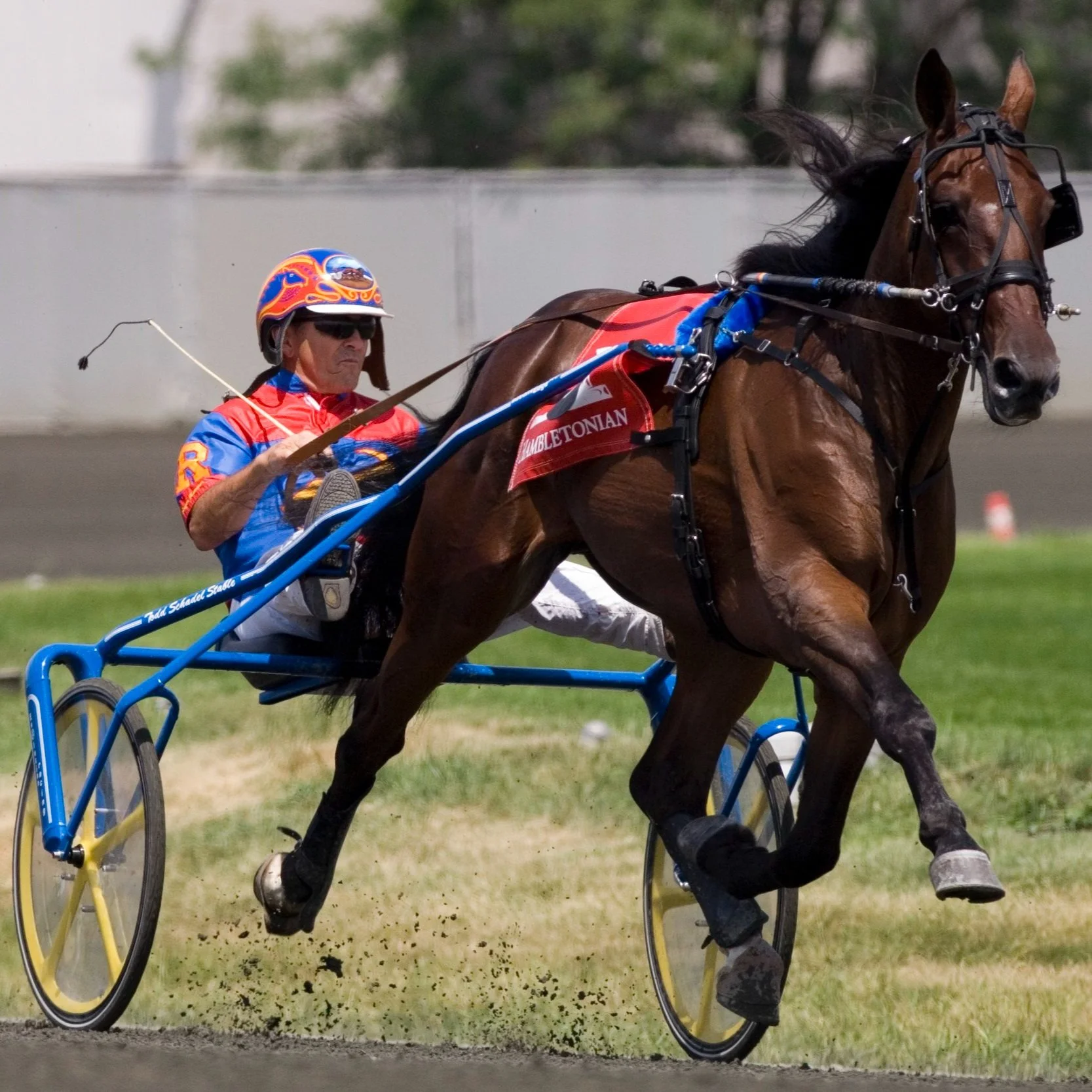
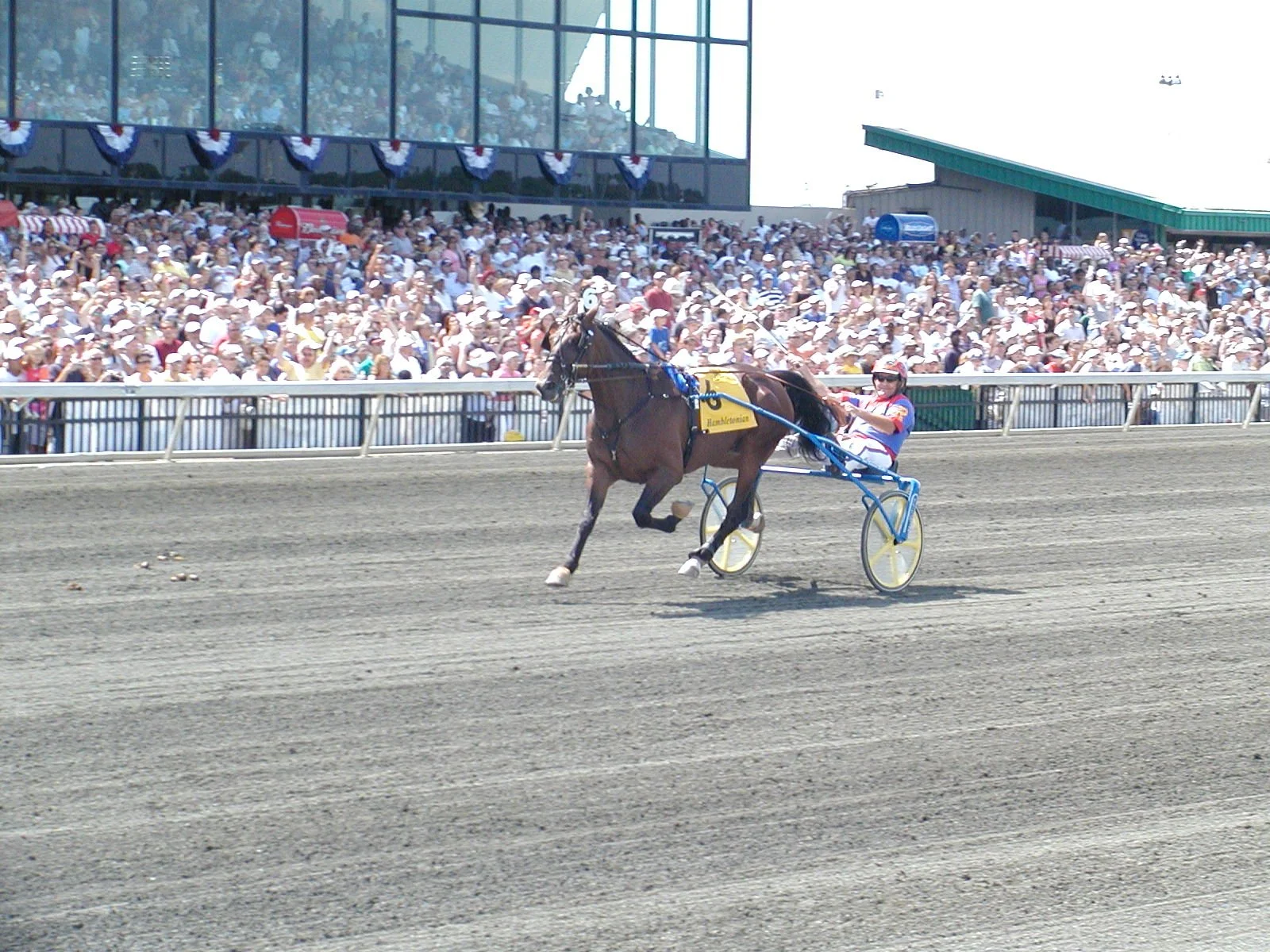
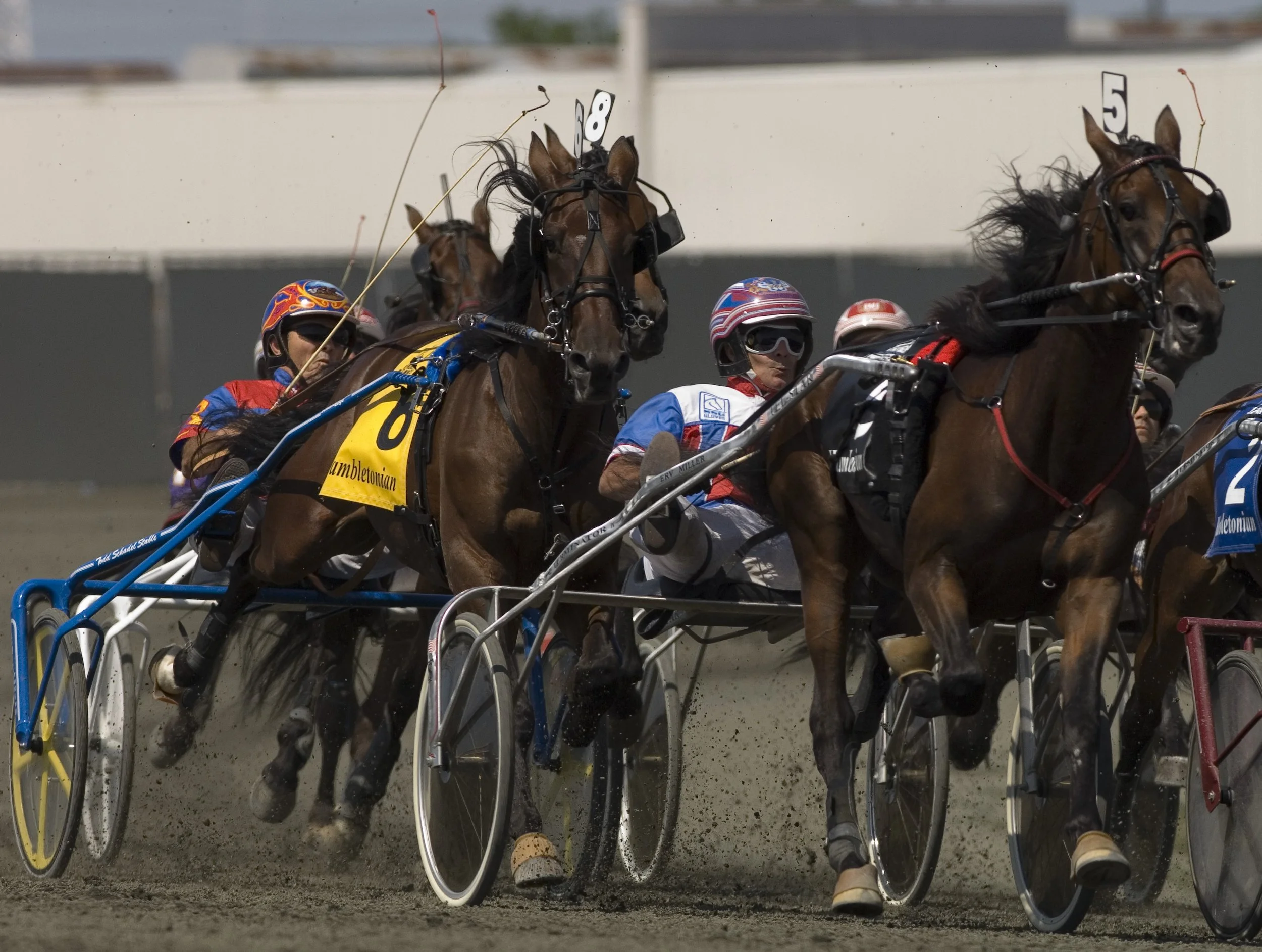
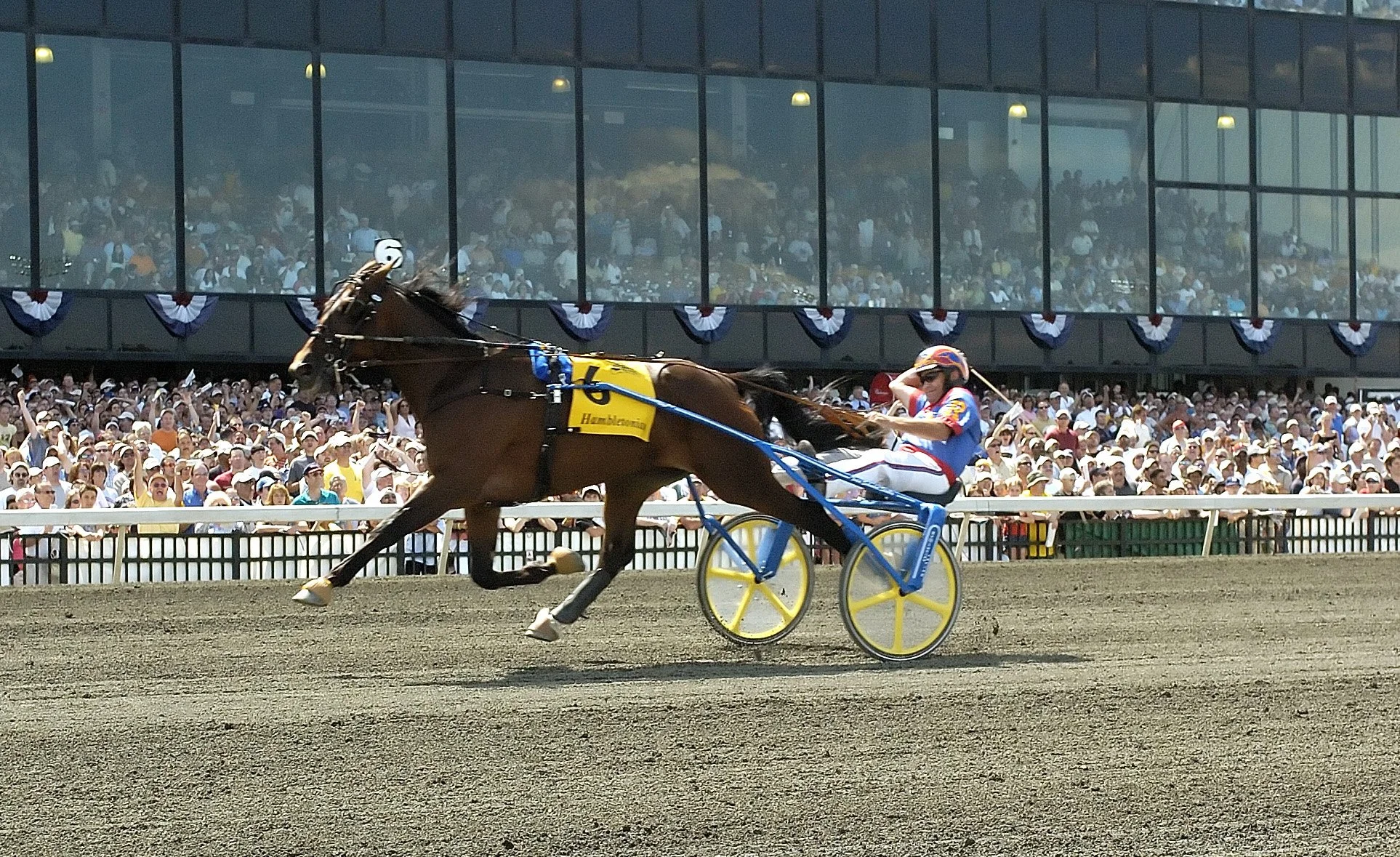
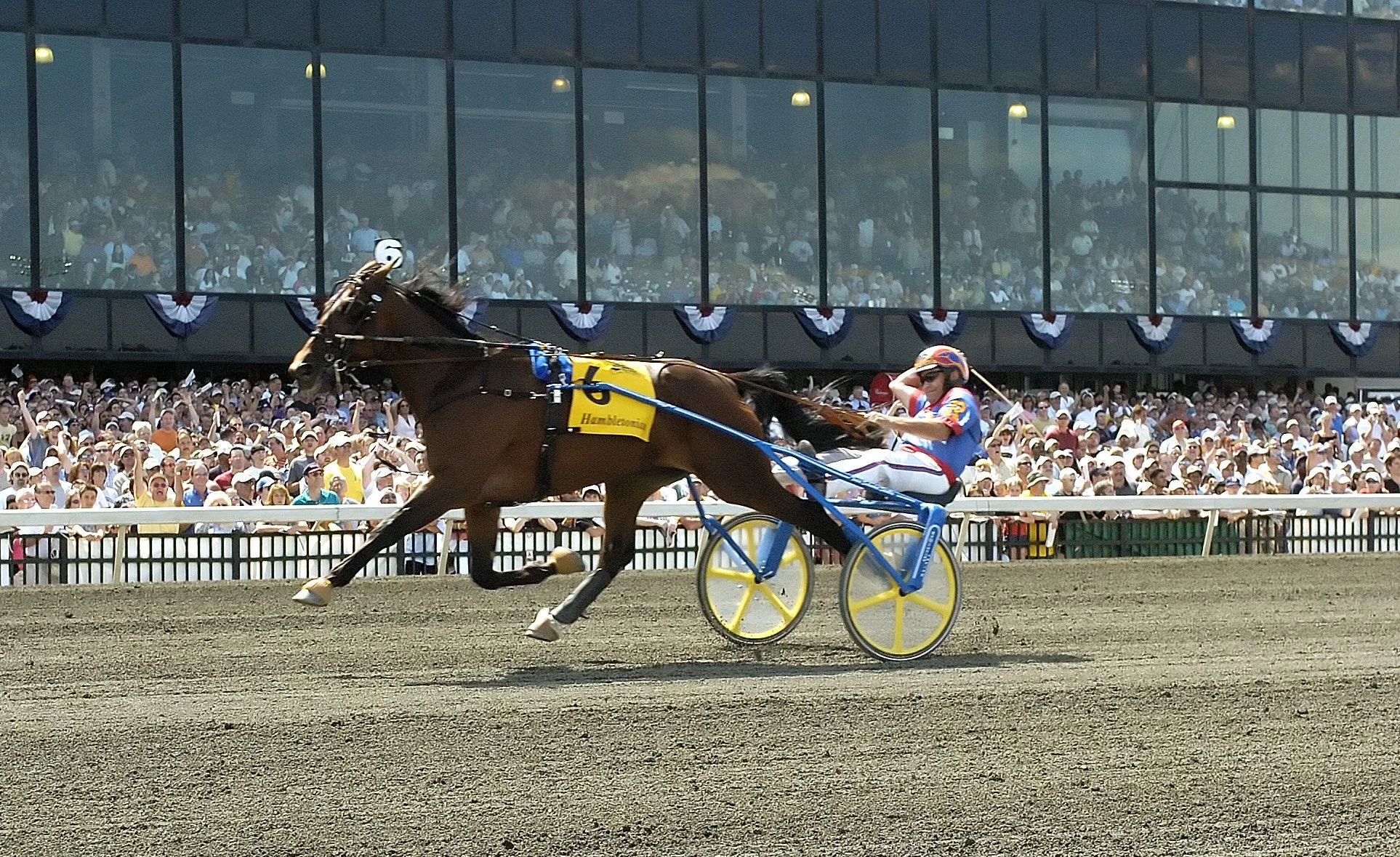
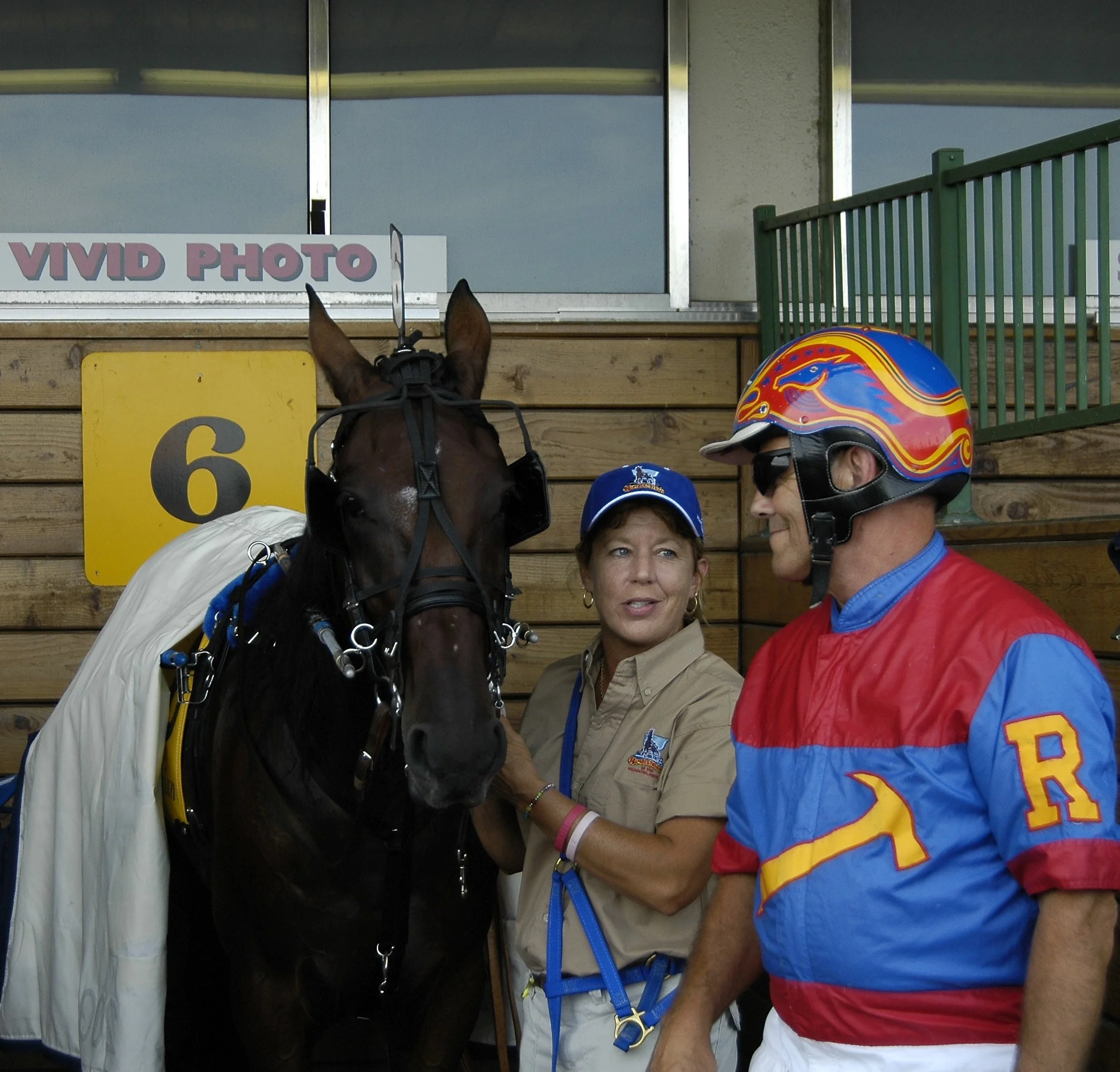
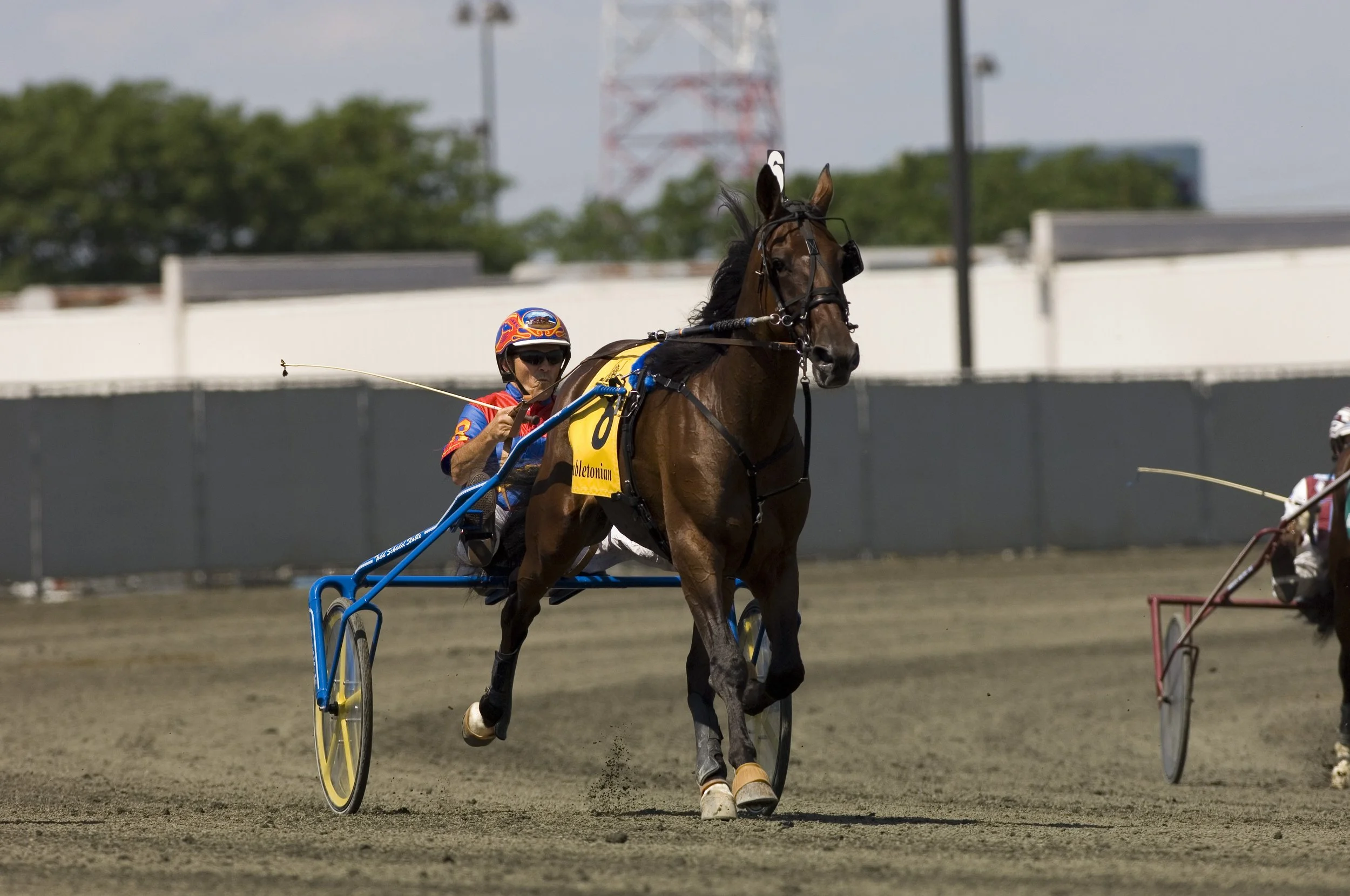
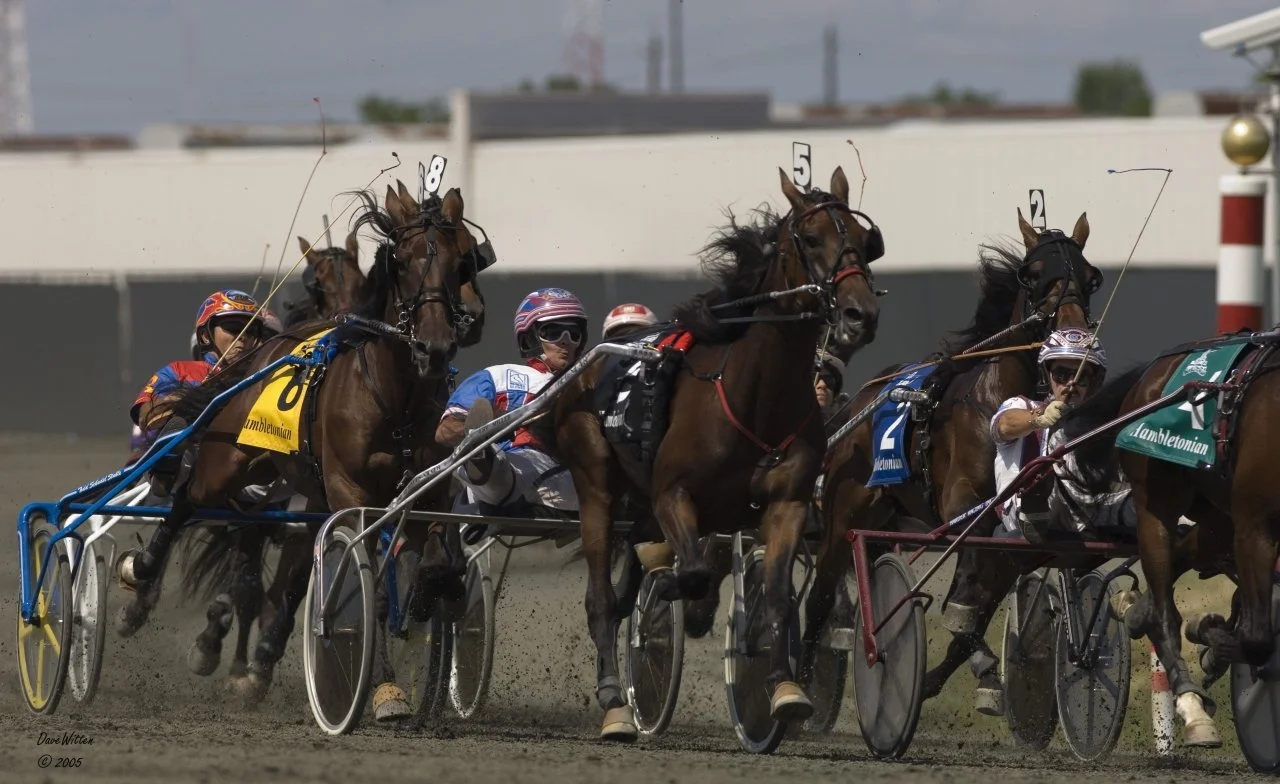
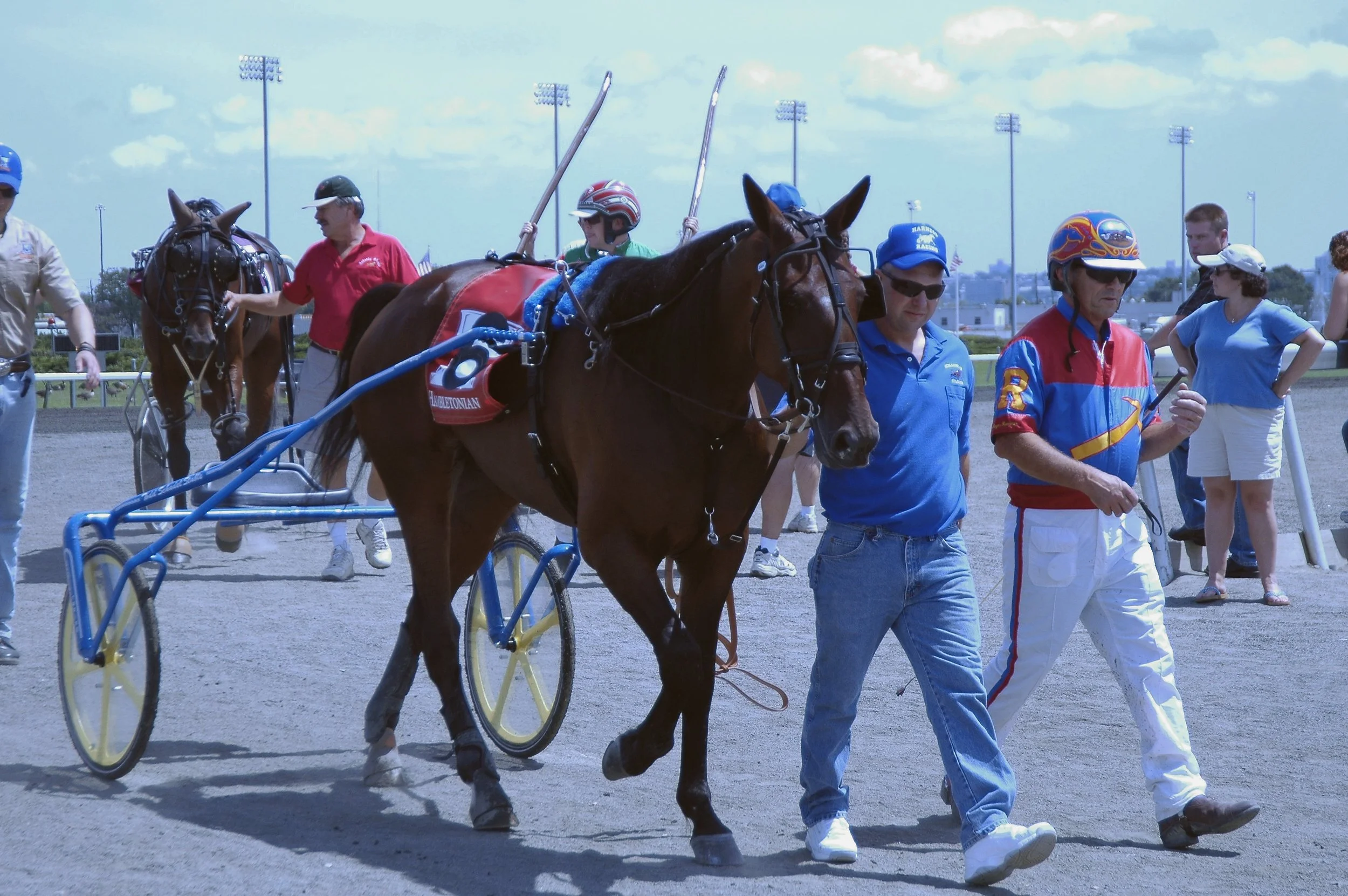
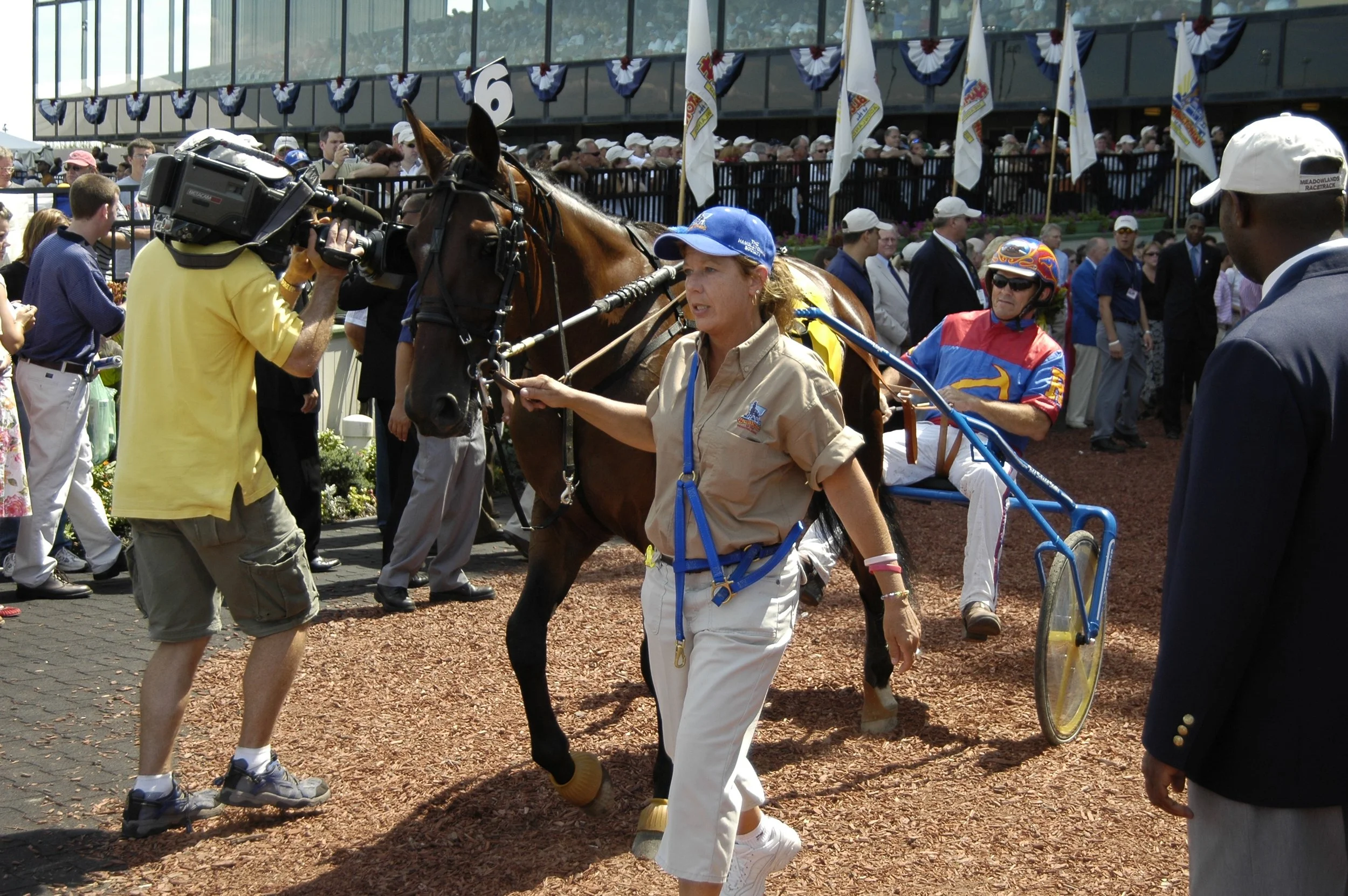
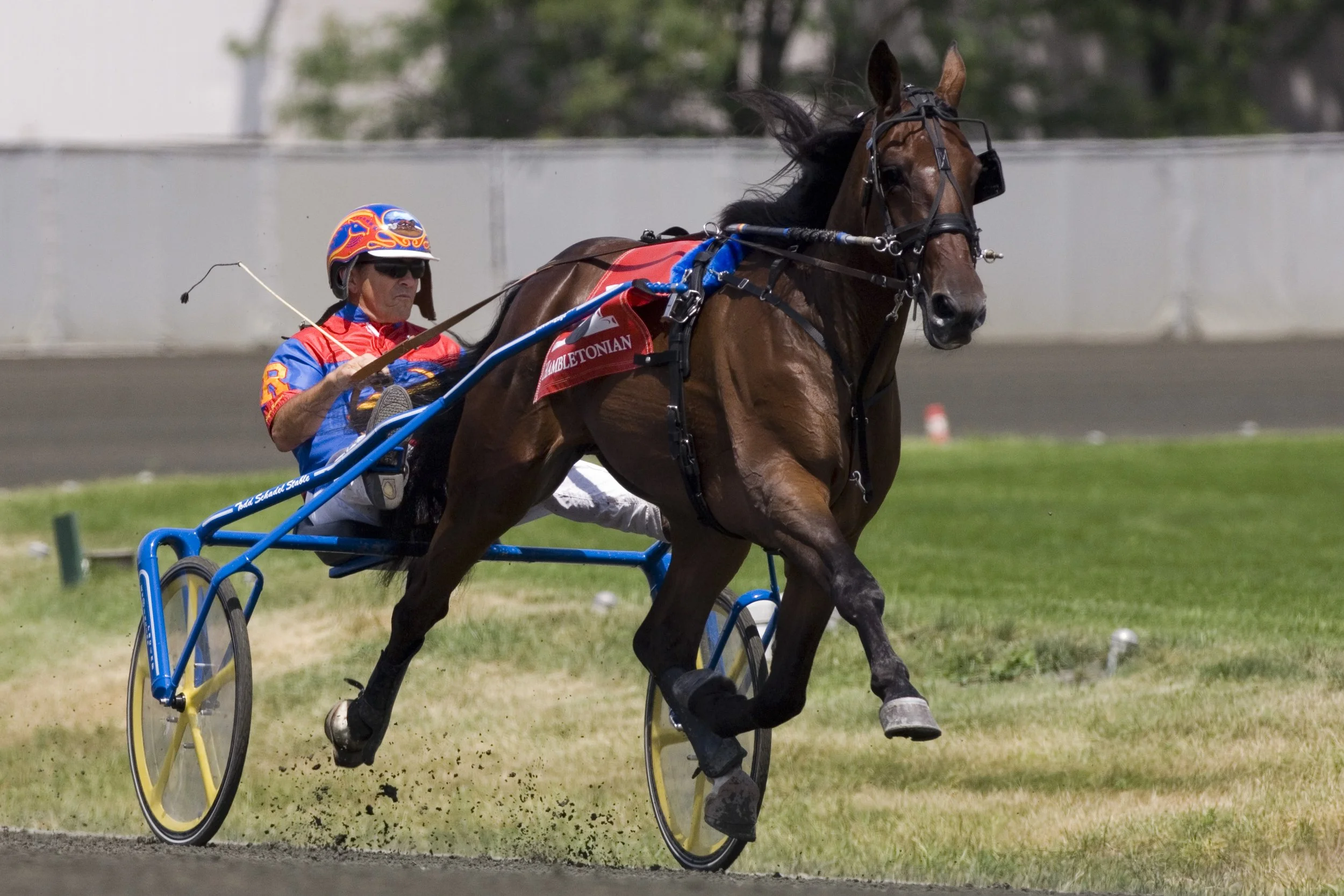
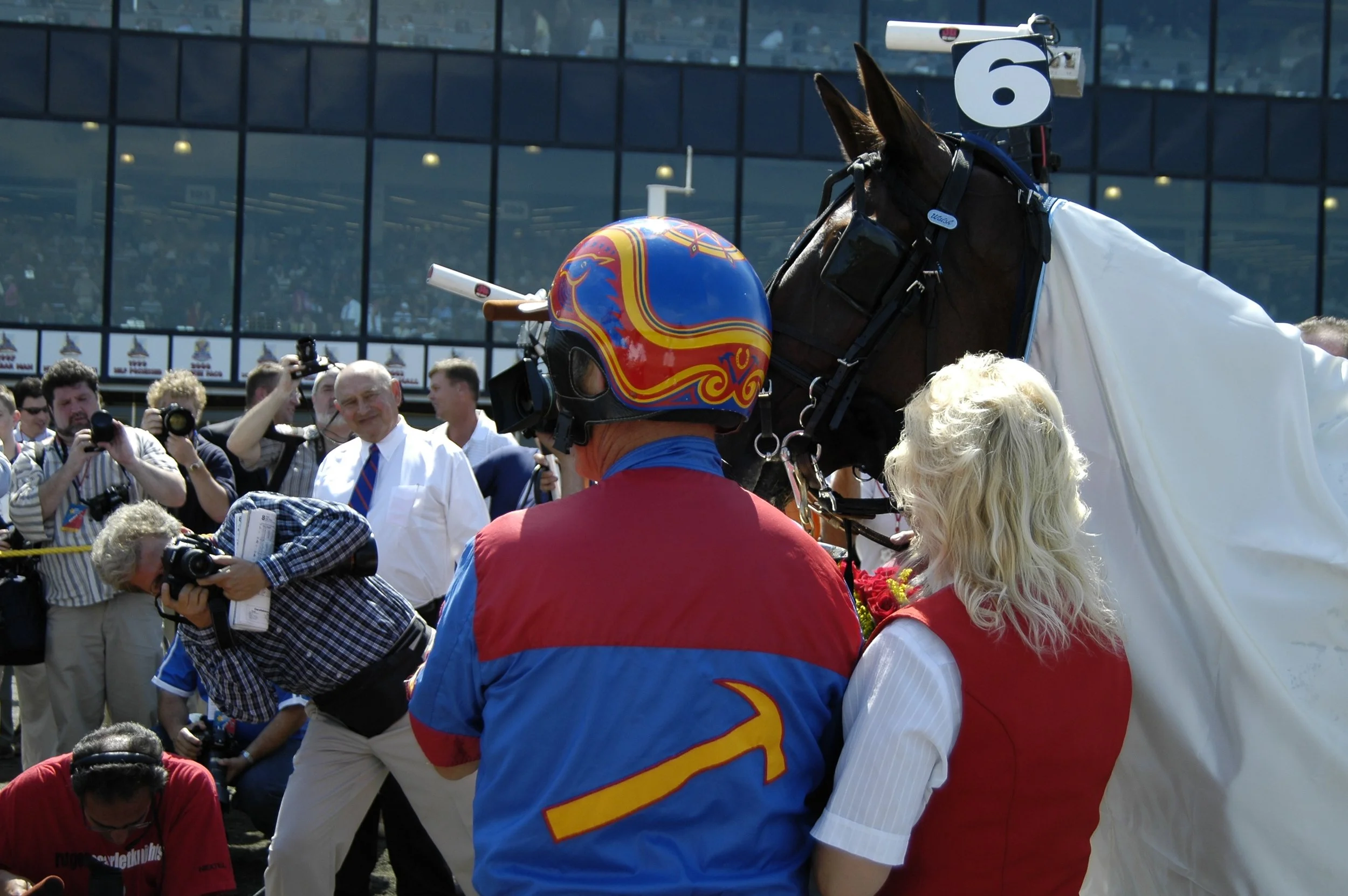
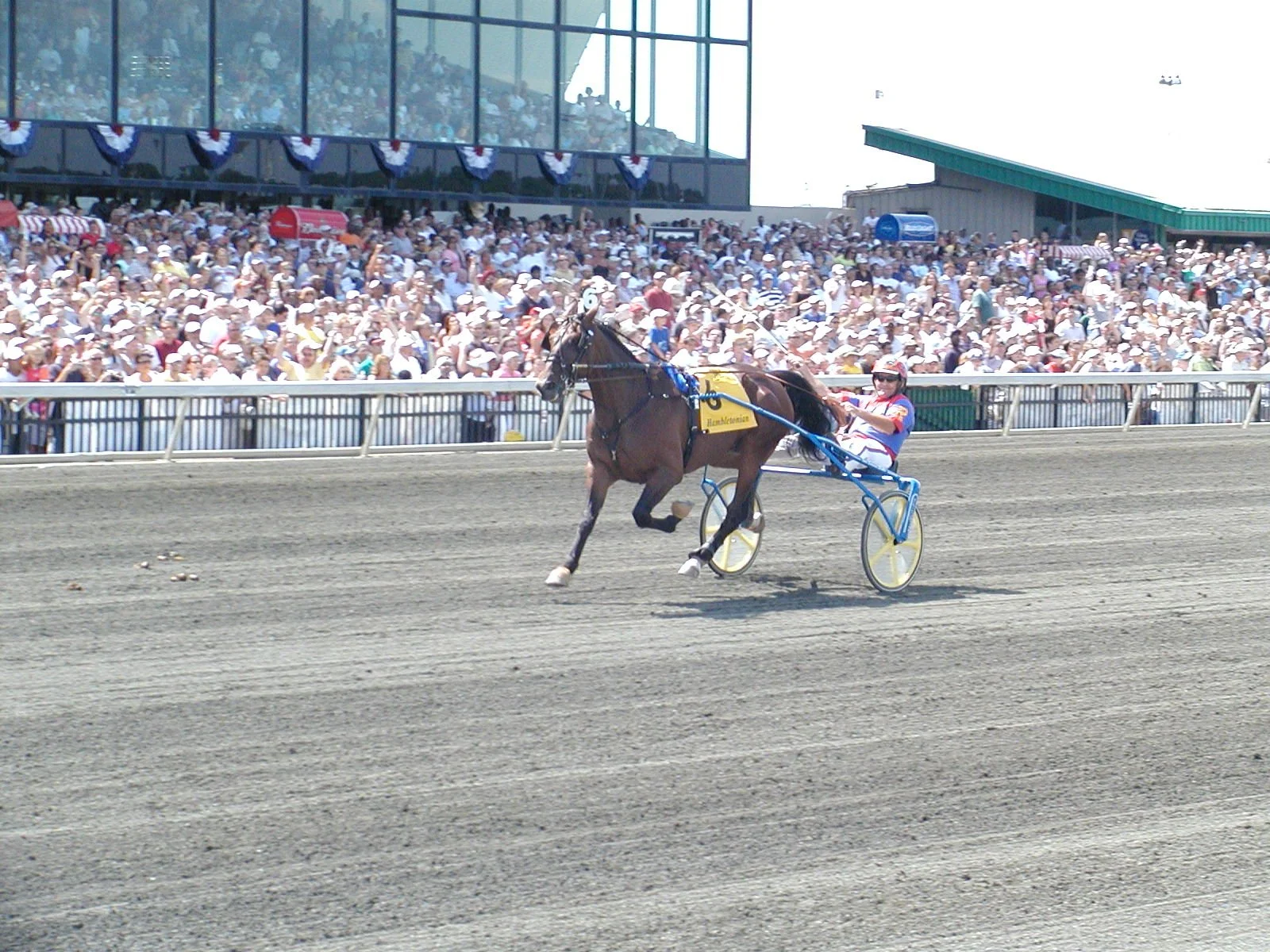
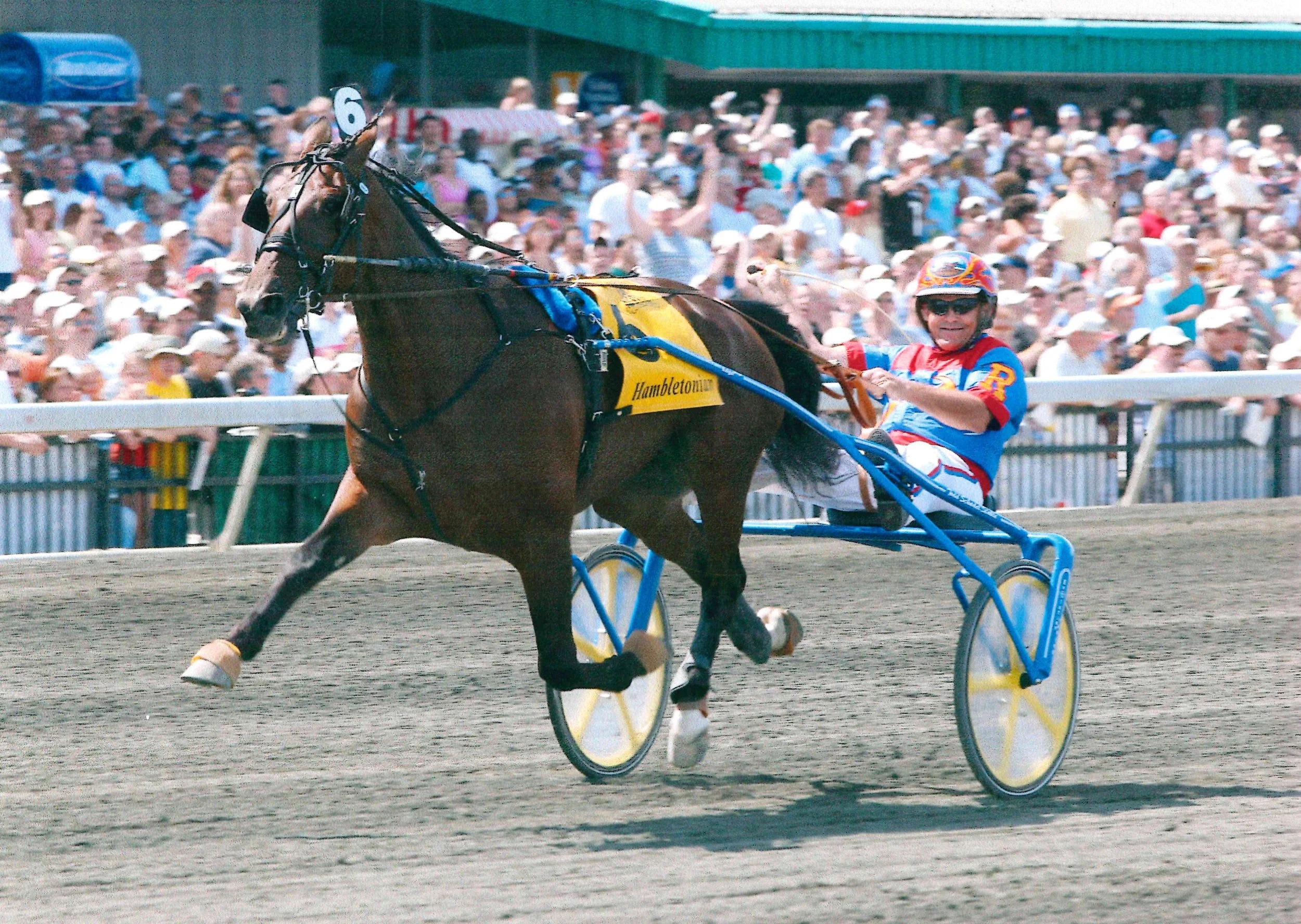
"From the Pennsylvania fairgrounds to the Hambletonian winner's circle"...so cried announcer Ken Warkentin as Roger Hammer swept under the wire with whip waving triumphantly. It was indeed a "photo" finish though the margin was three lengths. Vivid Photo and race time favorite Classic Photo finished one-two in the Hambletonian, stamping their sire, SJ's Photo as a force, and Vivid Photo as a horse to be reckoned with for the rest of the year, though he had barely spoken about in the mionths leading up to the Hambletonian. The name many expected announcer Ken Warkentin to be calling was, ironically, his own. The focus among the sophomore colt trotting group was rightfully directed on 2004 divisional Dan Patch champion the eponymous colt Ken Warkentin, who was the winter book and media favorite for the division's richest race. Yet the path for the Jimmy Takter-trained youngster contained several forks in the road. His 2005 debut was a successful one, but an ill-timed bout of sickness caused him to be scratched from the key prep race for the Hambletonian, the Stanley Dancer Trot. Instead, Classic Photo added the Dancer to his list of wins and stamped himself as the one to beat going into the Hambletonian. Meanwhile, eventual Hambletonian winner, Vivid Photo and trainer-driver Roger Hammer were on a much-less traveled path to the eliminations. hammer, known as the "King of the County Fairs" for his domination of the Pennsylvania fair curcuit, and his long-time friend and fellow horseman Todd Schadel bought Vivid Photo as a yearling for $30,000. Hammer figured they could earn at least the purchase price back on Vivid Photo since he was eligible to both Pennsylvania and Maryland sire stakes. Hammer thought Vivid Photo was a very talented two-year-old, though he had just six starts at the county fair level and ended the year with a minor stress fracture. The colt's rambunctious attitude in the stall, which Hammer was sure caused the leg injury, made the decision to geld him a proper one. Hammer also did something he rarely does and made three-year-old stake payments on the trotter. A sophomore campaign that started with a March qualifier, followed by two scratches and a seventh-place finish in a non-winners of two conditioned event did not seem likely to launch horse and river to the Hambletonian winner's circle. When Vivid Photo arrived at the Meadowlands for the Hambletonian eliminations he had a 1:54.4 world record for geldings at Pocono Downs and won six other races, ranging from a $3,100 event to a $22,000 division of the pennsylvania Sire Stakes. He drew post three in the Hambletonian elimination that also featured Ken Warkentin as the heavy favorite. It was no surprise that Vivid Photo and Hammer left hard at the start, as their past performances indicated. The surprise came when Ken Warkentin made his move and at the three-quarter pole and instead of engaging Vivid Photo in the stretch, broke into a gallop with an eighth of a mile to go. Vivid Photo went on to win by a neck in 1:53.2, while Classic Photo was flawless in the other elim, coasting to a three-length victory in 1:53.3 and declaring himself the one to beat. Classic Photo and Hall of Farmer Ron Pierce drew post five in the final and were accorded the favortie's role at 6-5. Vivid Photo drew post six and would have to leave hard to get around Classic Photo to the lead, where he was most comfortable. In fact, Vivid Photo had been on top at the half-mile pole in 10 of his 11 races that year, but Hamer had other plans for the Hambletonian. Hammer instead eased Vivid Photo off the gate, while Strong Yankee bulled his way to the top of the backstretch and led the field into the stretch. Northern Ensign elected to battle him first up, which set up perfect cover for Classic Photo to follow in a second-over trip. Tight on Classic Photo's tail lurked Vivid Photo, drafting all the way. When the trotters turned for home, Hammer floated out and easily overhauled the favorite in the stretch in a lifetime best of 1:52.3. Thought their county fair origins may have been considered humble, Hammer outdrove the best the Meadowlands had to offer.
Vivid Photo won the first Hambletonian to go for $1.5 million under the terms of a new contract with the Meadowlands. Prior to the Hambletonian elimination, Vivid Photo never raced for more than $22,077. The $750,000 winners share of the Hambletonian purse gave Hammer and Schadel some supplemental money to flesh out their gelding's skimpy stakes schedule. They paid the $25,000 supplement to race in the World Trotting Derby and the Kentucky Futurity and a $62,500 fee to supplement to the Breeders Crown. Vivid Photo closed out the year as the richest trotter of 2005 with $1,376,829 and divisional honors. Vivid Photo was the fourth winner in the last five years to make his Meadowlands debut in the Hambo elims. Others to follow the same course were Yankee Paco in 2000, Scarlet Knight in 2001 and Amigo Hall in 2003. Vivid Photo is just the fourth gelding to win. The others were Greyhound in 1935, Flirth in 1973, and Shiaway St. Pat in 1981. Sire SJ's Photo, who stands at Lindwood Farm in Greensburg, PA, was ineligible to the 1993 Hambletonian. Trained and drive by David Wade, he did earn more than $1.3 million racing through his five-year-old before retiring to a prolific international stud career. SJ's Photo produced 46 trotting colts in 2003; nine were kept eligible to the Hambletonian and three made the final. His sons Vivid Photo and Classic Photo finished 1-2 in the Hambletonian. Both SJ's Photo and 1998 Hambletonian winner Muscles Yankee were represented by three offspring in the final. Muscles Yankee sired the most expensive yearling, Muscle Bound ($175,000), and the least expensive, Muscle Memory ($17,000). Hammer's last appearance at the Meadowlands prior to the 2005 Hambletonian elims was 11 years prior, when he finished fifth in teh Hambletonian Oaks with Keystone Colorful. Vivid Photo gave Hammer his biggest career win at age 59. Prior to 2005, his best year was 1994, when he tallied $1.3 million topped by multiple stakes winner pacing colt Keystone Luther. Hammer was voted 2005 W.R. Haughton Memorial Good Guy Award by members of the U.S. Harness Writers Association. Hammer exemplified that role to the hilt in 2005, parading Vivid Photo before the crowd at the Little Brown Jug, and many other venues. First-time Hambletonian winning breeder credits go to Joe and Joanne Thomson's Winback Farm of Pennsylvania. They bred, raised and sold the 2003 and 2004 Horse of the Year honorees. No Pan Intended and Rainbow Blue, in addition to divisional and Hambletonian champion Vivid Photo. The dam of Vivid Photo is Miss Garland 5, 2:00f ($91,356). She had produced a hard-knocking daughter by Giant Hit that annexed $154,000 as her blackest type until Vivid Photo came along. His accomplishments won her Dan Patch honors as Trotting Broodmare of the Year. The 2001 breeding to SJ's Photo awakened a blue-blooded pedigree that lay dormat for 50 years - Vivid Photo's sixth dam, Selka Song, a sister to the dam of Triple Crown winner Speedy Scot. The crowd of 31,245 at the Meadowlands was the highest since 1990 and marked the fifth straight year that the attendance increased on Hambletonian Day. On-track handle was $3,398,009, the best since 1994. The total Hambletonian Day handle of $9,015,019 was the highest ever at the Meadowlands and set a North American harness racing record.
Media
Champions | 2000-2009
-
![]()
Yankee Paco
-
![]()
Scarlet Knight
-
![]()
Chip Chip Hooray
-
![]()
Amigo Hall
-
![]()
Windsong's Legacy
-
![]()
Vivid Photo
-
![]()
Glidemaster
-
![]()
Donato Hanover
-
![]()
Deweycheatumnhowe
-
![]()
Muscle Hill
Sailing to Hambletonian glory
August 5, 2006
East Rutherford, NJ
The MeadowLands
Purse $1,500,000
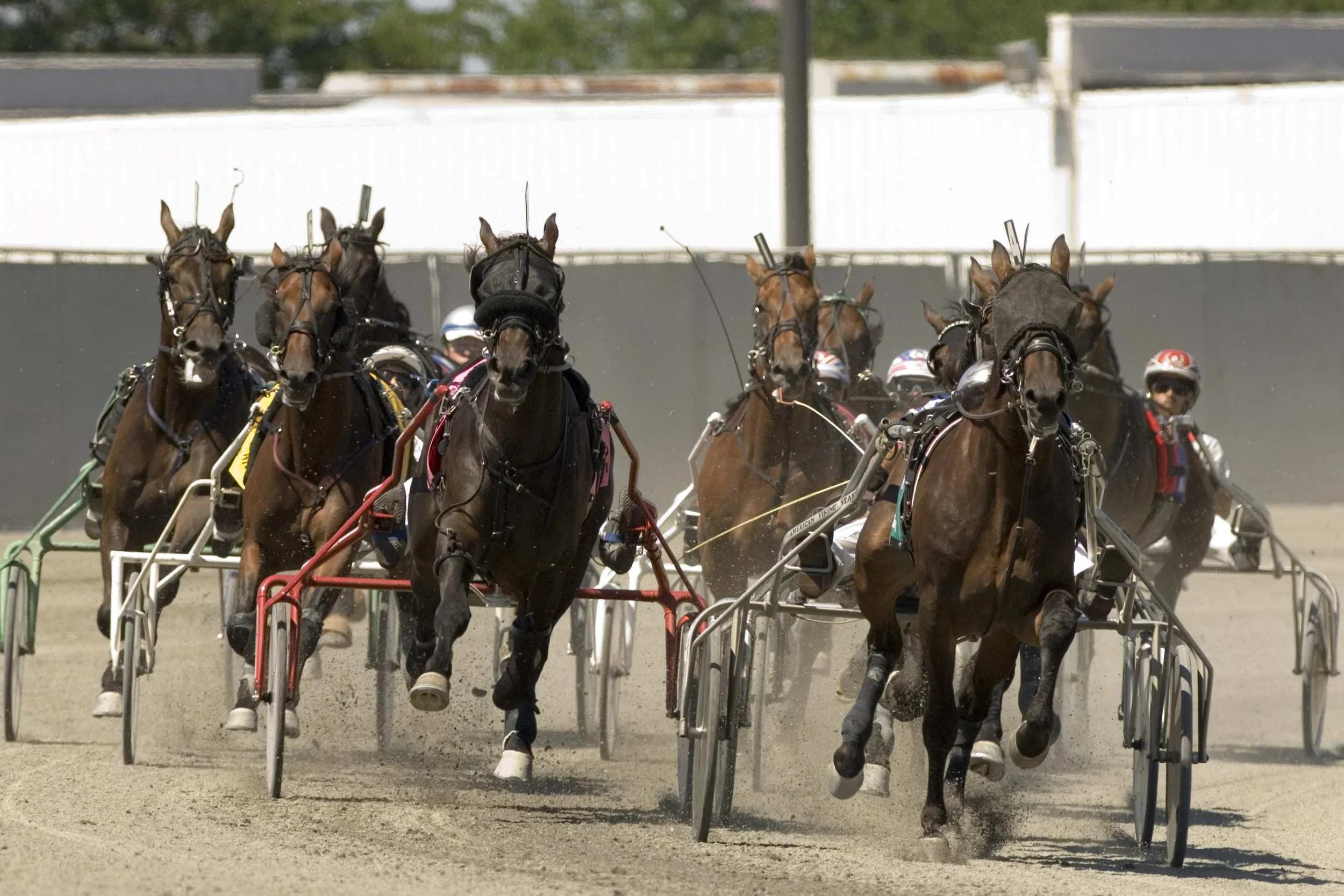
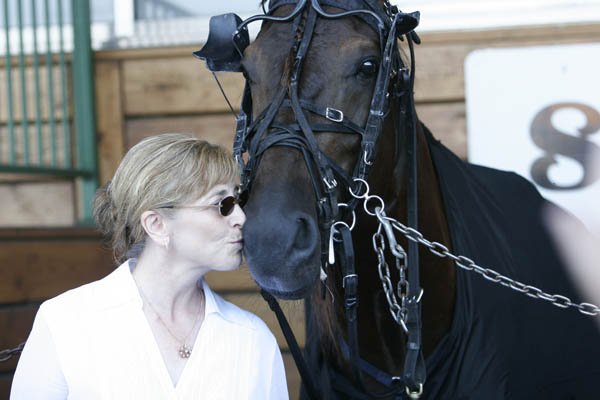
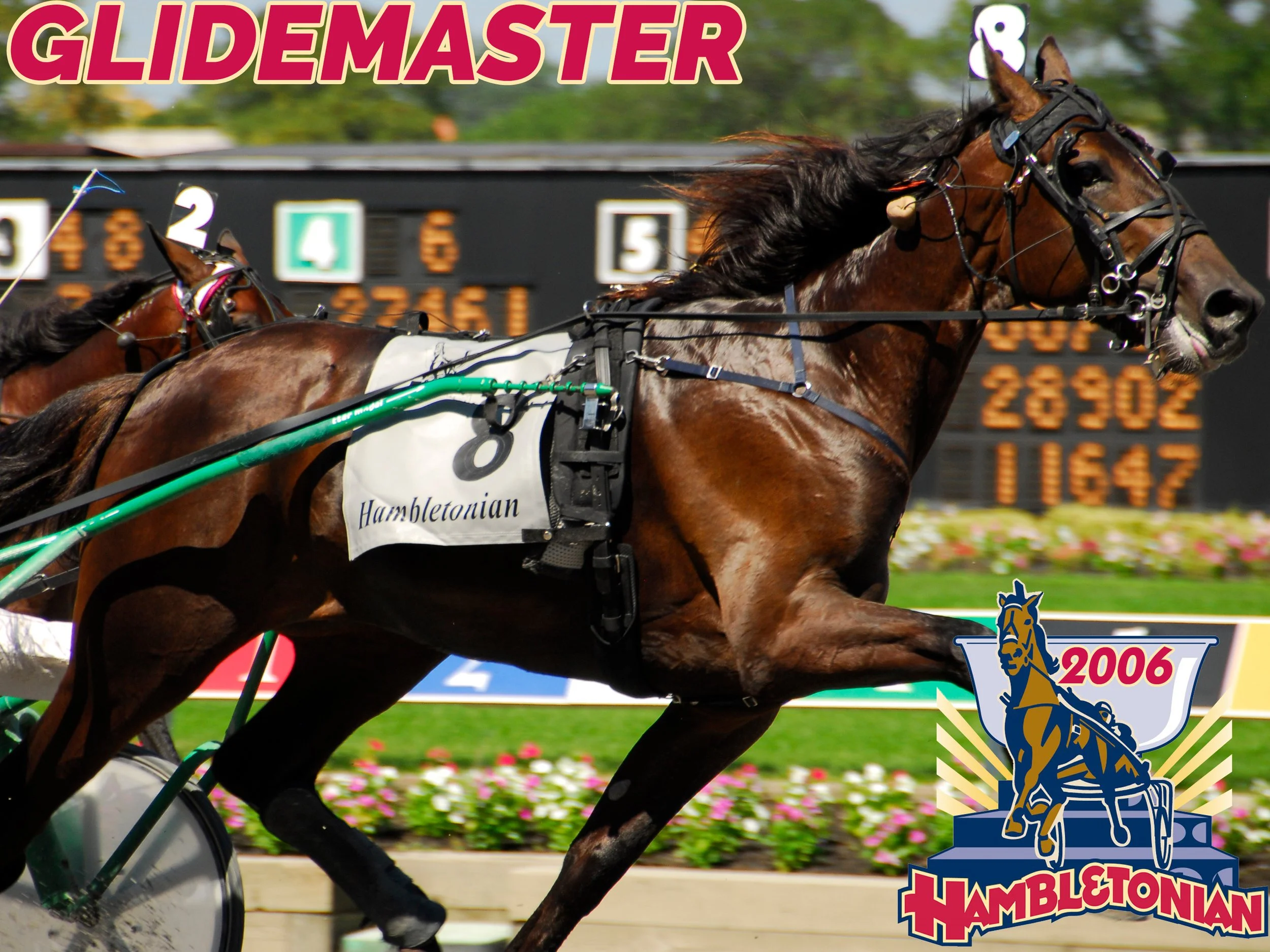
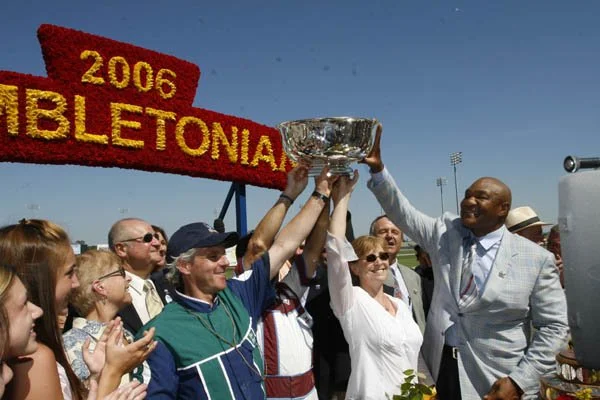
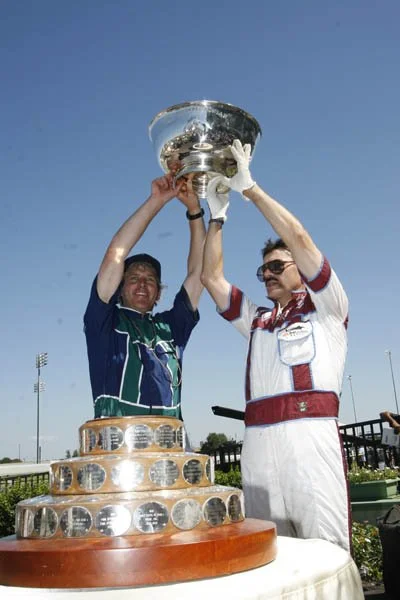
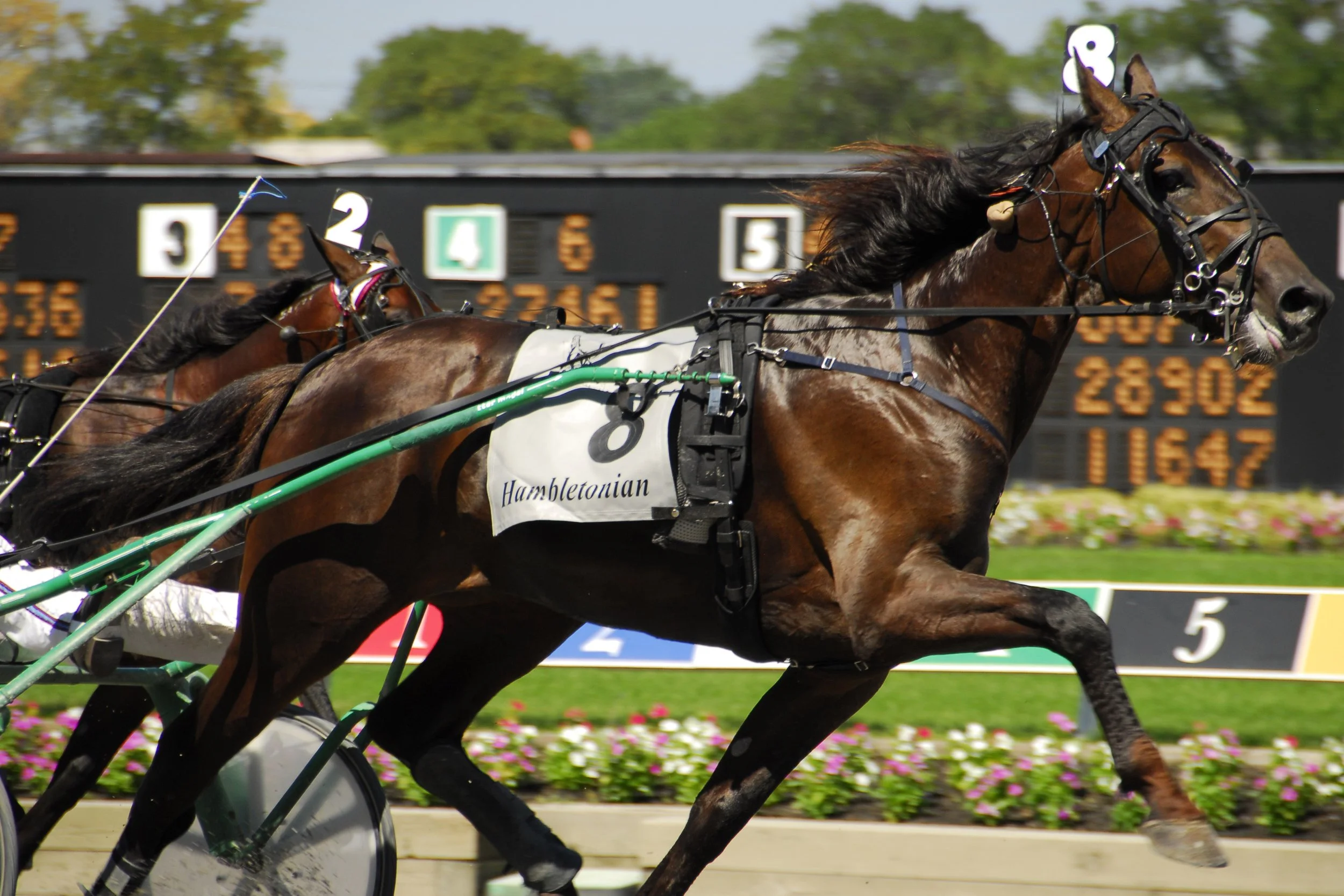
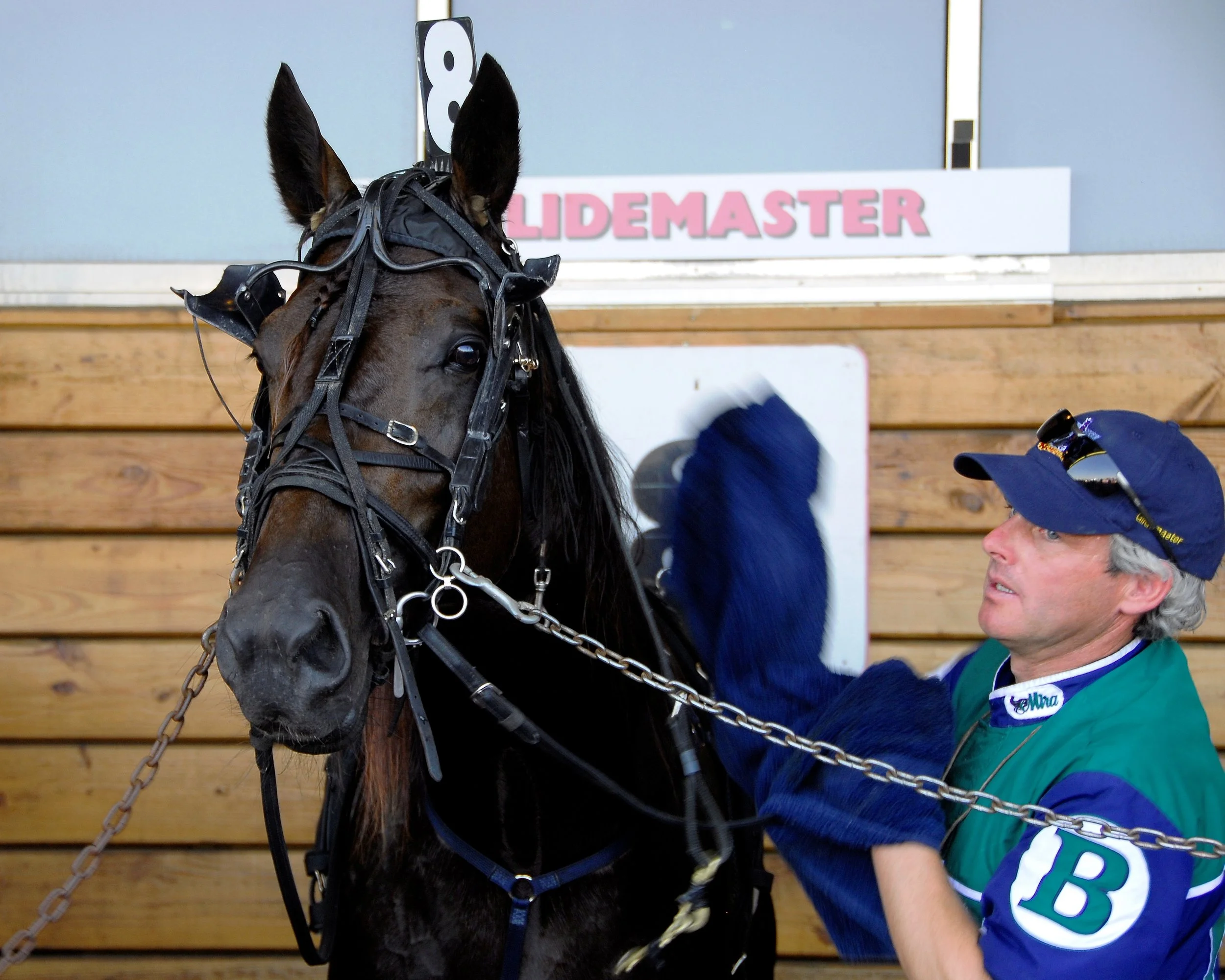
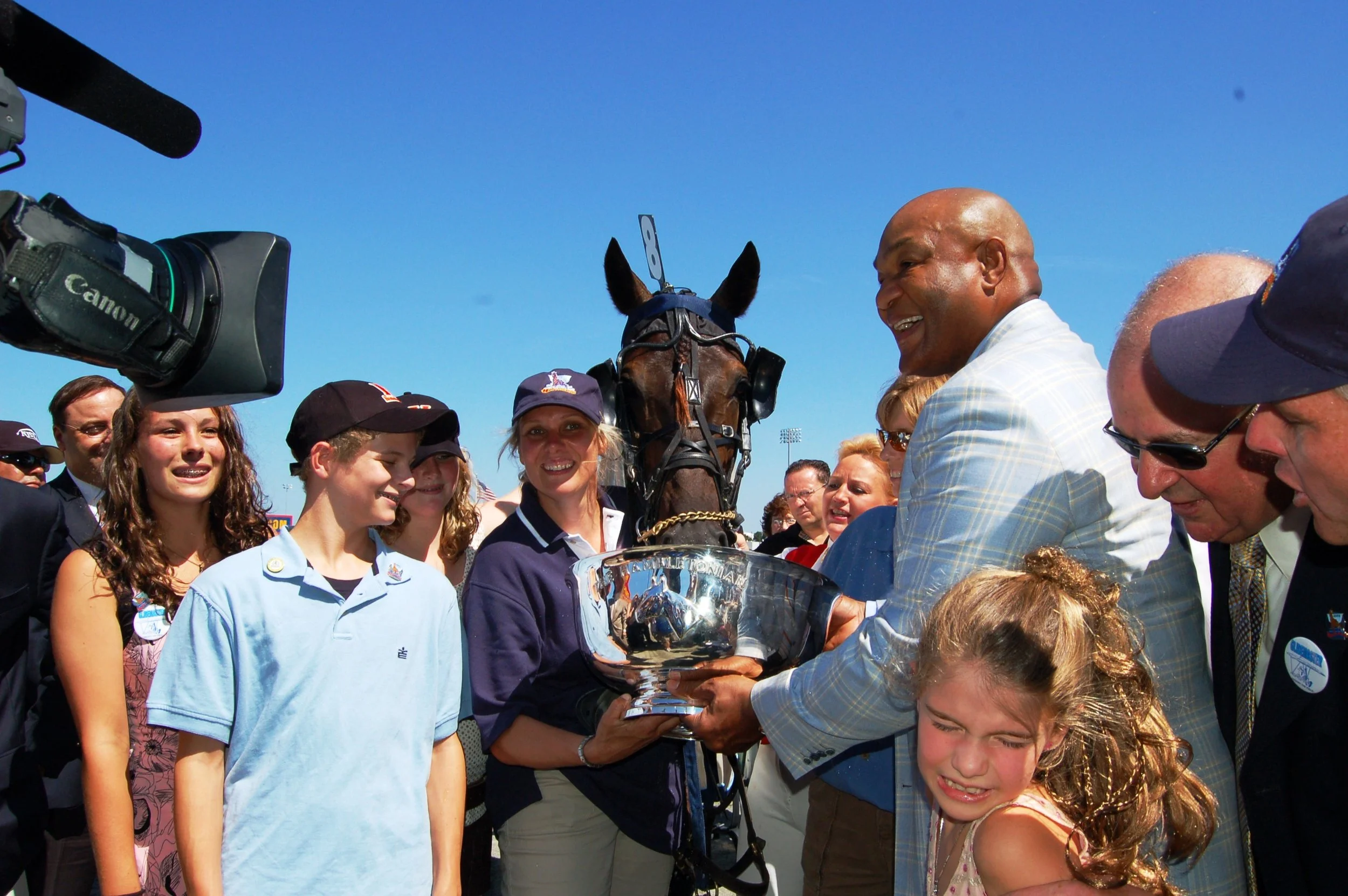
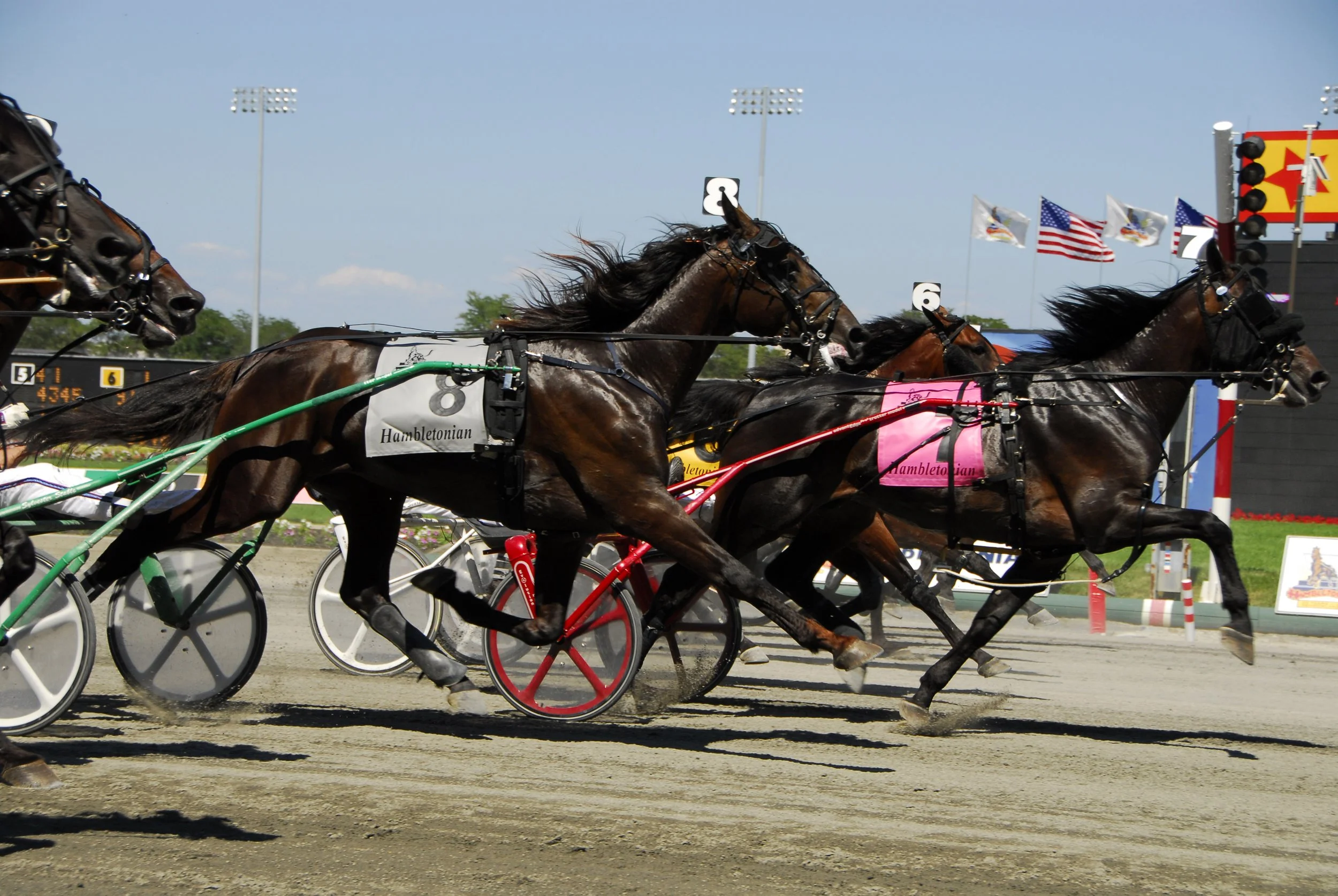
Just days before the Hambletonian eliminations, Glidemaster pulled a horseshoe loose in the stall, then stepped on a nail which punctured the outer rim of his hoof. Round-the-clock care administered by his caretaker and co-owner Karin Olsson-Burgess delivered a horse sound enough to race in the eliminations. Glidemaster finished second to Mr. Pine Chip in their elim, and was even stronger by the final.
· Trainer Blair Burgess deserves enormous credit for bringing a mannered and manageable trotter back to the races at three, a real challenge after the colt, as a two-year-old had shown aggressive tendencies, even running away with his driver at one point in a stakes race in Lexington after a gate mishap. The Burgess family operation spent a lot of time channeling the colt’s energy in the right direction and he returned a real contender at three.
· The Glidemaster ownership is similar to a cell phone calling plan in that it is a friends-and-family network. Blair Burgess bought Glidemaster as a yearling for $10,000 on the opening night of the 2004 Tattersalls sale, and raced him as a two-year-old for an ownership that included his father, Bob, his wife Karin, and friend Marsha Cohen, who had gone partners with the Burgesses for several years on assorted horses. In September of 2005 after Glidemaster had won three of four freshman starts, an interest in the horse was sold to his breeder, George Segal’s Brittany Farms
· It was Marsha Cohen’s first start and first win in the Hambletonian. Brittany Farms picked up their second owners trophy as Segal was part of the Self Possessed Stable in 1999. Karin and her father-in-law Bob, were co-owners on their only other Hambletonian entrant 2003 winner Amigo Hall, in partnership with Walnut Hall Ltd.
· Glidemaster was only the fifth Canadian-owned horse to win the Hambletonian in 83 years, and the Burgess’s account for two of the last three since 1998, with Yankee Paco being the third
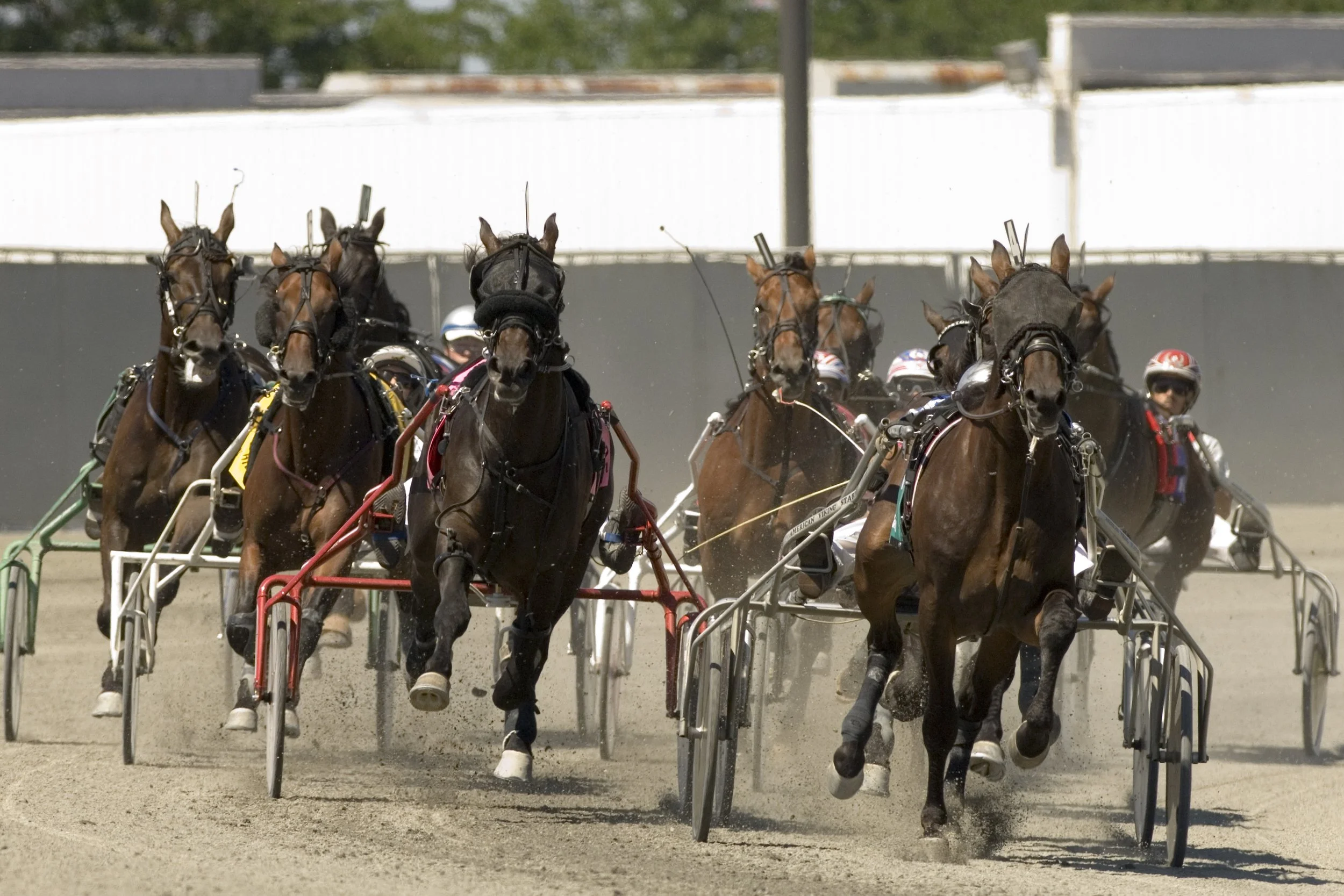
· Glidemaster gave Brittany Farms a third breeders credit. The Versailles, Kentucky, nursery also turned out 1996 winner Continentalvictory (1:52.1) and 1999 victor Self Possessed (1:51.3). Brittany-breds have owned the stake record in the Hambletonian for a decade. Glidemaster lowered the standard to 1:51.1. It would remain the fastest mile of his racing career.
· Brittany Farms became the first breeder to produce a Hambletonian (Glidemaster) and Oaks (Passionate Glide) winner in the same year; George Segal also owned both trotters. Segal had a phenomenal year by any yardstick, with big wins on both the trotting and pacing side. Horses he owned in whole or in part racked up more than $5 million in purses for the year.
· The 2006 Hambletonian was Blair Burgess’s fourth $1 million victory. He was favored in none of the events he won previously: the 1987 Meadowlands Pace (Frugal Gourmet); 2001 Meadowlands Pace (Real Desire); 2003 Hambletonian (Amigo Hall).
· Burgess and Chuck Sylvester are the only two trainers to win both the Hambletonian and the Meadowlands Pace in their career. Burgess is the ONLY trainer to have won it twice.
· Glidemaster was trainer Blair Burgess’ second entrant in the Hambletonian. His first, Amigo Hall, was the longest-priced winner in history, going off at 27-1. Burgess has twice played spoiler to trainer Trond Smedshammer's Hambletonian hopes. In 2003 it was Smedshammer’s heavily favored Power To Charm who fell to the Burgess-trained Amigo Hall. Though Smedshammer won in 2004 with Windsong’s Legacy, his three horse uncoupled entry in the Hambo, with Mr. Pine Chip the overwhelming favorite, finished third, sixth and tenth respectively. The same trio had finished 1-2-3 in the Stanley Dancer Memorial, the final prep to the Hambo.
· John Campbell, at the age of 51, won his sixth Hambletonian trophy, the most of any driver in the history of the event. It was his 22nd victory in a million-dollar race. No other driver comes close to that number. His record setting fifth Hambletonian was in 1998 with Muscles Yankee. On Hambo day, more than $3.8 million was distributed. John Campbell accounted for nearly one-quarter of all the purse money offered that day.
· Campbell suffered a near career-ending injury in 2003 and was not back in the sulky full time till 2005. His numbers that year were not inspiring, but in 2006 he silenced all questions about his driving abilities. Ironically, another driving accident in October would sideline him for several months.
· Year-end awards were showered on this group by the US Harness Writers. Glidemaster was voted HTA Nova three-year-old trotter of the year, Dan Patch 3-year-old trotter, Trotter of the Year and Horse of the Year. John Campbell was voted Driver of the Year, and George Segal was voted Norman Woolworth Owner of the Year. Dam Cressida Hanover won Trotting Broodmare of the Year. · Glidemaster’s sire, Yankee Glide , picked up his first Hambletonian credit. The son of Valley Victory won one of three Hambletonian eliminations in 1997 but broke stride in the final and finished tenth in the event won by Malabar Man.
· Yankee Glide also sired the Oaks winner, Passionate Glide. All told Yankee Glide offspring earned $1,365,000 on the day. Only two other times has the same sire claimed the winners of both races: Speedy Somolli in 1992 with Alf Palema and Worldly Woman; and Super Bowl in 1991 with Giant Victory and Jean Bi. · The Meadowlands has been home to the Hambletonian for 26 straight years, matching Goshen’s record of the longest any track has hosted the classic race. Prior to 1981, the Hambletonian was held at DuQuoin for 24 years.
· The attendance of 29,531 was a meet-high record. The world-wide handle on the day was more than $8 million for the 15-race program, third highest all-time.
· The 2005 Dan Patch champion, Chocolatier, finished second, from post 10.
· Cressida Hanover, the dam of Glidemaster was a $13,000 purchase by Ron Gurfein for George Segal, but the daughter of Mr. Lavec -Cristi Hanover raced just nine times in her life for a pedestrian $936 in earnings. In fact, the first four dams on his maternal side earned a grand total of $1,048! Glidemaster was her first foal. Despite her ignominious beginnings, Cressida Hanover was voted Trotting Broodmare of the Year by the US Harness Writers.
· Campbell drove Glidemaster to victory in his Breeders Crown elimination and then suffered a broken leg in an horrific accident four races later. Glidemaster, driven by George Brennan, lost the Breeders Crown to Majestic Son.
· Glidemaster would get his Crown a month later at Yonkers when Glidemaster became just the eighth trotter in history to capture Trotting’s Triple Crown of the Hambletonian, Kentucky Futurity and Yonkers Trot.
· He was the first trotter since 1972 to win the Triple Crown over the traditional format of two mile tracks and a half mile oval of Yonkers. Windsong’s Legacy’s Triple Crown included the replacement of Hawthorne, IL, mile track while Yonkers was closed for renovations. · Glidemaster surpassed Windsong's Legacy's 2004 single season money-earnings mark of $1,713,806, ending his year with $1,918,701, the largest amount ever won by a trotter in a single North American campaign. He was never worse than second, winning eight of 15 starts and placing second behind the only trotter to consistently beat him Majestic Son, who took top honors in Canada as O’Brien Horse of the Year. · He was retired at the close of his sophomore campaign to stand at Walnridge Farm of Pennsylvania.


Media
Champions | 2000-2009
-
![]()
Yankee Paco
-
![]()
Scarlet Knight
-
![]()
Chip Chip Hooray
-
![]()
Amigo Hall
-
![]()
Windsong's Legacy
-
![]()
Vivid Photo
-
![]()
Glidemaster
-
![]()
Donato Hanover
-
![]()
Deweycheatumnhowe
-
![]()
Muscle Hill
The hanover Dynasty
August 4, 2007
East Rutherford, NJ
The MeadowLands
Purse $1,500,000
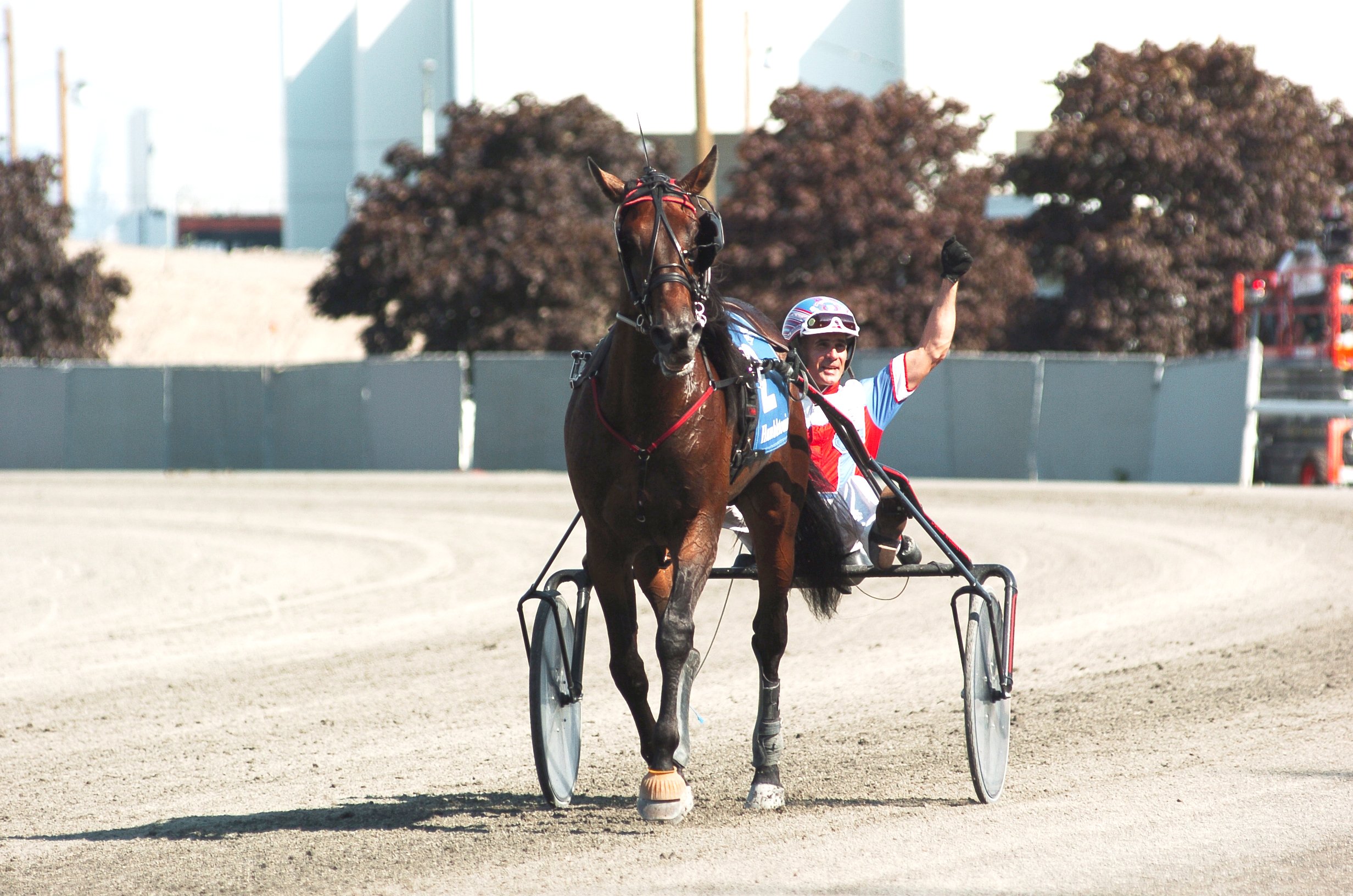
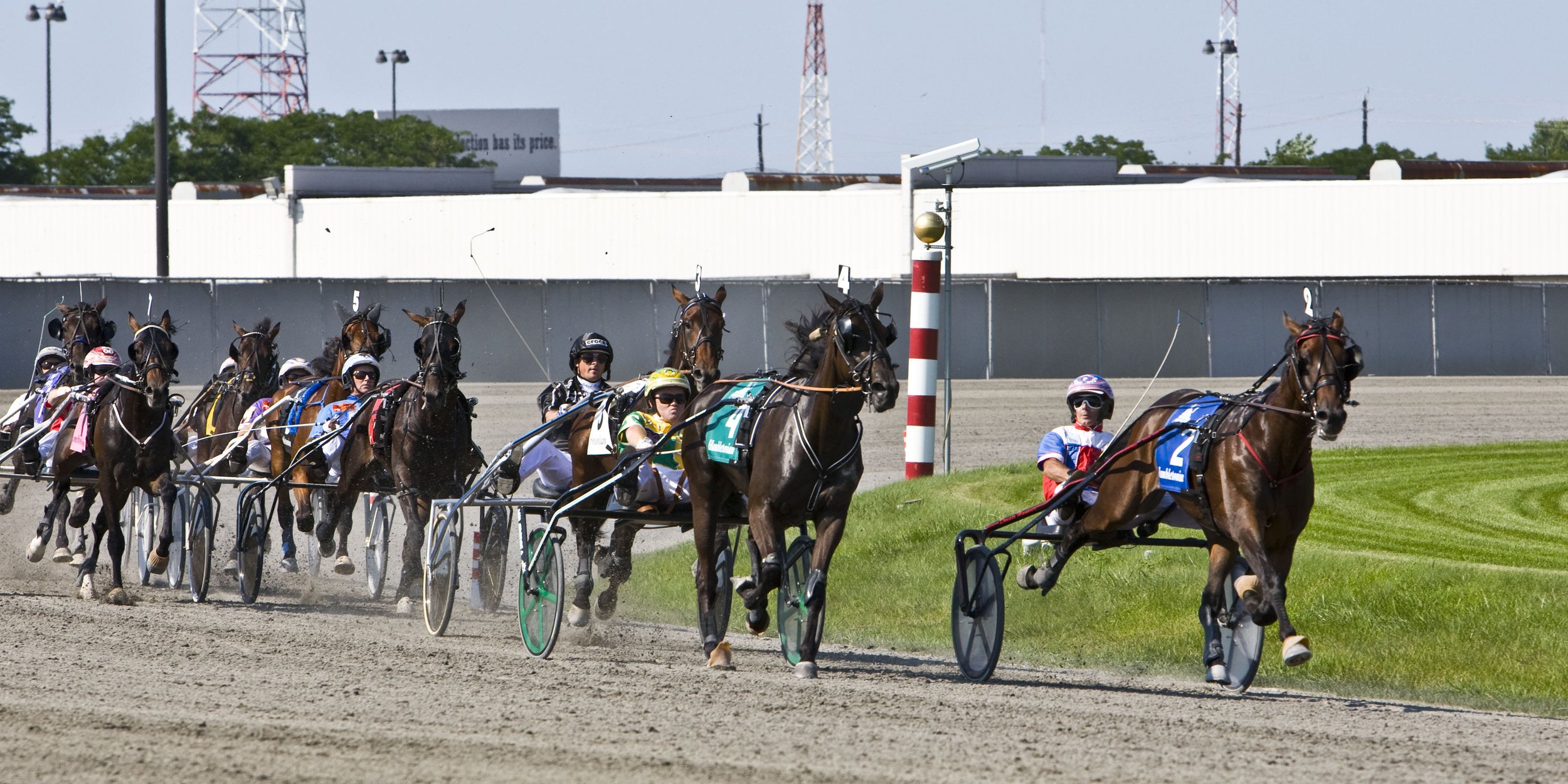
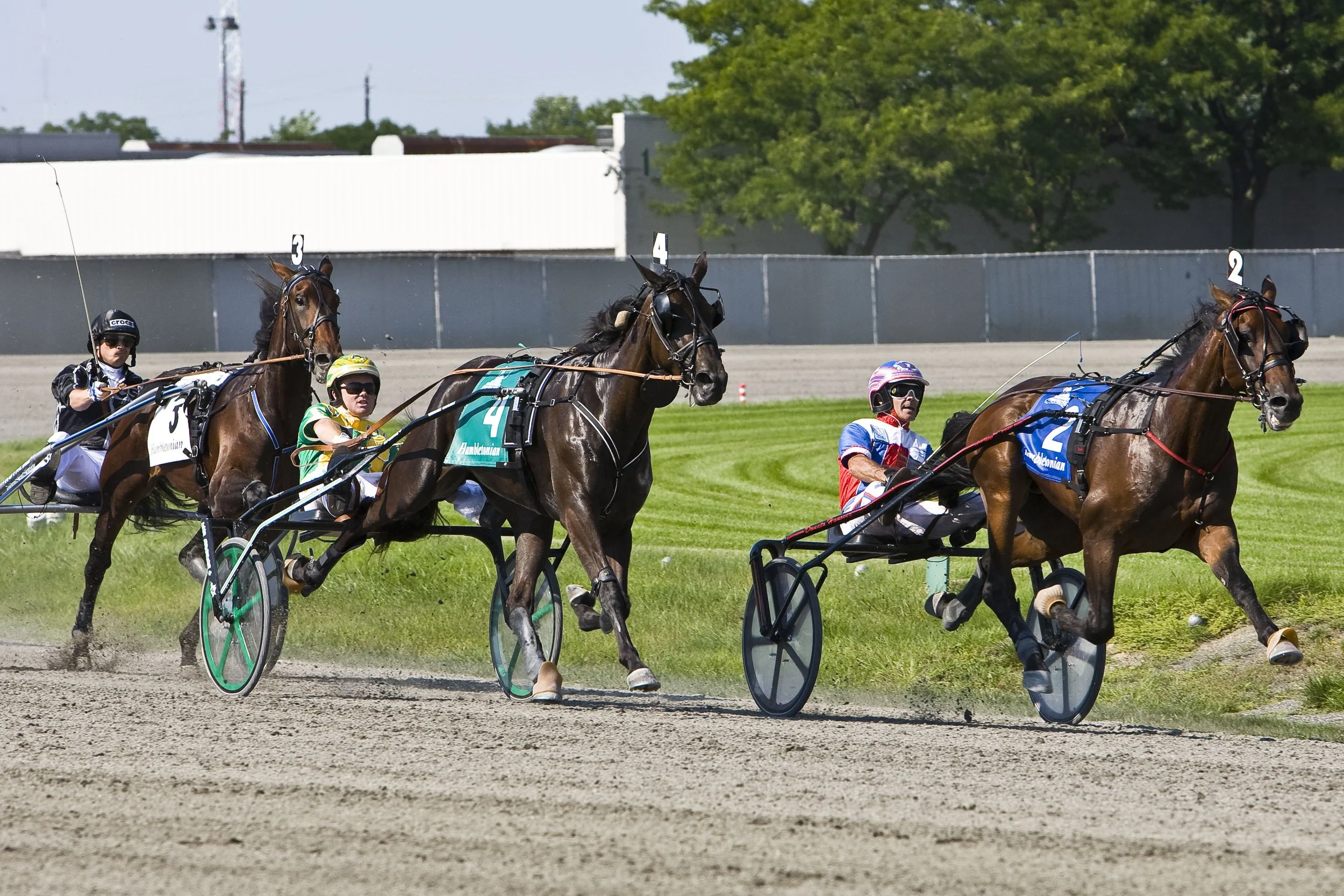
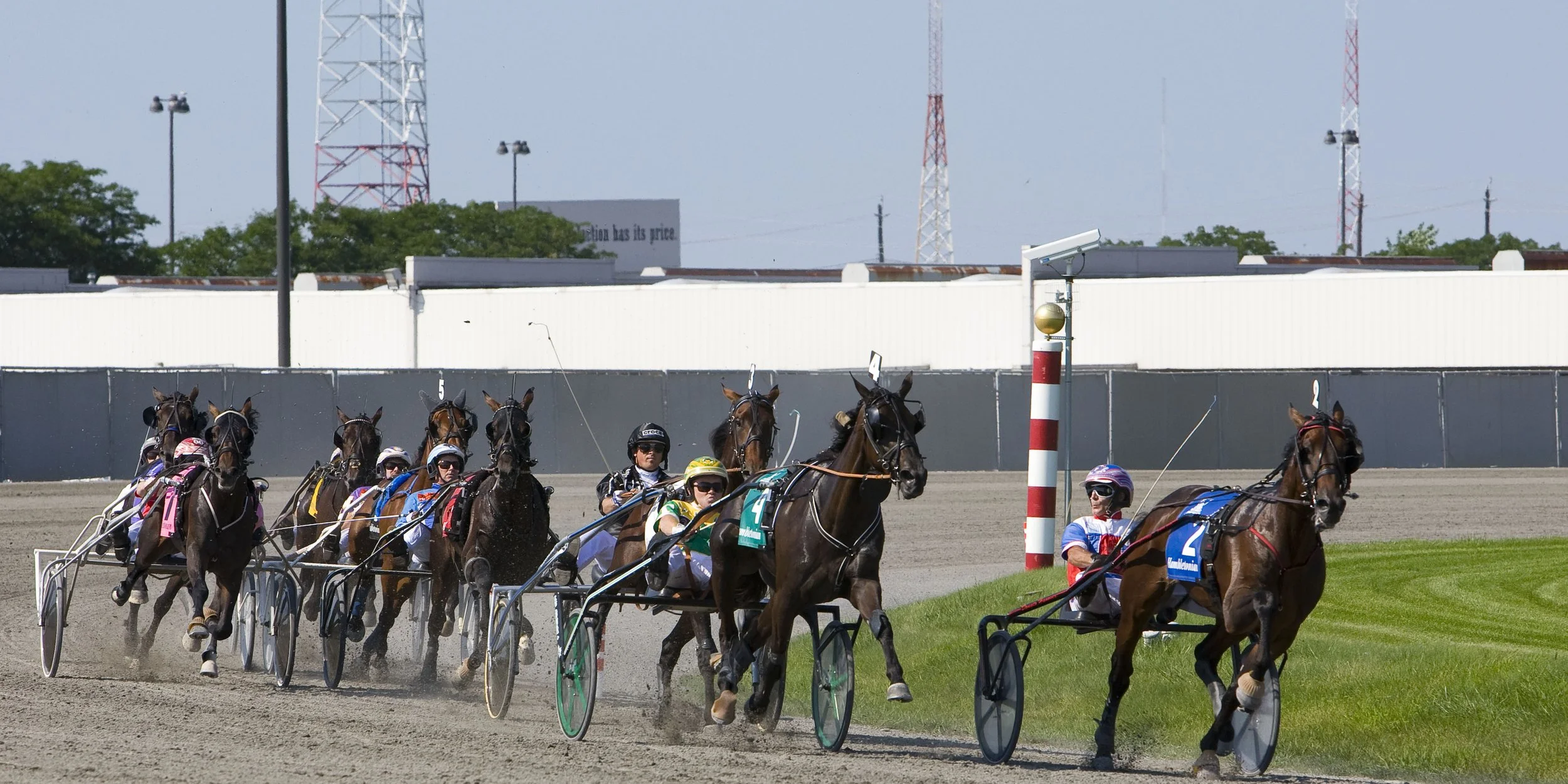
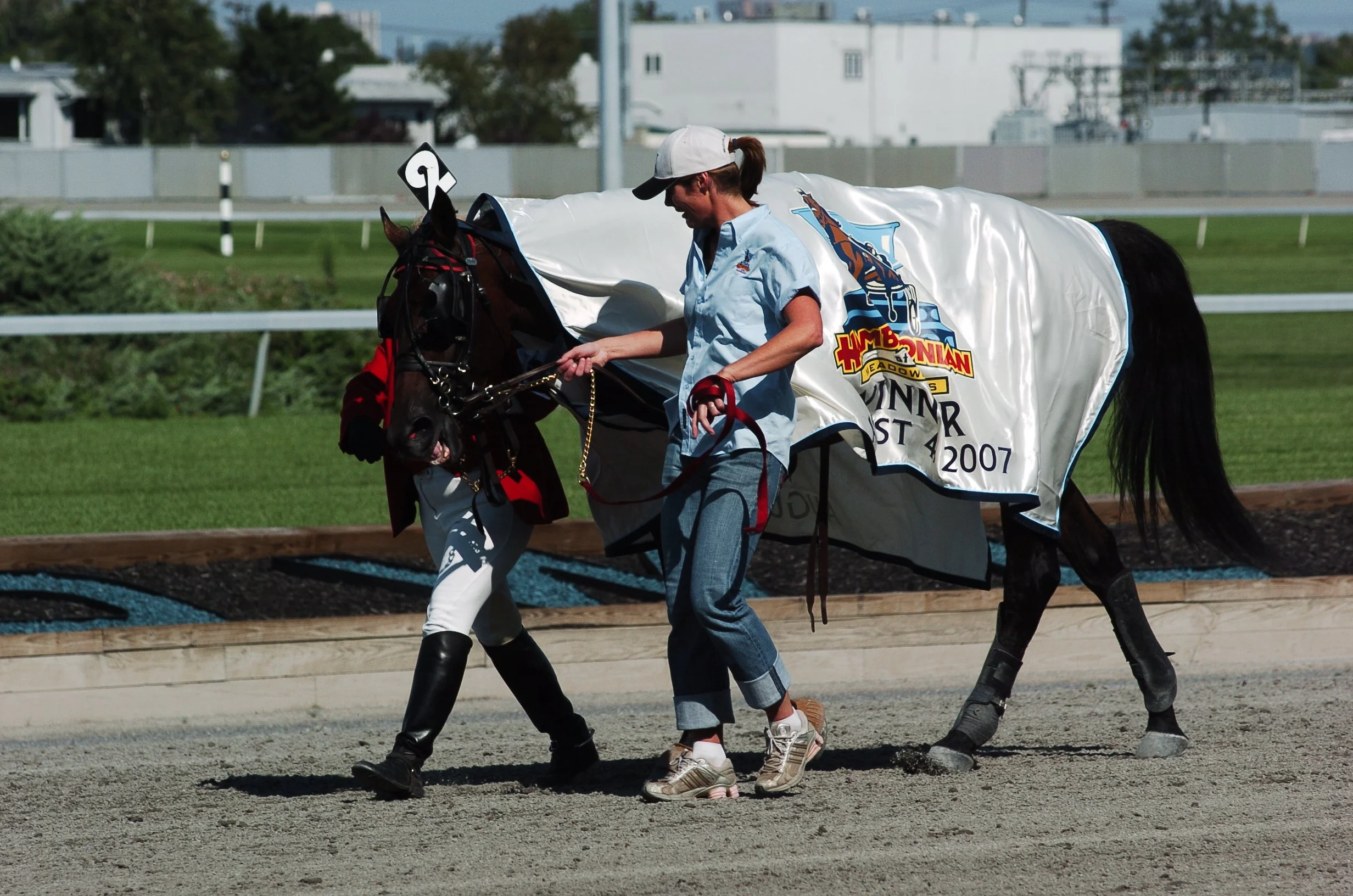
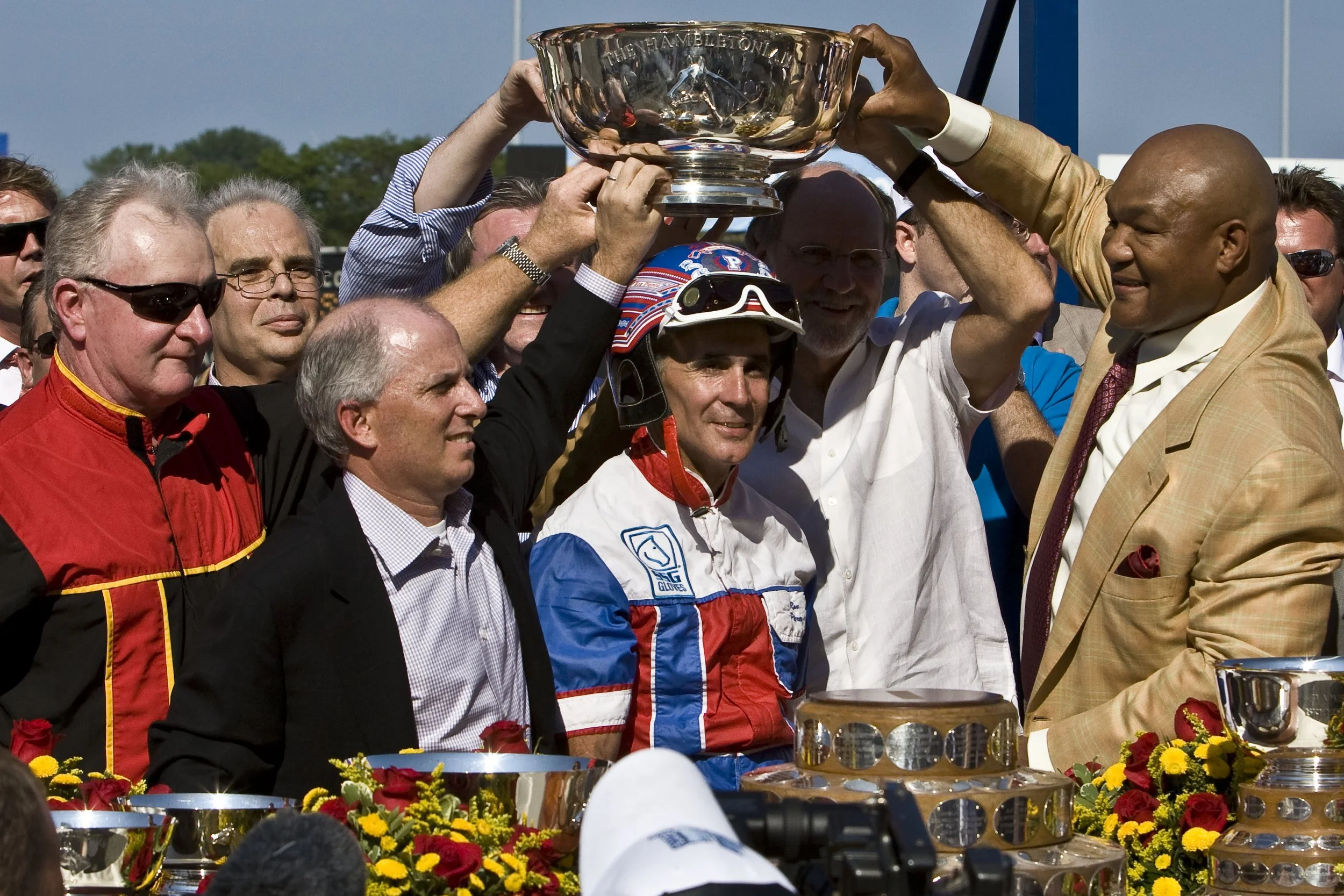
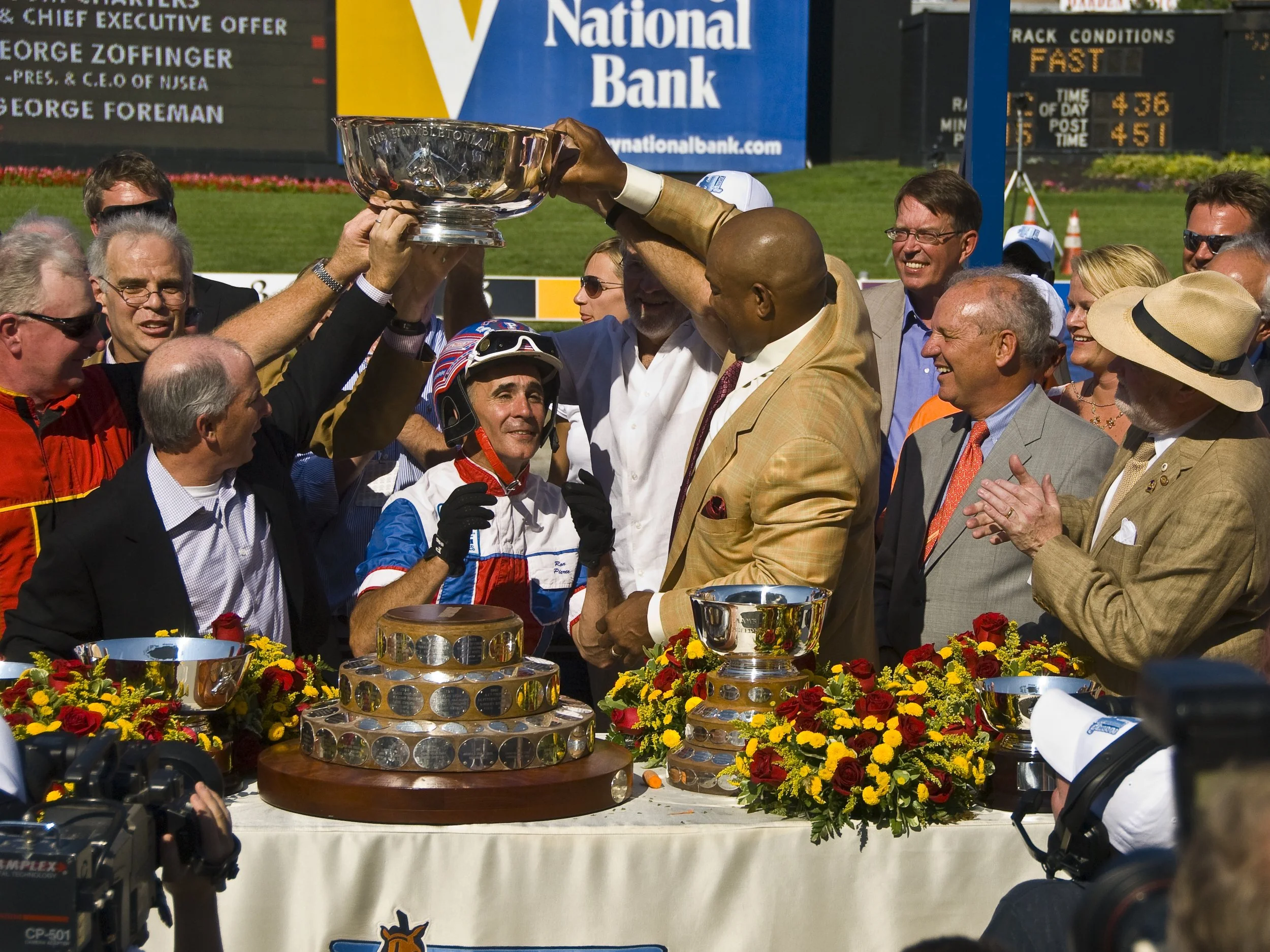
The dynasty that Hanover Shoe Farms visionary Lawrence Baker Sheppard seeded in 1922 remains the pinnacle of standardbred breeding and racing some 85 years later. Though the Hanover surname dominates harness racing record books, perhaps no stat is as impressive as the legendary “Shoe” Farms record as the breeder of 10 Hambletonian winners.
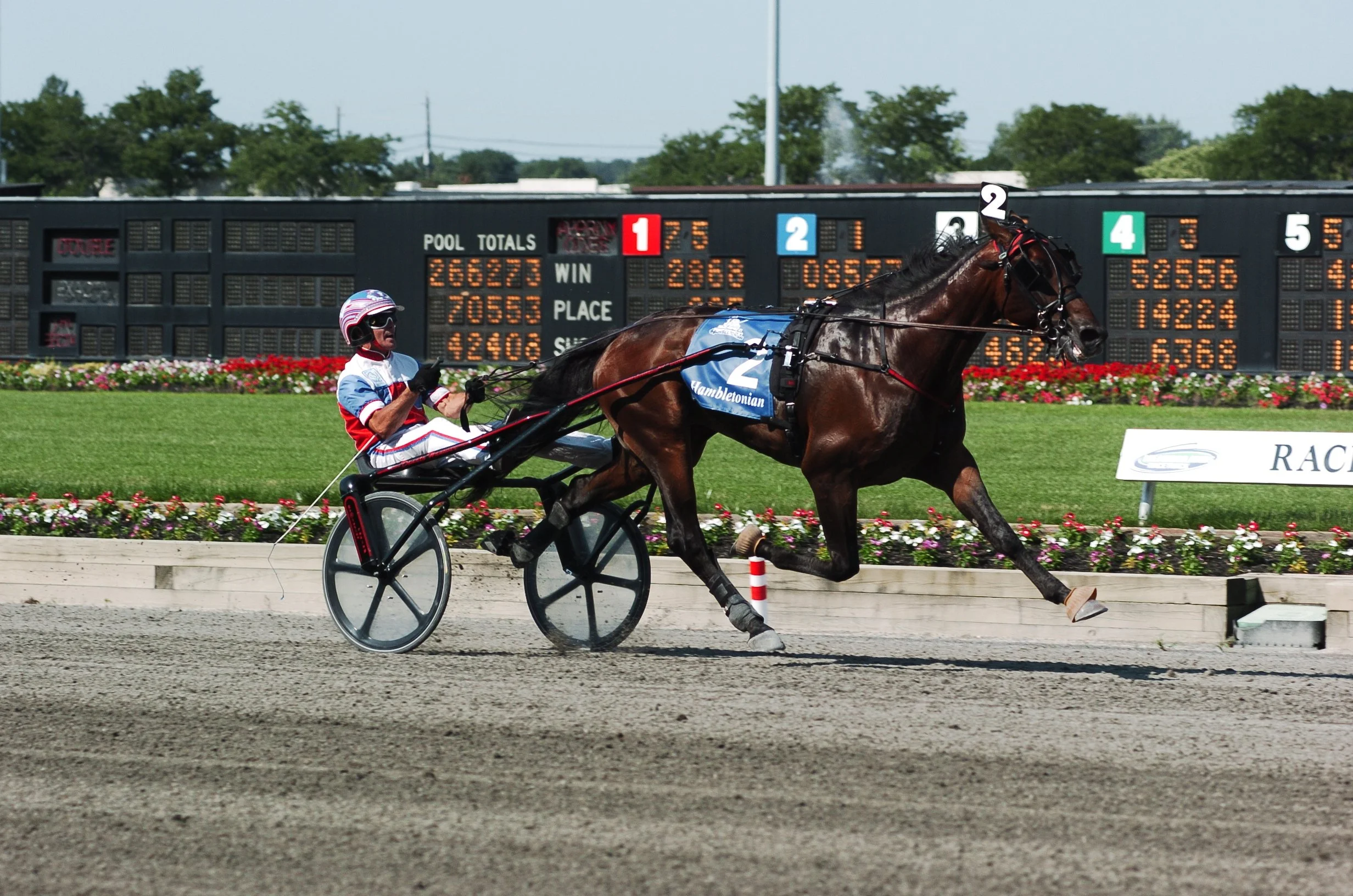
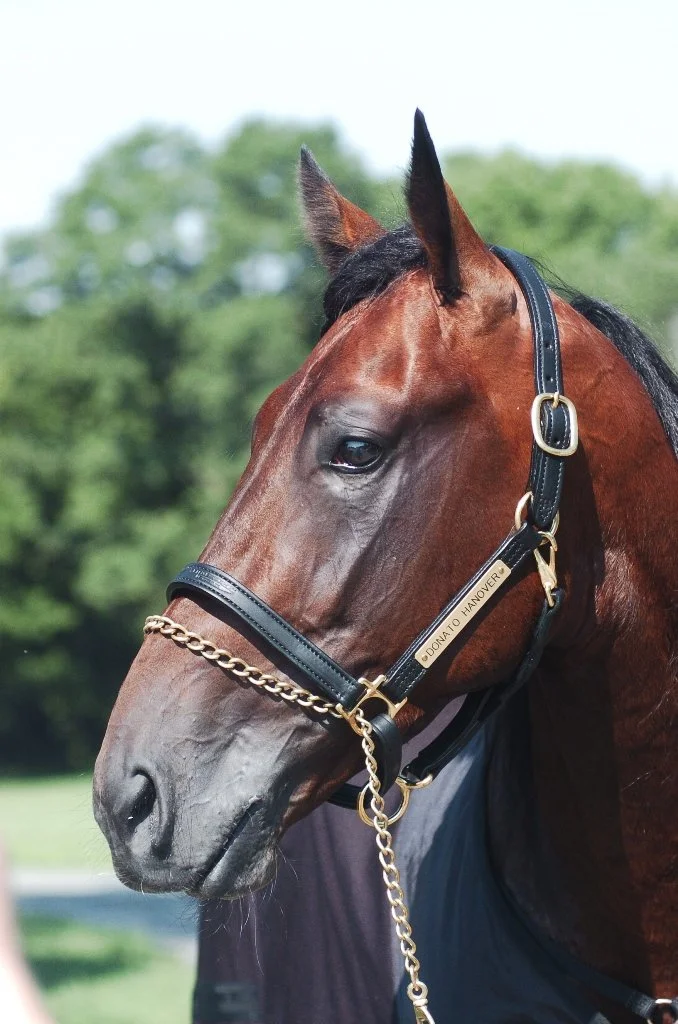
Never was there more at stake for the world-renowned farm and its syndication partners than when Donato Hanover went to the gate in the 82nd edition of the Hambletonian at The Meadowlands.
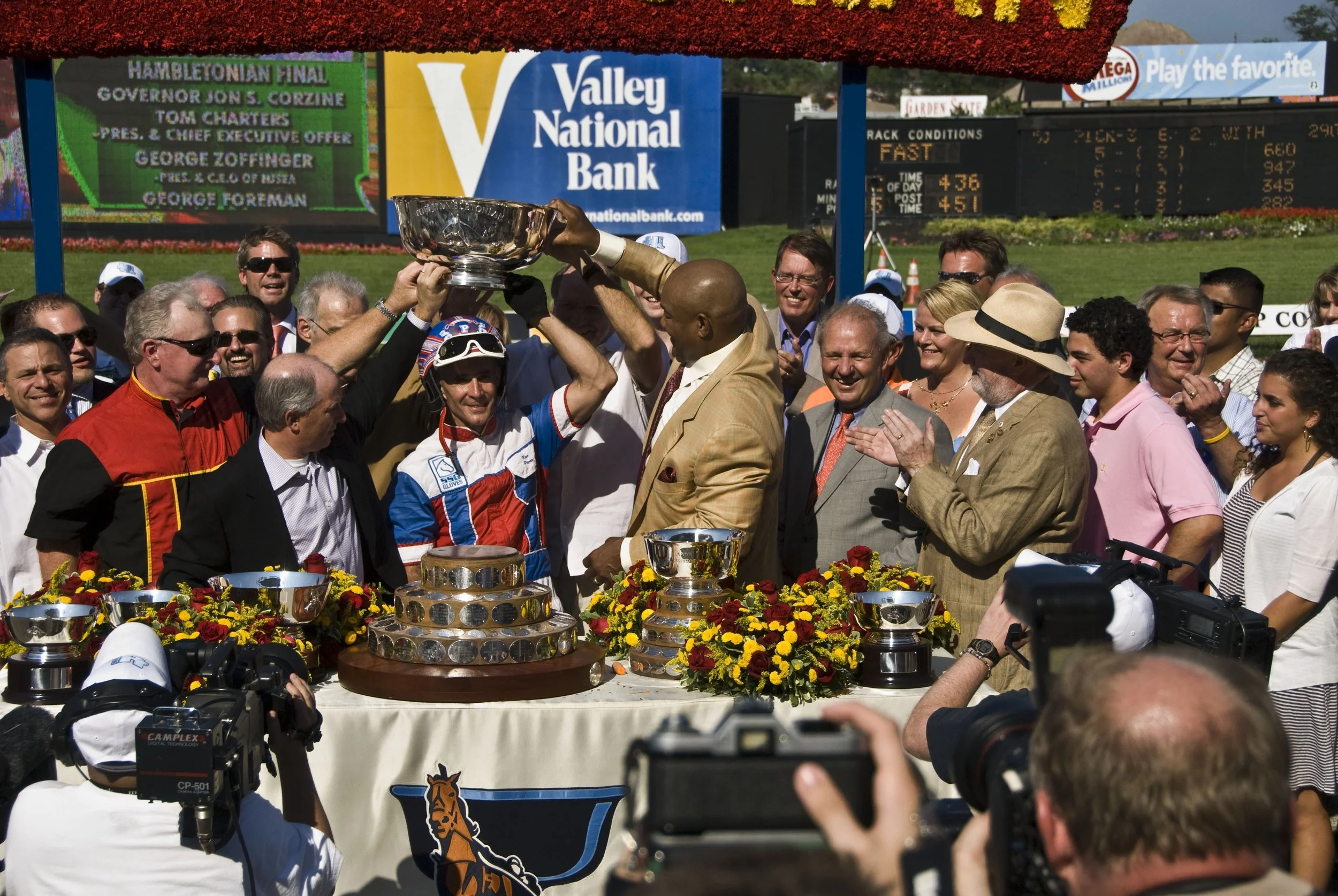
The decision to syndicate the precocious two-year-old in 2006 was the first time in the history of Hanover Shoe Farm that the farm management was directly involved with a Hambletonian champion prior to the horse actually contesting the race. The 120 shares in the $6 million syndication agreement, sold out quickly to 22 of the sport’s most prominent individuals and breeding farms as Donato Hanover ended his two-year-old campaign with a Breeders Crown victory that culminated in a Dan Patch year-end honors.
“Syndicating a two-year-old is a very dangerous business decision,” Hanover Shoe Farm President Jim Simpson said. “He had to have been a very special horse for us and the others to invest. Time will only tell if this was a solid investment. But he held up his end of the bargain as a true champion.”
The syndicate leased Donato Hanover back to the original owners, long-time partners David Scharf, Paul Bordogna and Steve Arnold, with the agreement that Donato Hanover would return to the Pennsylvania nursery for stallion duties at a fee of $20,000 at the conclusion of his sophomore campaign.
The dominant Donato was trained by Steve Elliott, and drew unavoidable comparisons to another Elliott trainee, Valley Victory. The great Valley Victory recorded a career remarkably parallel to that of Donato Hanover -- until the week of the 1989 Hambletonian when the heralded trotter nearly died from an illness that prevented him from racing in the Hambletonian or ever again.
Nineteen years later Elliott was back on the Hambletonian trail. He kept Donato Hanover on familiar ground in the lead-up to the $1.7 million Hambletonian, easily annexing the Historic Dickerson Cup and the Stanley Dancer Memorial elimination and final. Another eerie coincidence to the 1989 Hambletonian emerged. That year’s event was billed as a battle of the sexes – Valley Victory vs. the great filly Peace Corps. When Valley Victory wasn’t entered and Peace Corps [who carried a 17-race win streak into the race] failed to fire and finished fifth and second in the preliminary heats, the result was an epic stretch battle between Park Avenue Joe and Probe that ended in the one and only dead-heat in Hambletonian history.
A battle of the sexes circa 2007 evolved after Bob and David Anderson entered their brilliant filly Pampered Princess against the boys instead of in the $850,000 Hambletonian Oaks. Both Donato and she played their parts to perfection, each winning their respective Hambletonian eliminations. The stage was set for a classic confrontation between the two defending divisional champions, with the element of foreign intrigue added from the third elimination winner, Swedish import Adrian Chip driven by Robert Bergh.
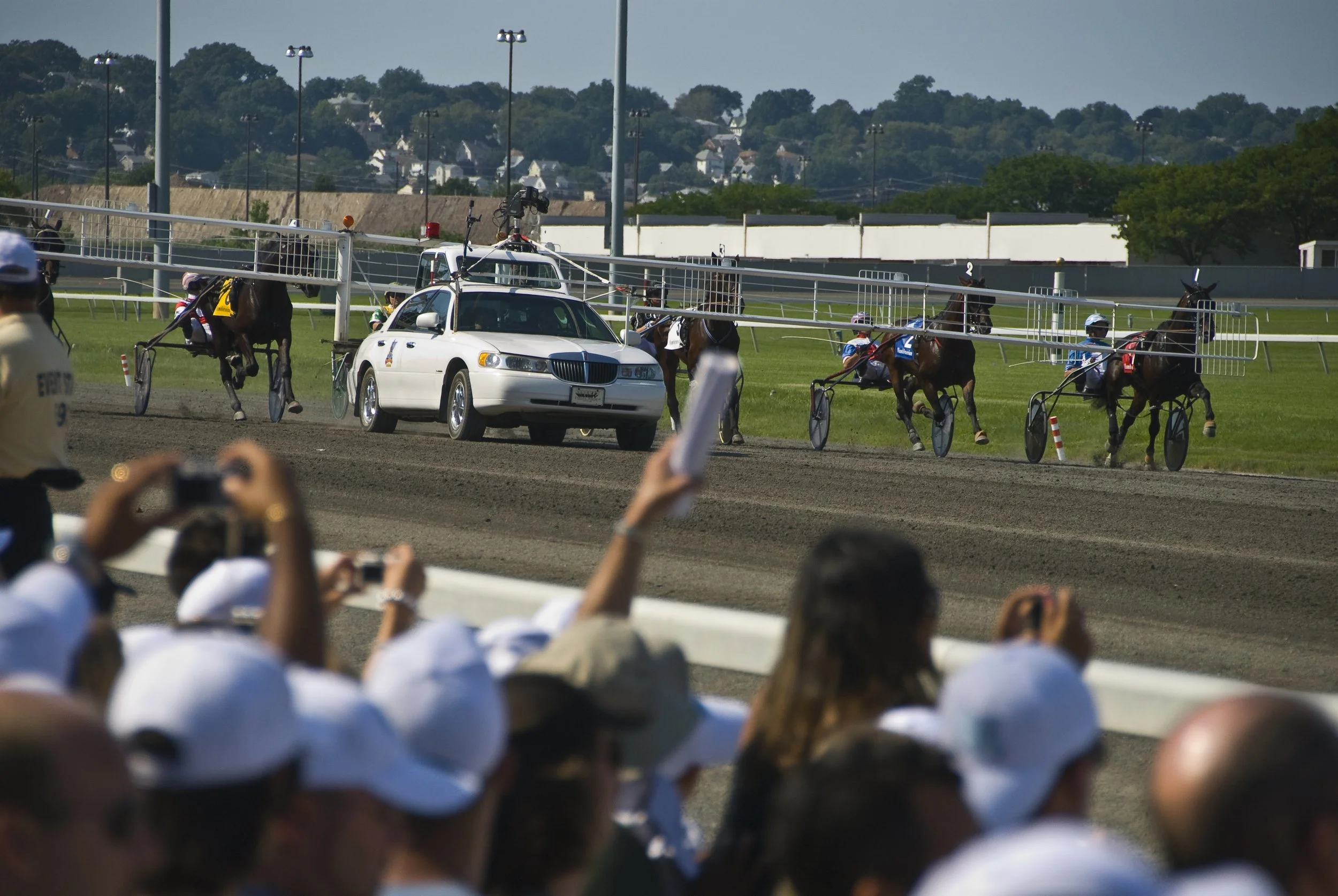
Connections of the three contenders chose their post positions by lot, a privilege awarded elimination winners. They lined up with Donato Hanover as post two, Adrian post three and Pampered Princess post four, prompting the morning line odds-maker to deem Donato Hanover an even money favorite.
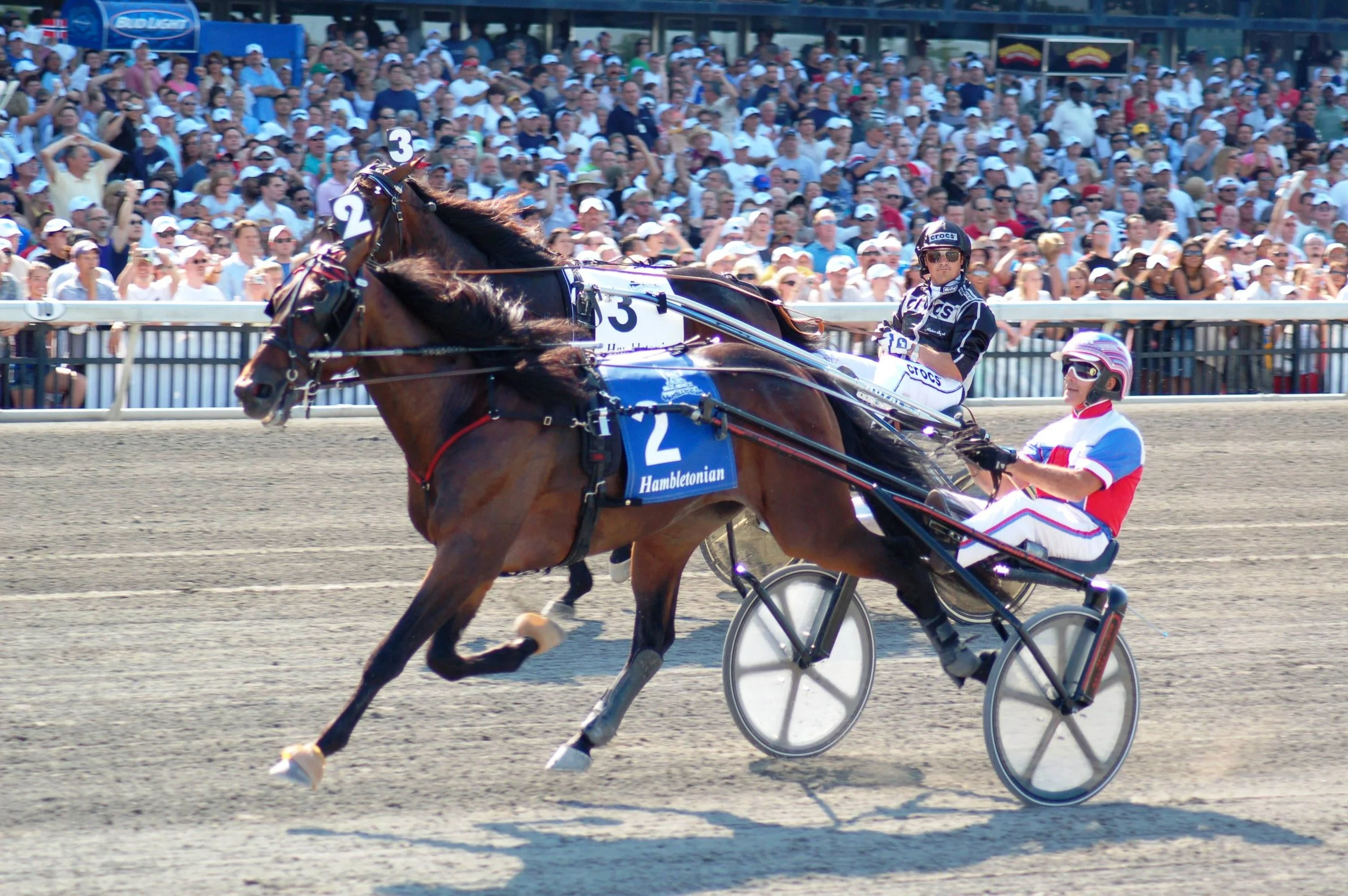
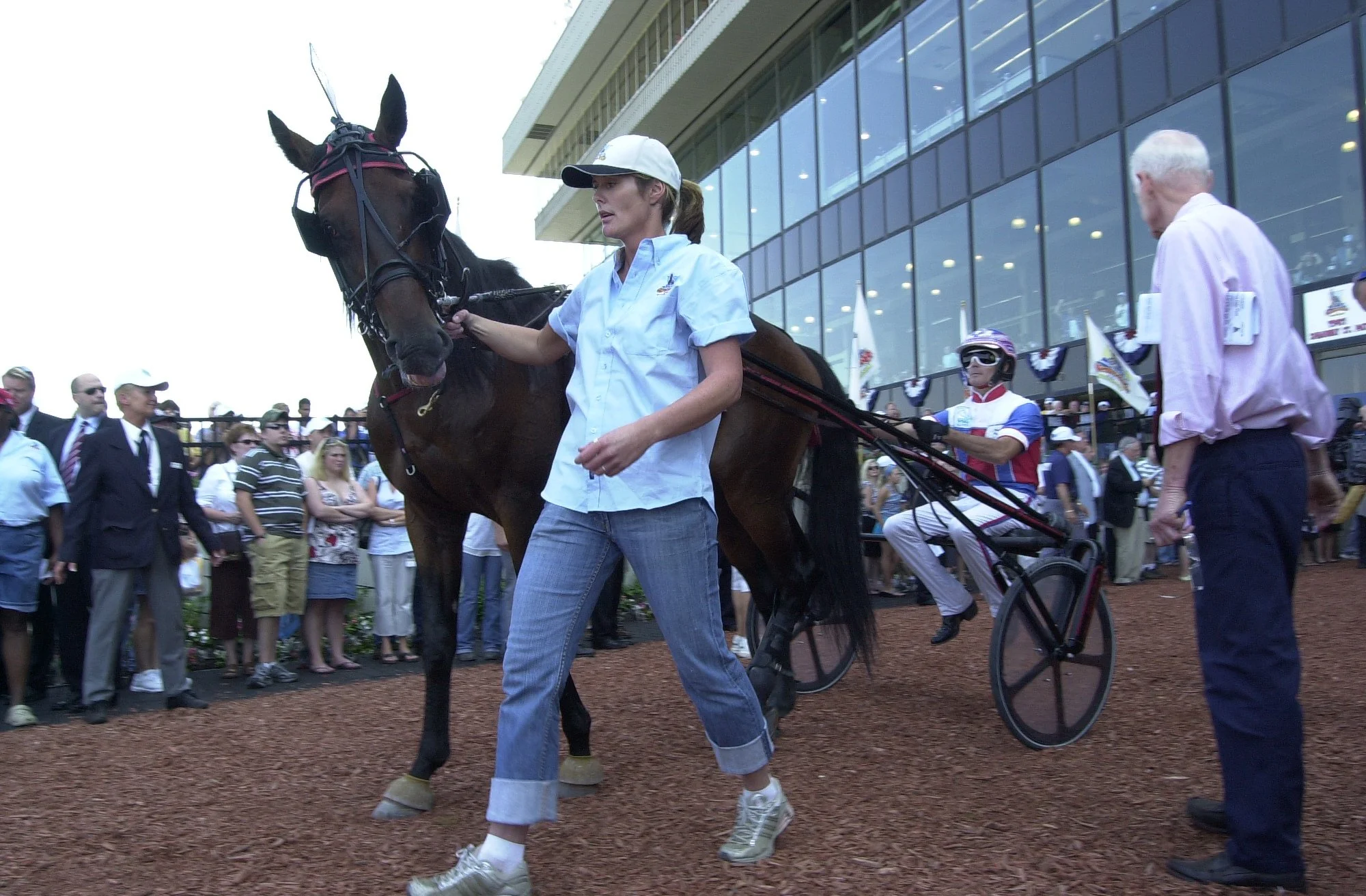
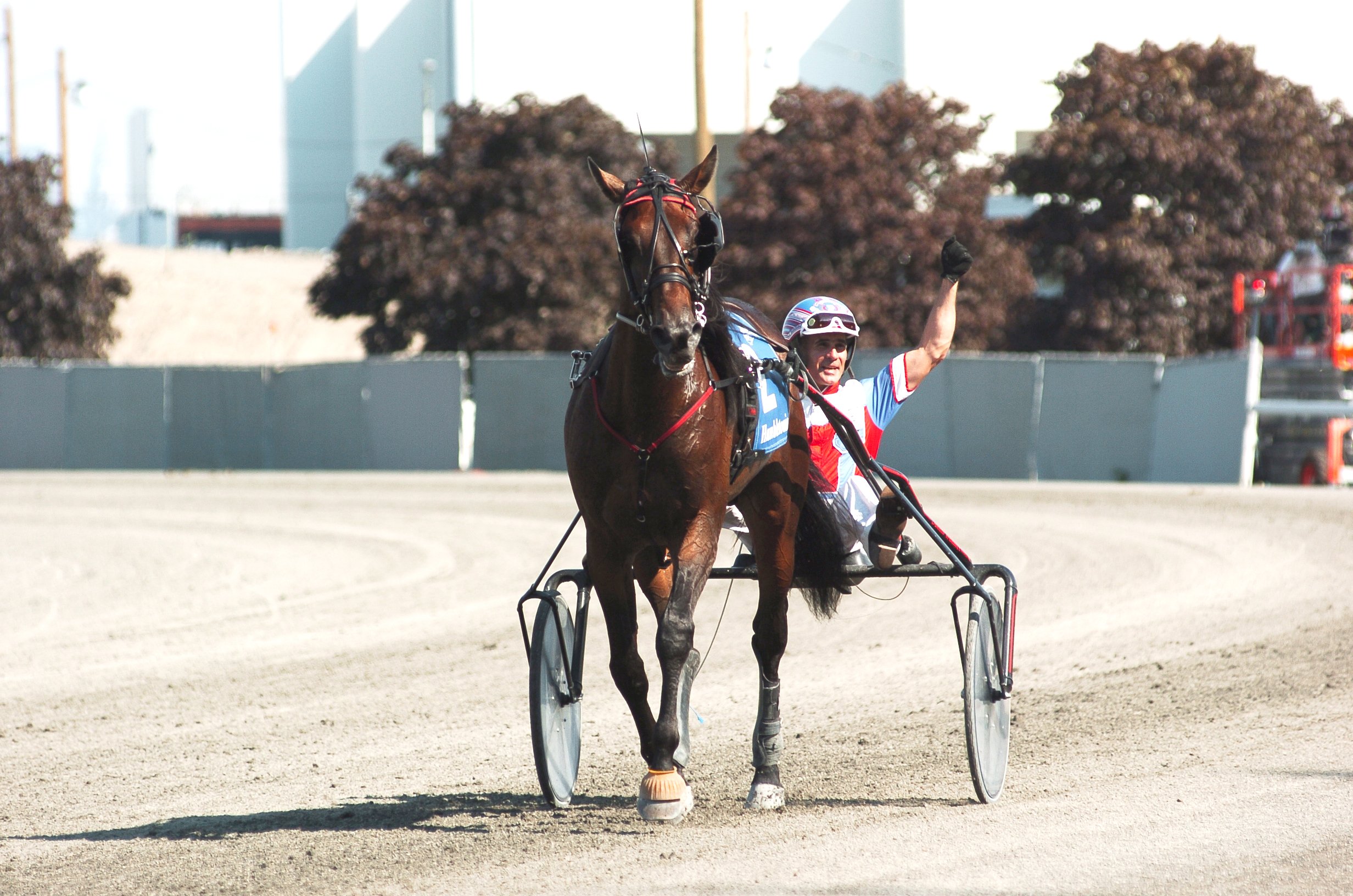
Under sunny skies on a breezy afternoon that kept the crowd comfortable despite the 88 degree temperature, Donato Hanover got a drive worthy of a champion from Hall of Fame pilot Ron Pierce.
Pierce let others bid for the early lead and kept the eventual winner along the rail in third in the early going, on the way to a 28.2 first quarter. He moved Donato Hanover off the rail just before the quarter pole and quickly stepped to the lead, but slowed the tempo and sealed the outcome of the race as Donato Hanover led to the half-mile, timed in a soft 58.2.
The second choice, Pampered Princess and driver Tim Tetrick, joined the chase on the backstretch, and trotting fans around the globe got the contest they wanted as the pair raced side-by-side for an eighth of a mile.
At the start of the turn the filly actually had a brief lead, but Donato Hanover surged up on the inside, was able to reclaim the advantage and trotted off to win by an unthreatened 1-1/4 lengths. Adrian Chip, who raced in the pocket, trailing the dueling favorites by about three lengths on the final turn, gave his best effort to catch Donato Hanover in the stretch but finished second.
The 82nd Hambletonian, trotted in 1:53.2, was now a career defining victory and furthered Donato Hanover’s status among the greatest trotters of this era.
Laddie (Paul MacDonell) and Please Poppy (Brian Sears) came on late and finished third and fourth, respectively. Pampered Princess faded to seventh, before being placed up to sixth, when fifth place finisher Too Salty was disqualified and placed back to seventh for violation of the breaking rule.
“I honestly believed Pampered Princess had the ability to win the Hambletonian,” trainer Jimmy Takter said. “If Donato had been forced to take the trip my filly had to go in that race, I honestly believe the roles might very well have been reversed.”
Donato Hanover’s convincing victory, the lucky 13th in a row in his career gave the sophomore son of Andover Hall – D Train an insurmountable lead on Horse of the Year honors. Follow-up victories in the World Trotting Derby, Canadian Trotting Classic and Kentucky Futurity created a frenzied demand for the precious syndication shares that had been shopped the year before.
Following the win, trainer Elliott, who would be named the winner of the Glen Garnsey Award as Trainer of the Year for the second time in his career, echoed the thoughts of his rival and friend Takter.
“It makes you feel good to see them walk to the half and it's your race to win or lose,” Elliott said. “I before the race the trip would win the race; we were able to walk to the half and we won the race. If we would have been on the outside and had to come after the filly we might have been standing here and watching her in the winner’s circle.”
Though Donato Hanover faltered in the late November Breeders Crown, finishing third to Arch Madness, he cleaned up in the year-end honors, garnering 189 votes from the members of the United States Harness Writers Association while no other horse was received more than four ballots.
At the end of the season, Donato Hanover went back home to his birthplace, Hanover Shoe Farm, with the single season’s earning record of $2,336,190, [eclipsing that of Glidemaster set the year before] completing a career that included 19 wins, a second and two third place finishes in 22 starts and life earnings just short of $3 million.
Attendance on Hambletonian Day, 2007, with temperatures in the 90s was 26,115 against 29,531 in 2006. Total handle was $7,981,435 against $8,096,024 in 2006, with $2,525,120 of that coming on track.
In his Hambletonian elimination, Donato Hanover moved for the lead off the gate and dominated throughout the mile to capture his 12th straight victory by a length in a career best time of 1:53.1.
At two, Donato Hanover won the $55,875 Harriman Cup at the Meadowlands, the elimination and $456,000 Peter Haughton Final at the Meadowlands, a $82,800 division of the Bluegrass at the Red Mile, a $79,500 division of the International Stallion Stakes at the Red Mile and his elimination and $600,000 Breeders Crown Final at Woodbine. After his impressive performance last year, Donato Hanover was voted the Dan Patch Award as the 2006 Two-Year-Old Trotting Colt of the Year.
Steve Elliott is a Detroit native and veteran of New Jersey racing. He got his start with cousin Dave Elliott, and was stable assistant when Dave set a training record of 100 wins at the Meadowlands in 1983. Steve gained his own recognition when he won the 1987 Woodrow Wilson with Even Odds and then became one of very few trainers to campaign three divisional champions in the same year in 1988. He was voted Trainer of the Year for that accomplishment.
It was the first Hambletonian win for Elliott, 54, (November 4, 1953), whose stable has earned in excess of $17 million. The Elliott stable was well decorated at years-end. Besides Donato Hanover who took Three-Year-Old Trotting Colt, Trotter of the Year and Horse of the Year honors, Elliot also conditioned sophomore pacing filly Dan Patch winner Southwind Tempo and was himself voted Trainer of the Year and the W.R. Haughton Good Guy award by the Harness Writers.
This year, with Donato Hanover, Breeders Crown winner Artistic Fella [$674,640] and Southwind Tempo [$849,554], the Elliott stable hit an all-time high benchmark of $4.8 million.
Elliott became one of an elite group of trainers who won both the Meadowlands Pace and the Hambletonian in their careers. The others are Blair Burgess and W. R. Haughton [who’ve won each event twice], Ray Remmen and Chuck Sylvester.
It was the second Hambletonian victory for David Scharf of New York. Scharf’s initial interest in horse racing came about when he attended Roosevelt Raceway. He claimed his first horse, Flash Jack N, at the age of 18. An attorney whose specialty is corporate bankruptcy restructuring, was part of partnerships that owned the 1999 Hambletonian winner, Self Possessed and ENS Snapshot who finished seventh in 2002.
It was the Hambletonian debut for owner Paul Bordogna’s Golden Touch Stable. A real estate portfolio manager who resides in Fair Lawn, New Jersey, he’s been teamed up with trainer Steve Elliott for more than 20 years and owned standout Riverboat King. He and Scharf have been partners on many horses.
“David picked this one out,” Bordogna said of Donato Hanover. “He made me go look at him before the sale. I would say he’s not our typical purchase, but he has turned out to be a great one.”
It was also the first Hambletonian appearance for owner Steve Arnold, who along with his wife Robin Finder, resides in Purchase, New York. His father-in-law, Morton Finder, owned Pine Hollow Stud Farm, and was part of the syndicate that owned 1980 Meadowlands Pace winner Niatross. Arnold’s cousin is Triple Crown winning trainer Jerry Silverman.
It was the second Hambletonian driving victory for legendary Ron Pierce. It was his 10th Hambletonian appearance He won the 1993 Hambletonian with American Winner, and finished second with Like a Prayer in 2002 and Classic Photo in 2005 .
Driver Ron Pierce, 52, is a native of Livermore, California who now lives in Clarksburg, New Jersey, and was inducted into the Harness Racing Hall of Fame in 2005. Pierce was the Driver of the Year in 2004 when he won a career-high 395 races and led North America with $12.3 million in purses. His career earnings top $137 million. Ÿ Donato Hanover retired the fastest 3-year-old trotter ever (1:50.1) and tied seven-year-old trotting mare Giant Diablo for the fastest trotter ever regardless of age.
No horse had come closer than one length to Donato Hanover at the finish of his 2007 races until his Crown elim. Than Arch Madness was only able to get a neck up on him.
Donato Hanover is the second foal from the Donerail mare D Train, who Scharf also owned. Her first foal was the world champion and multiple stakes winner Her first foal, Here Comes Herbie [by Credit Winner], sold for $47,000 and earned $365,541, finishing sixth in the 2006 Hambletonian.
Media
Champions | 2000-2009
-
![]()
Yankee Paco
-
![]()
Scarlet Knight
-
![]()
Chip Chip Hooray
-
![]()
Amigo Hall
-
![]()
Windsong's Legacy
-
![]()
Vivid Photo
-
![]()
Glidemaster
-
![]()
Donato Hanover
-
![]()
Deweycheatumnhowe
-
![]()
Muscle Hill
Undefeated
August 2, 2008
East Rutherford, NJ
The MeadowLands
Purse $1,156,800
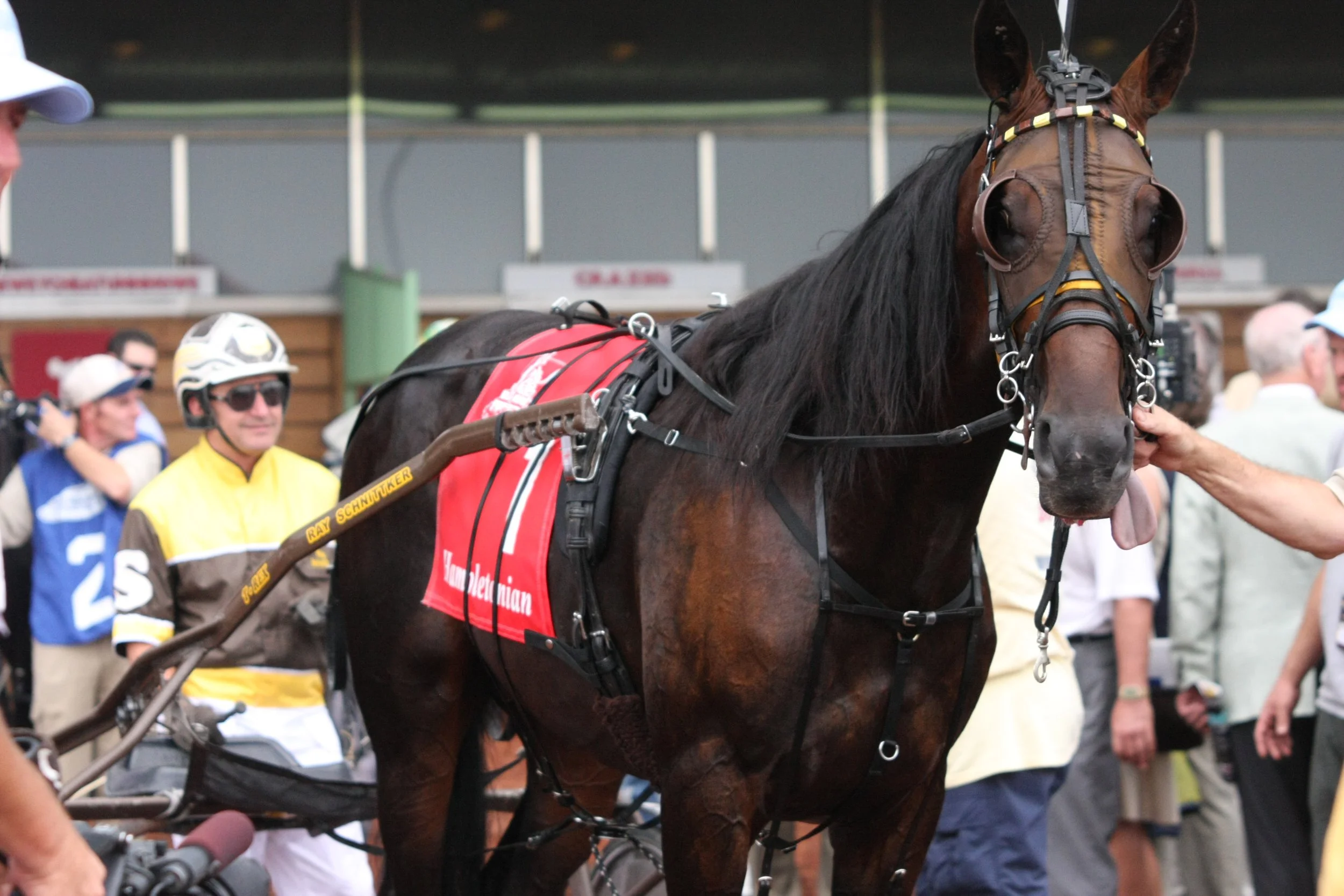
An orphaned colt named for a comedy act turned the tables on the harness world and instead developed into a deadly serious contender on the racetrack, dominating all competition for two straight years. Deweycheatumnhowe, named for a skit about an unscrupulous law firm, defined his career by trotting decisively into the history books as the first ever undefeated horse to win the Hambletonian.
"Dewey" was foaled at breeder Steve Jones' Cameo Farm in Montgomery, New York. Six weeks after his birth, his dam died from intestinal problems and Dewey was left to fend for himself. He remained with the broodmare band and their foals, and grabbed meals wherever there was an opportunity.
Dewey met the first adversity of his life head on, and grew to be more than 16 hands, or about 65 inches at the shoulder. His size, even as a 2-year-old, may have worked against him in the auction ring, but trainer/driver Ray Schnittker felt the colt looked good enough to warrant an $80,000 final bid. Schnittker retained an ownership share in the strapping son of Muscles Yankee, and regular partners Frank Baldassare and Charlie Iannazzo, as well as Ted Gewertz (an attorney with a sense of humor) went in on the colt as well. Gewertz had actually owned the dam of Deweycheatumnhowe, Trolley Square, but sold her in 1998.
"In his first baby race, I could tell that he might be something special," Schnittker reflected on his youngster's progress at 2. "He finished second, yet he made up 15 or 20 lengths, and he was really motoring down the lane. It was his stride. I always thought he'd be at least a decent horse, and maybe better later on in his career because he was so big, but he's also so athletic."
Dewey proved Schnittker right, and racked up 10 straight wins – including victories in the Harriman Cup, New Jersey Sire Stakes final, International Stallion and Bluegrass Stakes, Valley Victory and Breeders Crown – as he marched through his freshman campaign to divisional honors. By August of his freshman year he added more owners, in the form of Jerry Silva, who also owned the top 2-year-old filly contender, Snow White, as well Alan and Meg Leavitt's Walnut Hall Ltd. of Kentucky.
In October 2008 it was announced that Dewey would stand at Walnut Hall Ltd. for the 2009 breeding season at a fee of $25,000, with a limited book of 140 mares. Shares in his breeding future sold furiously and many of the sport's top breeders and owners across the globe had a new rooting interest.
Schnittker and Dewey set a single-season earnings record of $936,191 for a 2-year-old trotting colt and were quite properly voted Dan Patch and Nova awards as the best of his group. Dewey assumed the mantle of Hambletonian winter-book favorite.
During the off-season Schnittker rode, swam and jogged his charge, to keep him fresh and sound. The regimen worked so well that Schnittker incorporated the unorthodox exercise into his racing schedule, often swimming the big horse at a pond on his farm. Deweycheatumnhowe may be the only Hambletonian prospect ever ridden under Western saddle.
By June, Dewey was ready to launch his Hambletonian assault, and after a pair of ridiculously easy qualifiers, made his debut in winning the Dickerson Cup. Schnittker had purposefully planned a road to the Hambo that did not involve leaving the Meadowlands, and with the Stanley Dancer Memorial elim and final ahead, the route looked clear. Dewey lowered his lifetime mark to 1:52.2 in his Dancer elimination, and his best competition, Clerk Magistrate, could not get within four lengths of him. Once again Dewey proved his versatility, causing Schnittker to marvel at the ease with which his big horse could switch gears on the track.
"He was just awesome coming down the lane. He hasn't lost so I guess that's where we want him to be," said Schnittker. "He can do anything; he can leave, he can come from behind. He's real easy to drive, just a really great horse. At the head of the lane I asked him and he just opened up three or four [lengths]. He's got tremendous speed."
One week later Dewey removed any doubt that he would be the overwhelming Hambletonian favorite, cruising to his 13th straight win in the Stanley Dancer Memorial final by a comfortable margin. With two weeks off, Ray and his veterinarian wife, Dr. Janet Durso, entertained a constant stream of visitors and well-wishers who wanted to see the amiable Dewey go for a swim or a trail ride in lieu of traditional training preps. NBC racing analyst Donna Brothers traveled to Middletown, N.Y. to do a feature on Ray and Dewey and the former jockey ended up reporting from atop Dewey's back!
Despite Dewey's dominance, 22 other sophomore trotters dropped in the Hambletonian box against him. Win No. 14 came in the Hambletonian elimination, and one of the perks of winning was choosing a post position for the following week's $1.5 million Hambletonian final. The other elim winners were Crazed and Atomic Hall. Schnittker was second to pick his post and took the rail, the same spot from which he won the $350,000 Stanley Dancer Memorial.
"I've won a lot of races off the rail," said Schnittker, who also qualified Make It Happen for the Hambletonian final. "I'll just see how things develop. You can't tell until the race gate opens up."
Ironically, Schnittker's other Hambletonian qualifier, Make It Happen, was placed in the open draw and drew post 10, so Schnittker interests bookended the field. Deweycheatumnhowe was installed the prohibitive 2-5 favorite for the biggest race of his life.
Hambletonian Day featured a thunderstorm of biblical proportions, but it passed as quickly as it gathered. The track was fast and the air thick with tension as the 10 colts lined up behind the starting car.
In his trademark fashion, Schnittker sent Deweycheatumnhowe sailing to the front in a snappy opening quarter of 26.4 seconds. Schnittker gave his colt a breather down the backstretch, reaching the half in :55, and began to pick up steam again as they put away the challenge of Velocity Hall on the final turn. At the head of the lane, Tim Tetrick popped Crazed out of the pocket, prompting Schnittker to call upon his colt again. Deweycheatumnhowe responded, gamely digging in for a half-length victory over Crazed in 1:52. Schnittker's other Hambletonian entrant, Make It Happen, rallied from eighth at the head of the lane to finish third.
"I was trying to back into Dave [Miller and Velocity Hall] as much as I could," Schnittker said. "I knew he didn't have much stock and was just trying to keep Crazed from having a fresh shot at me, [trying to] keep him in as long as I could. About a quarter of the way down the lane, we were trying for all we could go. He [Crazed] was coming; it was a dogfight. I would have rather won by eight [lengths].
"I have a lot of great partners and a lot of great owners," he added. "I had a lot of people pulling for me and wishing me luck – drivers, race secretaries, judges – it was really surprising."
The win was Dewey's 15th straight, making him the first horse to ever carry an undefeated streak both into and out of the Hambletonian. American swimmer Jenny Thompson, one of the most decorated Olympians in history, presented the silver Hambletonian trophy to the delighted owners, even placing a mock Olympic medal around Dewey's neck.
Dewey may have been named for comedic value, but his extraordinary talent and ability gave him the last laugh on Hambo Day.
If there was an unfortunate spin to the nearly perfect career of Deweycheatumnhowe, it was that he was foaled the same year as pacer Somebeachsomewhere, hailed as one of the greatest pacers to look though a bridle. The "Beach" lost just one race in his career, beaten a neck in the $1 million Meadowlands Pace – and he and Deweycheatumnhowe were very close in the polls for Horse of the Year prior to the Breeders Crown in late November.
Dewey, who had never put a foot wrong in two years, finally suffered a setback in mid-November. A swelling in his throat clearly affected him in the Breeders Crown final, and he finished an uncharacteristic third in the year-end championship series. Somebeachsomewhere won his Crown division in devastating fashion. The die was cast. In February, Somebeachsomewhere was voted Horse of the Year over Deweycheatumnhowe. Dewey, however, is one of only 84 Hambletonian winners, and the only undefeated horse to win it.
Deweycheatumnhowe was voted Trotter of the Year with 155 votes. Two-year-olds Muscle Hill received two and Honorable Daughter had one. "Dewey" also received Dan Patch honors as the best 3-year-old colt trotter.
Deweycheatumnhowe became only the second trotter to reach $2 million in a single year, earning $2.2 million in 2008, and was the first trotter in history to reach $3 million in lifetime purses at the age of 3.
Ray Schnittker was also showered with love by the Harness Writers in the year-end honors. He was voted W.R. Haughton Good Guy and Glen Garnsey Trainer of the Year.
Co-owner Jerry Silva was voted Owner of the Year.
The colt's victories after the Hambletonian included the $930,000 Canadian Trotting Classic, $565,000 World Trotting Derby and a three-heat triumph in the Kentucky Futurity. His eligibility to the Yonkers Trot was discontinued after his 2-year-old season, therefore there was no attempt at becoming a Triple Crown winner. He finished 2008 with 12 wins in 15 races and closed his career with 22 victories in 25 starts and $3.1 million.
Schnittker, a rarity among the catch-driver dominated scene at the Meadowlands, has been down the road to the $1.5 million Hambletonian several times before. He finished third twice with a pair of 40-1 longshots, Armbro Plato [1997] and Armbro Trick [2000], the closest he had come to the Hambletonian trophy.
Runner-up Crazed represented a third generation Hambletonian legacy. His 24-year-old trainer Frank Antonacci Jr., followed in the footsteps of his father, Frank J., uncle, Gerry, and grandfather, Sonny. The Antonaccis and/or Lindy Racing were involved with numerous Hambletonian winners, including Lindy's Pride (1969), Speedy Crown (1971), Probe (1989), Harmonious (1990), Victory Dream (1994), and Continentalvictory (1996).
None of the other foals of Trolley Square, a Speedy Somolli mare who made only $3,100 on the track, achieved the success of Dewey. Breeder Steve Jones purchased Trolley Square in foal to Giant Victory for $37,000 as part of a 1998 dispersal sale of horses owned by Ted Gewertz. The six Trolley Square foals sold by Jones yielded $384,000 at sale. Dewey was Trolley Square's last offspring as she died on June 1, six weeks after he was foaled on April 12, 2005.
Cameo Farms is located in Orange County, N.Y., the birthplace of Hambletonian 10, the great father of all Standardbreds racing today, in whose honor the Hambletonian race was created.
Jones came up with the name Dewey, Cheatum & Howe, a fictional law firm cited in multiple comedy routines over the years by figures as divergent as Johnny Carson, the Three Stooges, Daffy Duck and Groucho Marx, thinking it might attract bidding from Ted Gewertz and his wife, Claire Chappell, who are both attorneys and previously owned Trolley Square.
Deweycheatumnhowe was sold at the 2006 Lexington Selected Sale for $80,000 to Schnittker, Charles Iannazzo, Frank Baldassare and Ted Gewertz. In August of 2007, breeders Alan and Meg Leavitt of Walnut Hall Limited bought a 50 percent interest in the precocious colt as the Deweycheatumnhowe Stable. Schnittker retained 15 percent for himself, Gewertz and Iannazzo each kept 12.5 percent and Baldassare retained 10 percent.
Schnittker has up to 50 horses in training, split between Mark Ford's new training center, in Wallkill, N.Y., and the historic Goshen, N.Y. oval. The Buffalo native worked alongside his father, Warren, and campaigned a strong stable of claiming horses on the New York circuit in the 1980s. Schnittker's breakthrough at the Meadowlands came with Covert Action, who won the 1991 Presidential [paying a stakes record $118]. Covert Action earned $1,183,594 while racing from 1987 through 1995, winning 49 of his 251 starts. The pacer's success gave Schnittker the financial freedom to buy better quality horses. He credits his wife, equine veterinarian Dr. Janet Durso with playing a vital role in the stable's success, lending her expertise to both the daily care of the horses and in selecting yearlings to buy.
Deweycheatumnhowe was driven in all his starts by Schnittker. Despite the overwhelming prevalence of catch-drivers in the sport, Schnittker joined a growing group of trainer/drivers who have triumphed in the Hambletonian in the past decade. They include Vivid Photo [Roger Hammer – 2005], Windsong's Legacy [Trond Smedshammer – 2004] and Scarlet Knight [Stefan Melander – 2001].
Schnittker also developed and sold Here Comes Herbie (2006) and Strong Yankee (2005), who reached the Hambletonian final in their 3-year-old campaigns for trainer Trond Smedshammer.
Ted Gewertz now has three Hambletonian trophies to his credit, with two previous wins coming from Giant Victory (1991) and Windsong's Legacy (2004).
Jerry Silva also added a third Hambletonian trophy to his collection. He was part of the ownerships of prior Hambletonian winners Continentalvictory (1996) and Self Possessed (1999).
Charles Iannazzo and Frank Baldassare, longtime patrons of the Schnittker stable, celebrated their first Hambletonian win.
Walnut Hall Limited produced 2003 Hambletonian winner Amigo Hall. Walnut Hall Limited is owned by Meg Nichols Leavitt, 63, of Lexington, KY, and Alan Leavitt, 72, of Lexington, KY. Meg is the great-granddaughter of Lamon Harkness, who founded Walnut Hall Farm more than a century ago. Walnut Hall Farm produced eight Hambletonian winners from 1932 to 1956.
Dewey never lost a stakes final until the Breeders Crown, the last race of his career. His only prior losses came in an elimination race for the Canadian Trotting Classic (snapping his 17-race win streak) and a heat of the Kentucky Futurity.
Deweycheatumnhowe is a son of 1998 Hambletonian winner Muscles Yankee.
Earlier on the card, Illinois émigré, Andy Miller scored the biggest win of his driving career behind Creamy Mimi in the $750,000 Hambletonian Oaks for fillies for trainer Trond Smedshammer. Lantern Kronos, the 3-5 favorite, was caught wide early and made a three-wide move to finish second. Stage Show was third.
Trainer Trond Smedshammer was relieved to finally hoist the Oaks trophy after near misses in 2004, 2005 and 2006.
Creamy Mimi was a $165,000 yearling purchase by owners Marvin Katz and Al Libfeld of Ontario.
A crowd of 25,006 turned out to watch the 83rd Hambletonian. A total of $1,524,115 was wagered on the eighth race Hambletonian.
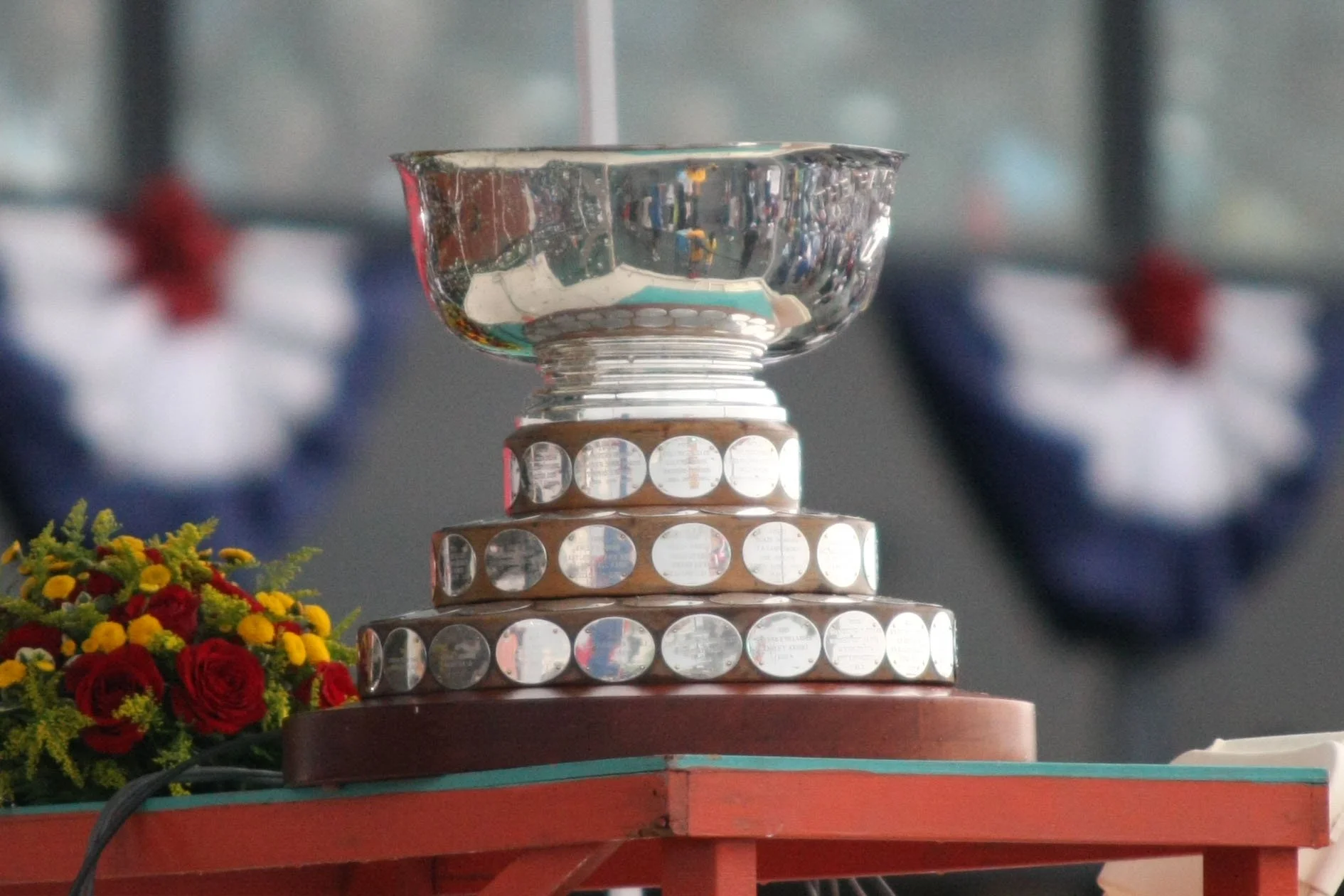
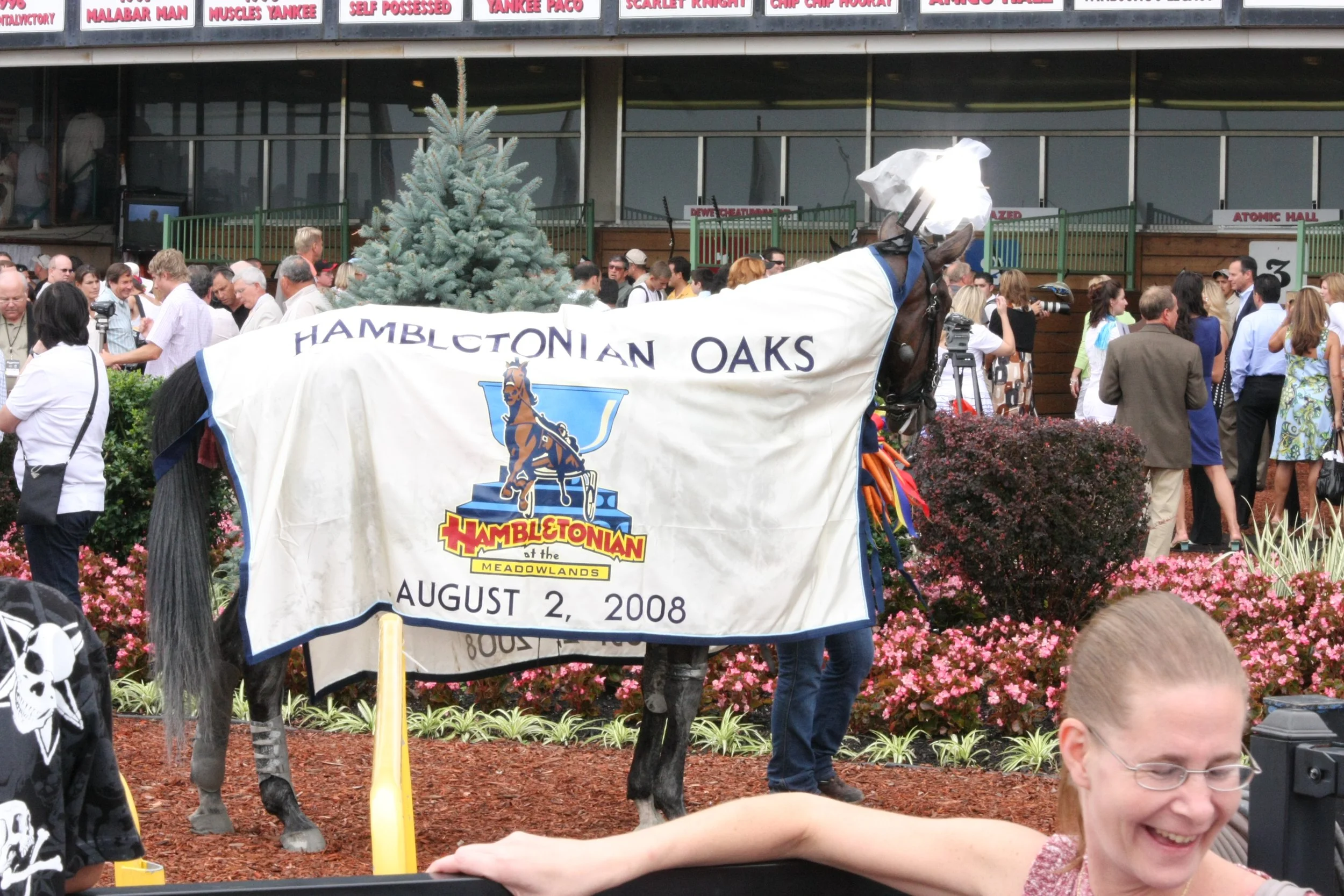
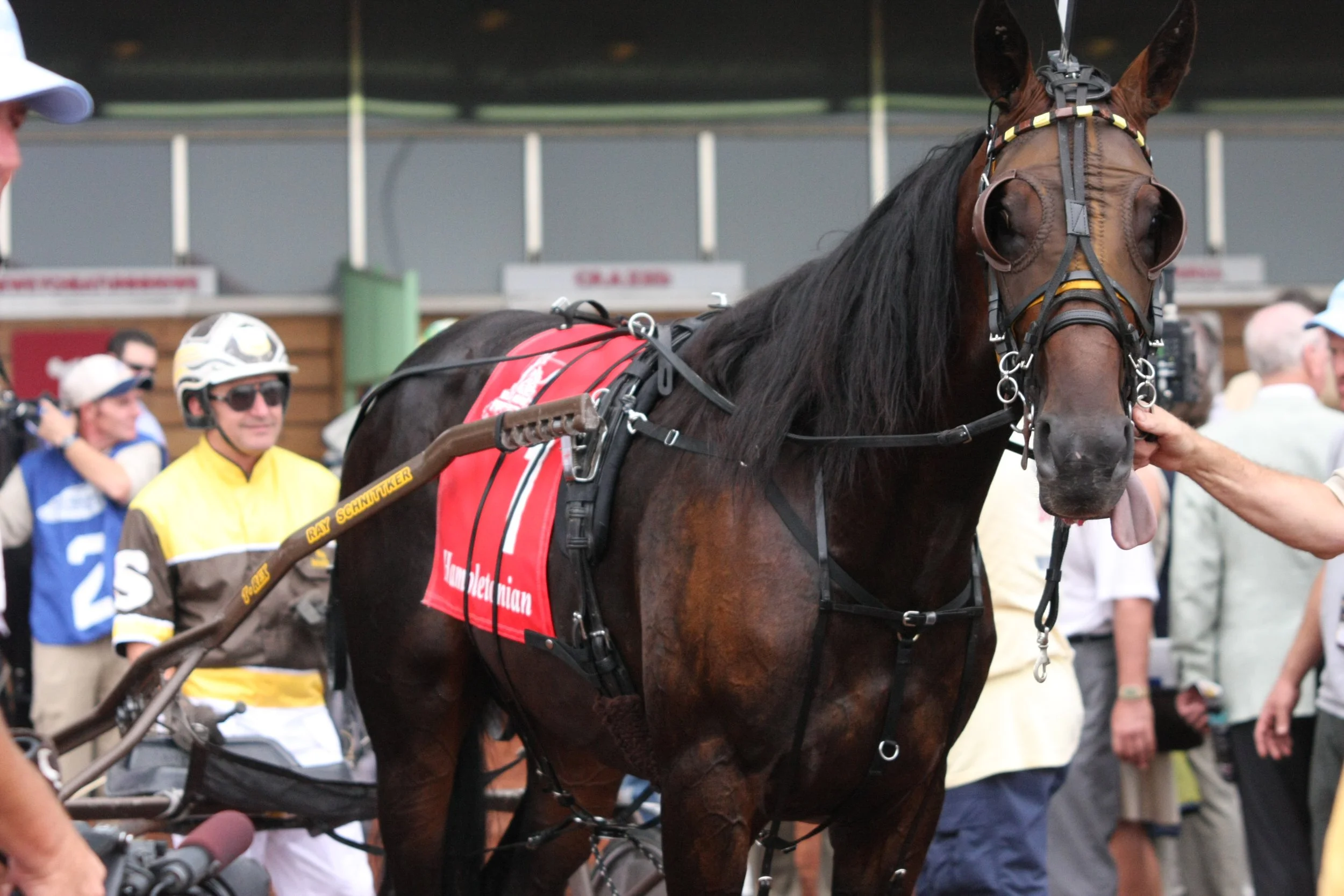
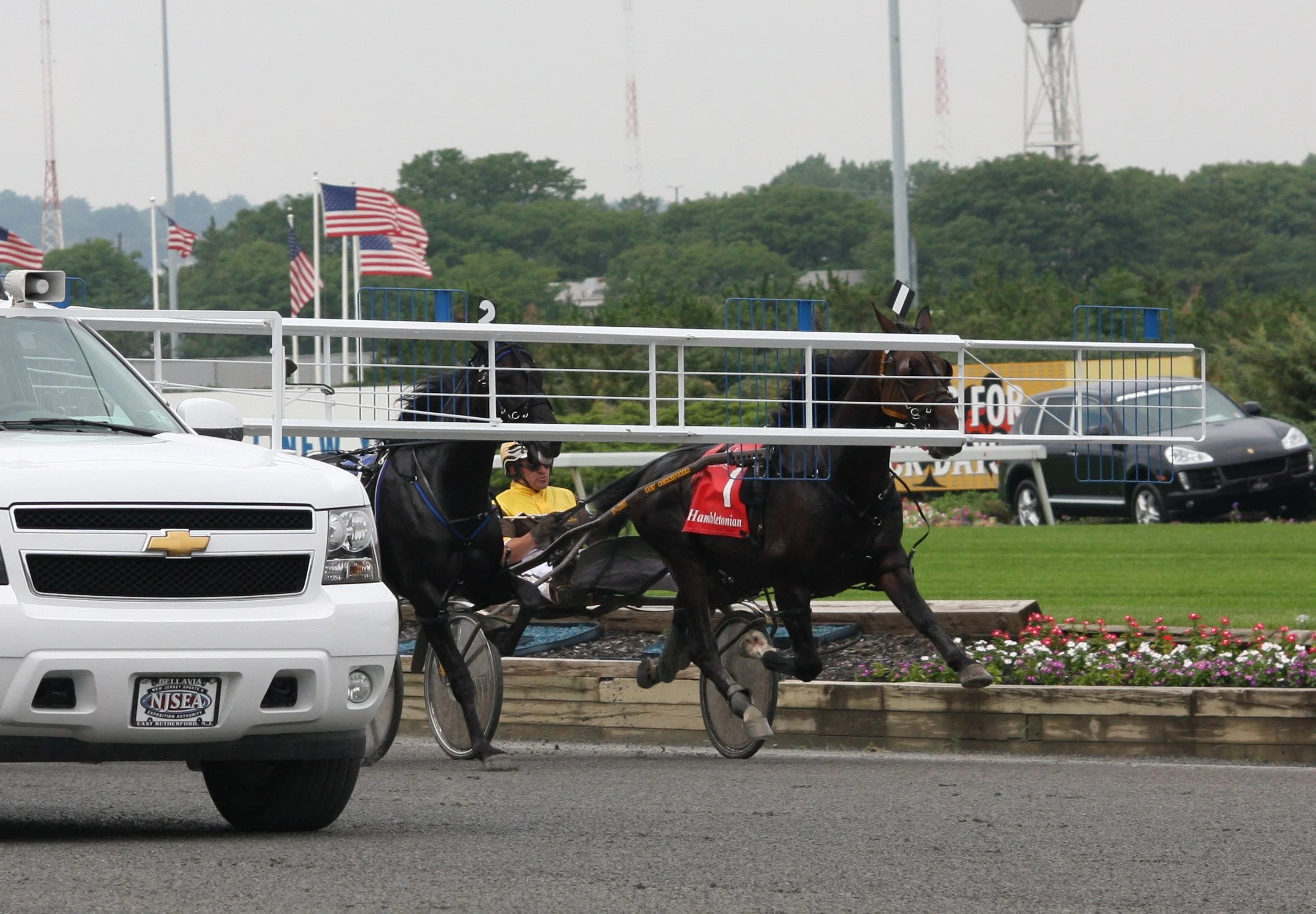
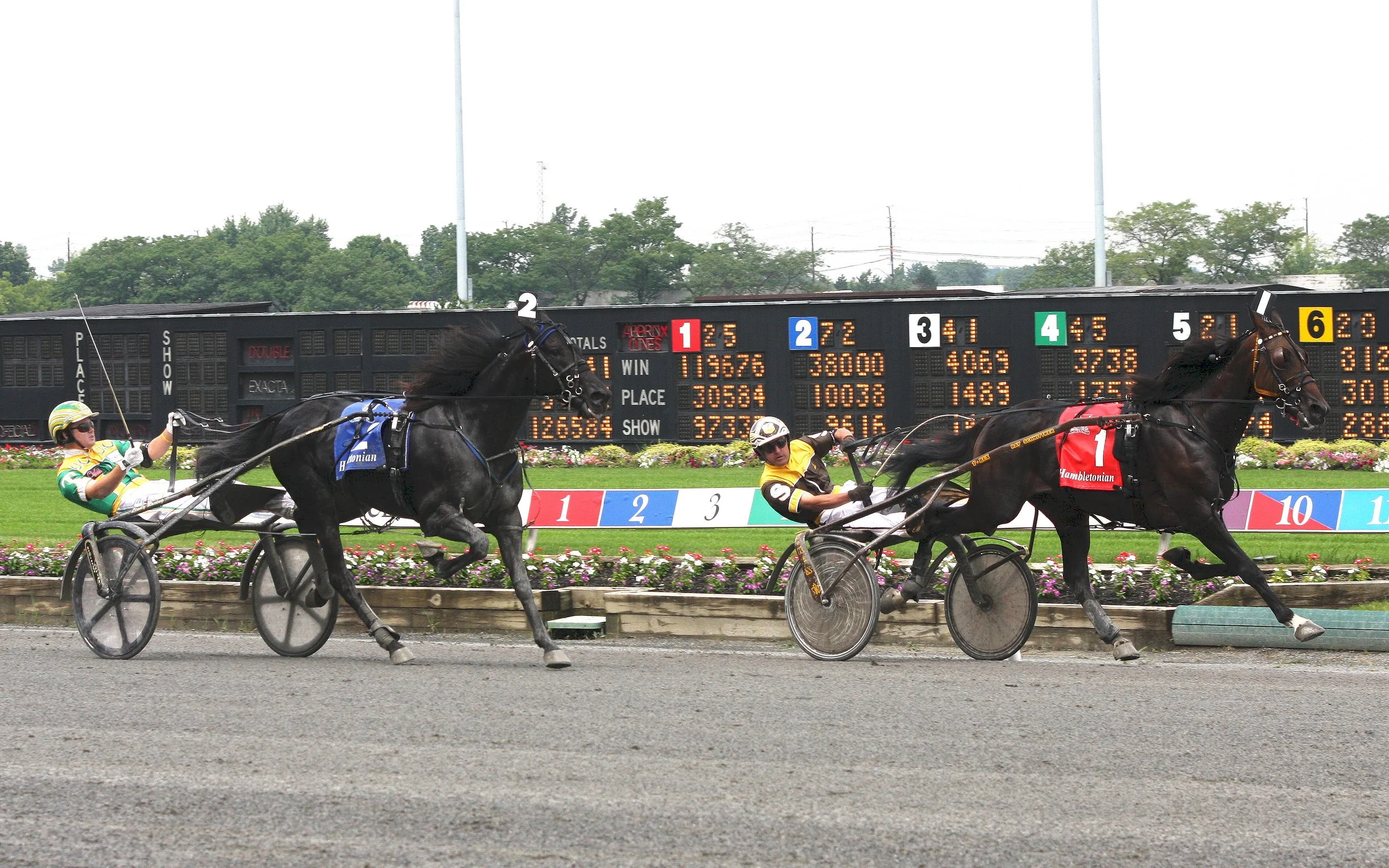
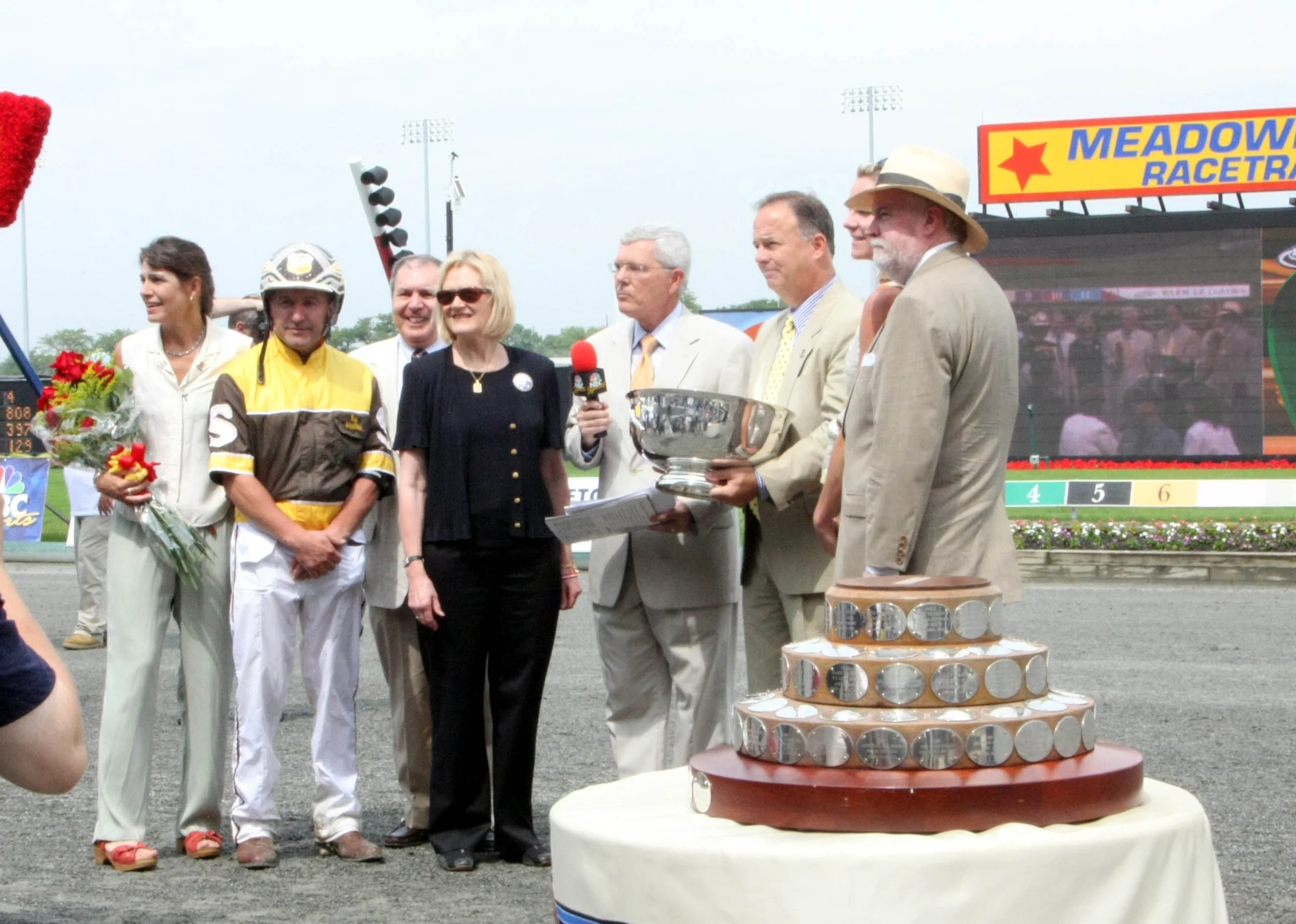
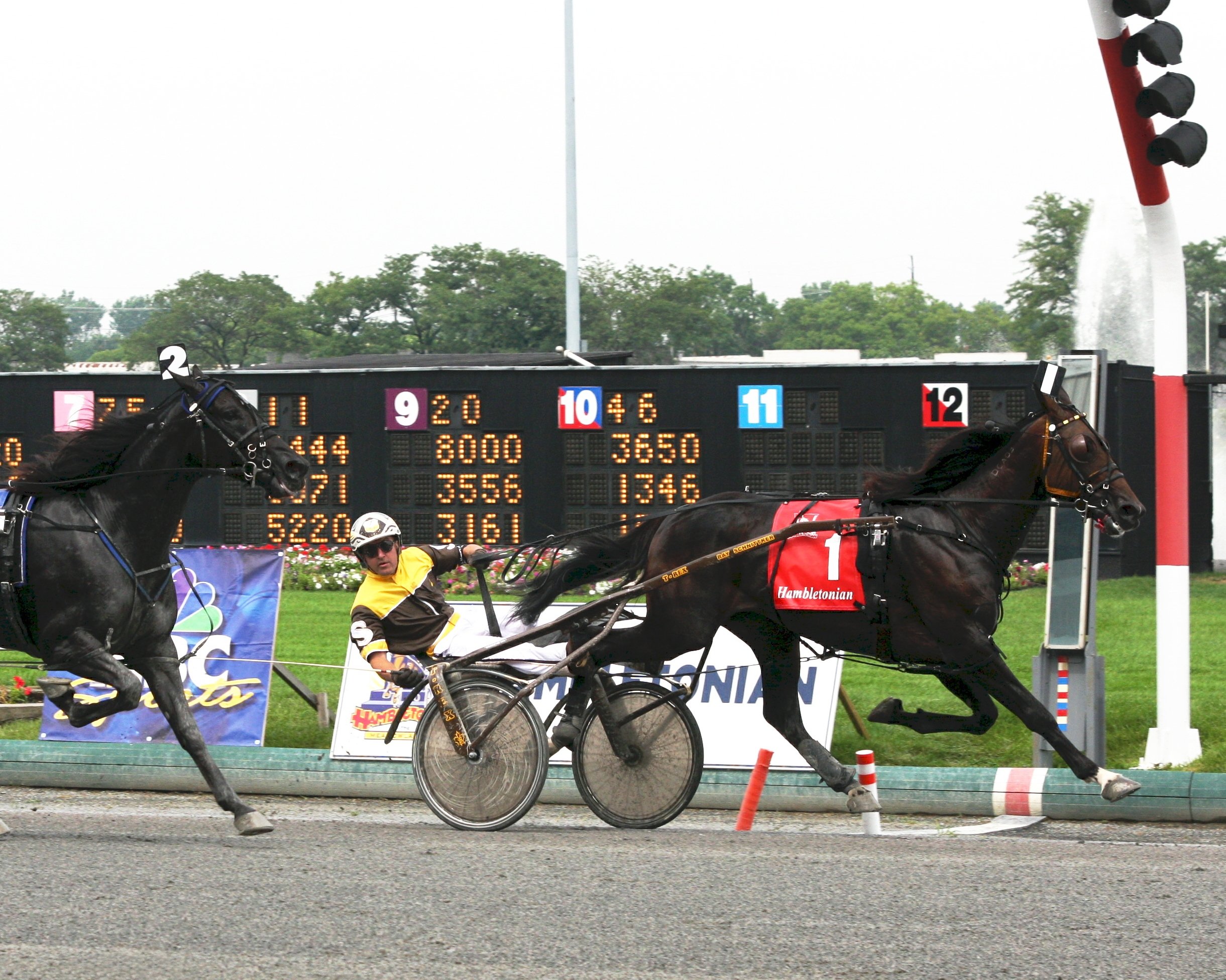
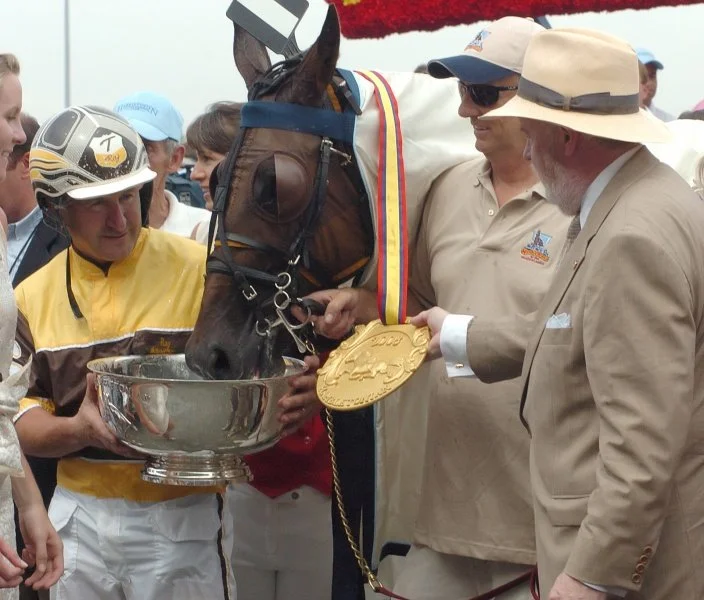
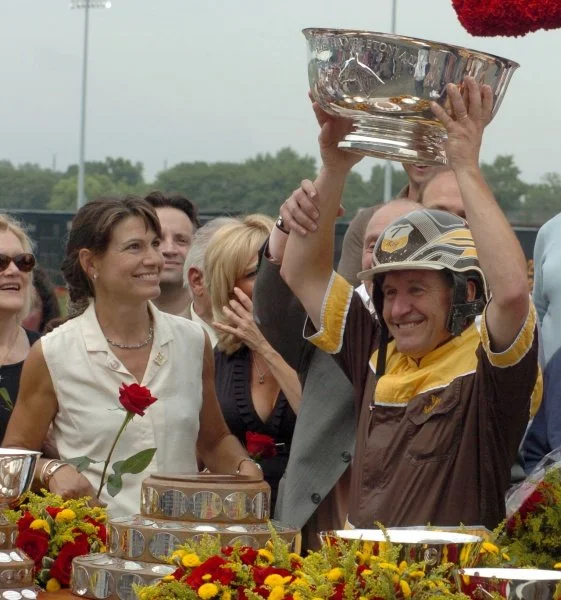

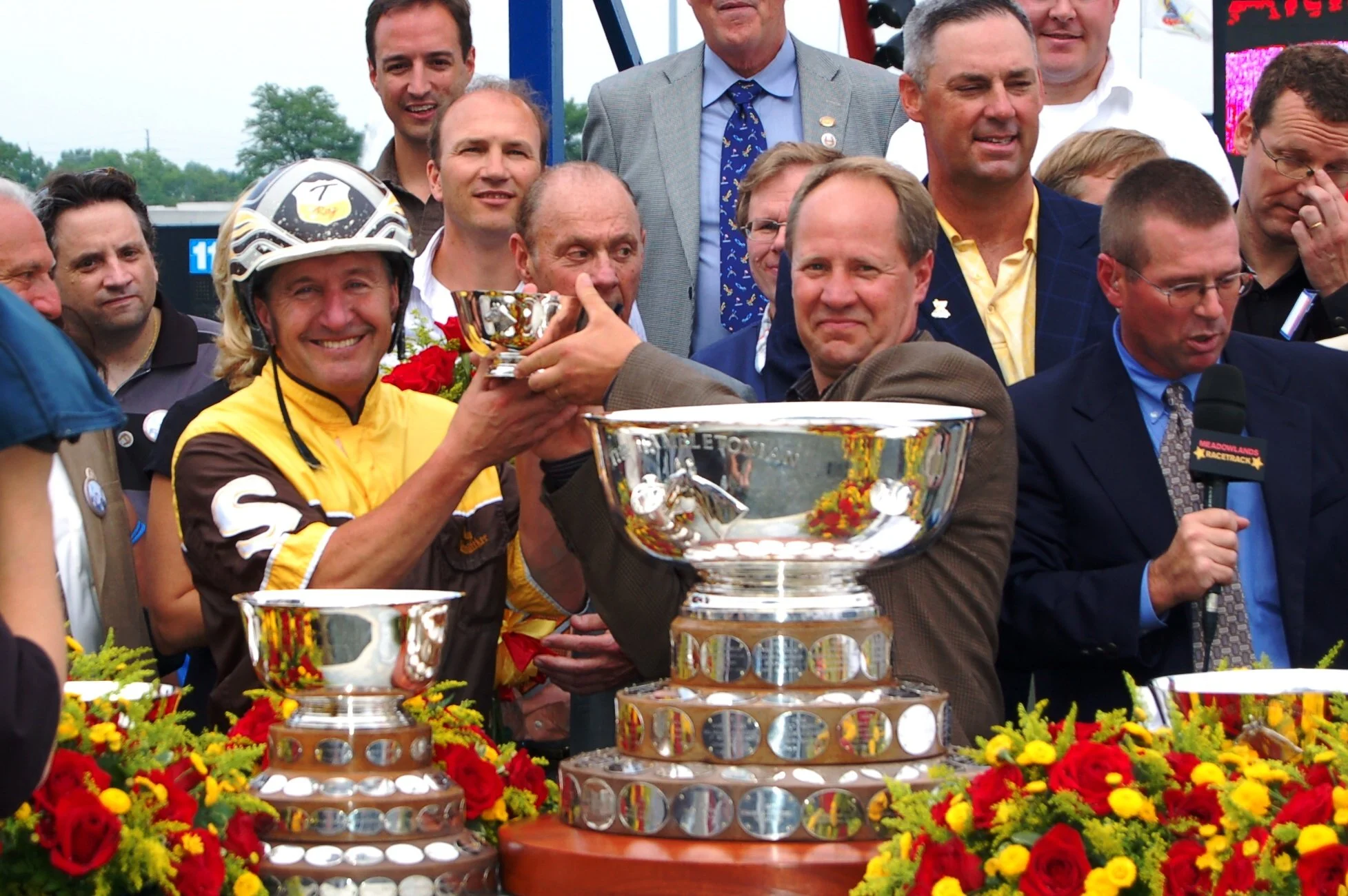
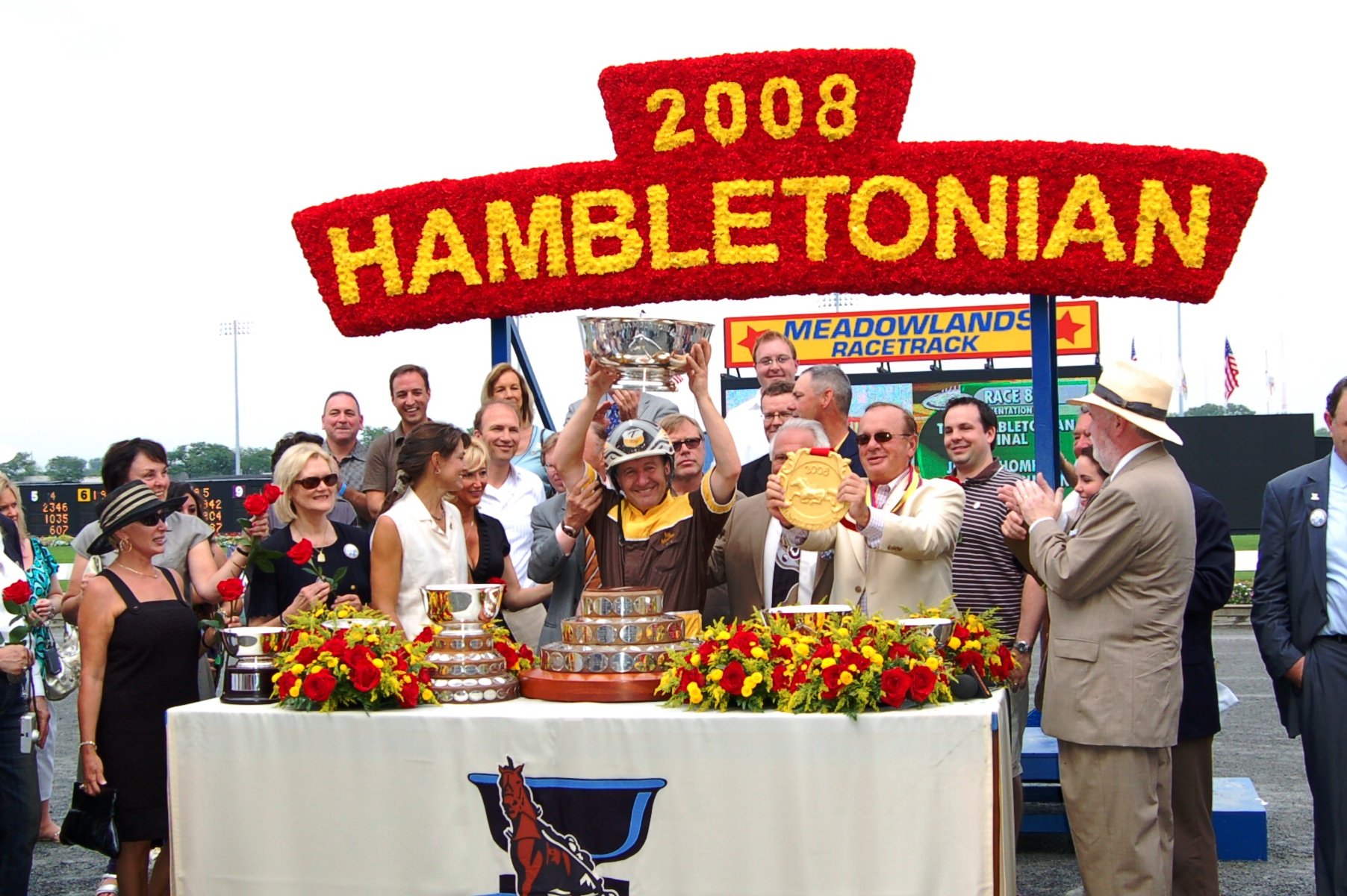
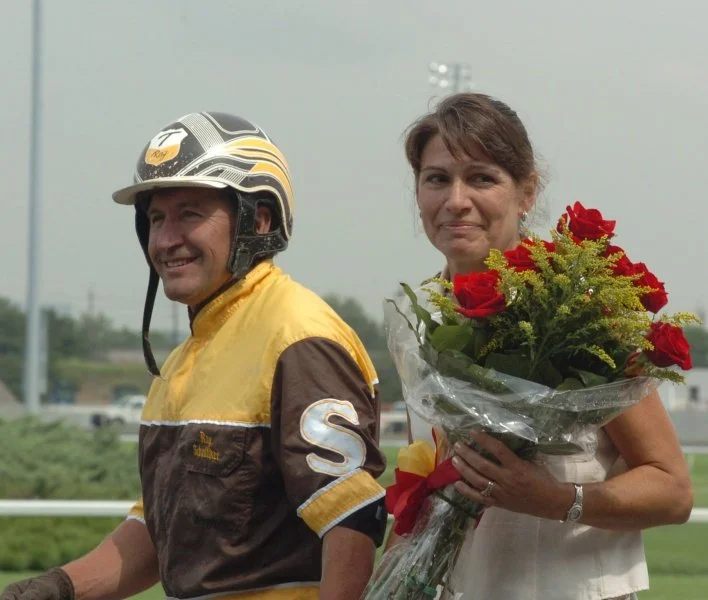
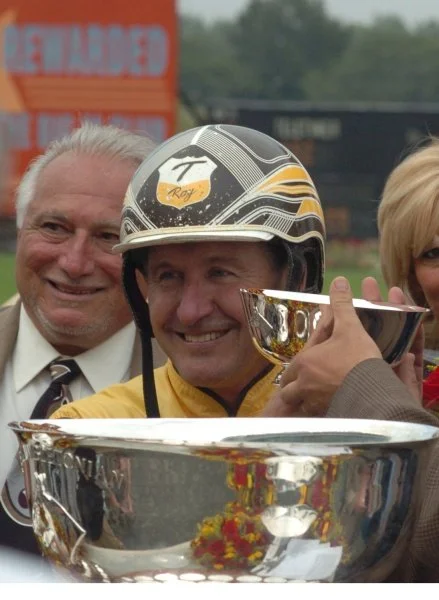
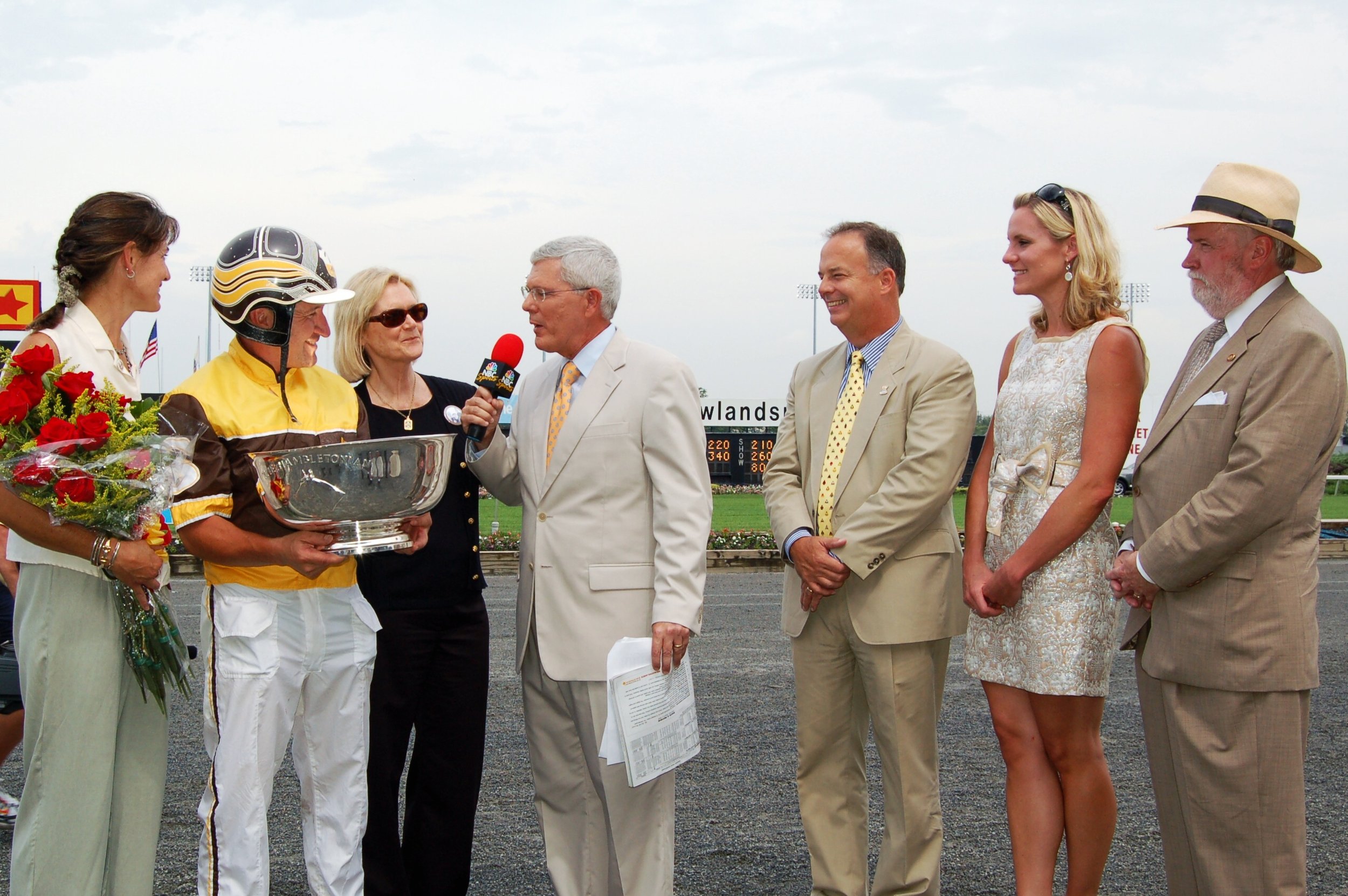
Media
Champions | 2000-2009
-
![]()
Yankee Paco
-
![]()
Scarlet Knight
-
![]()
Chip Chip Hooray
-
![]()
Amigo Hall
-
![]()
Windsong's Legacy
-
![]()
Vivid Photo
-
![]()
Glidemaster
-
![]()
Donato Hanover
-
![]()
Deweycheatumnhowe
-
![]()
Muscle Hill
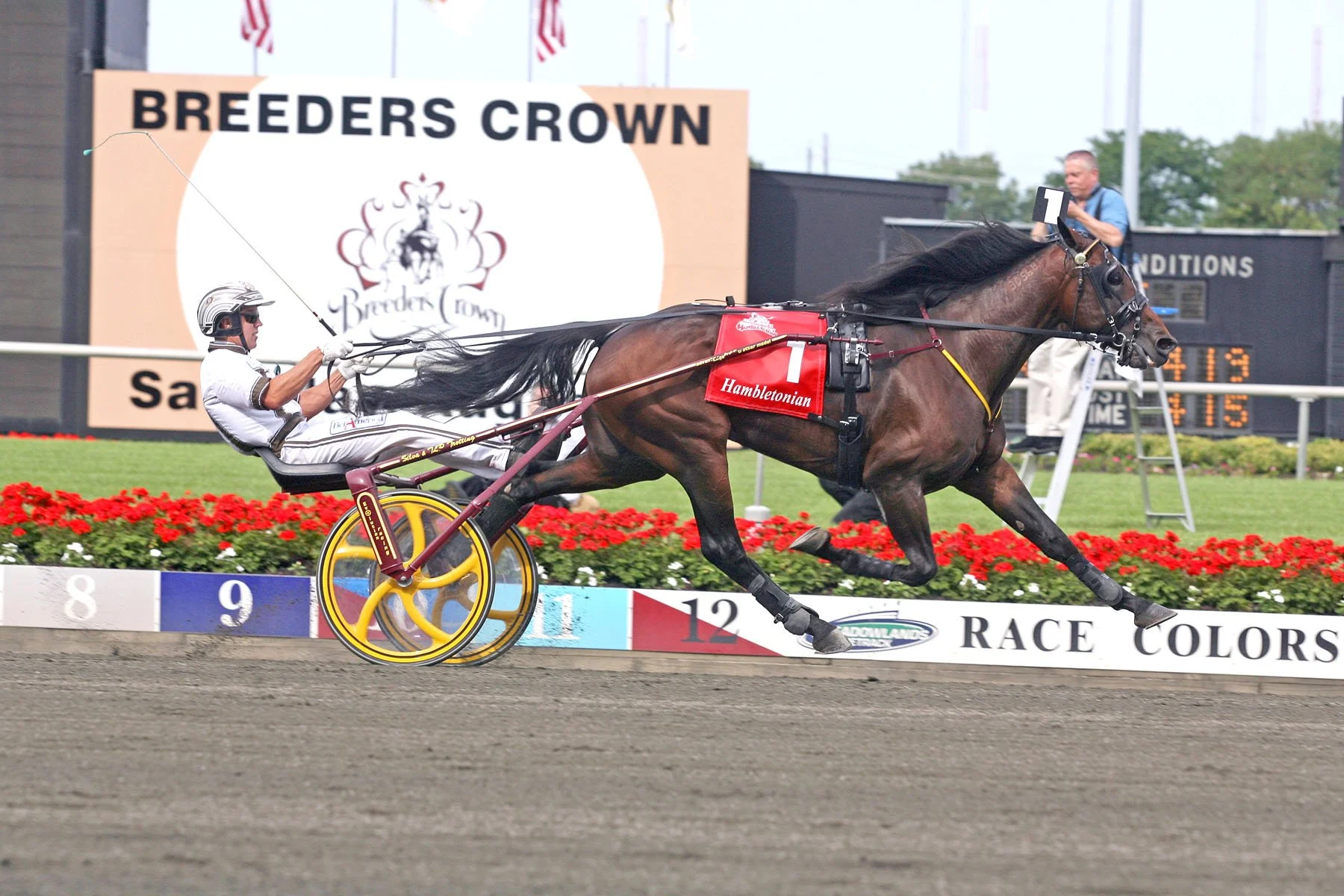
King Of The Hill
August 8, 2009
East Rutherford, NJ
The MeadowLands
Purse $1,500,ooo
Trainer Greg Peck’s Operation: Hambletonian was complete as Muscle
Hill etched his name in the record books with a stunning 1:50.1 victory. Starting
from rail position, Muscle Hill and driver Brian Sears coasted untested through
splits of :27.1, :55 and 1:23 and drew off to a six-length victory.
The colt equaled the all-age record on a mile track and eclipsed the
stakes record by one full second. Sears, who also steered Broadway Schooner
to a narrow win in the Hambletonian Oaks, became the first driver in history
to capture both the Hambletonian and its companion event in the same year.
Sears and Peck also captured the Peter Haughton Memorial for 2-year-old
trotting colts with Holiday Road that afternoon.
“It’s very humbling to win such prestigious races on a day like today,” Sears
said. “I knew I had the horse this year to get it done and I never had any doubts.”
“Midway around the last turn, I could see Ronny [Pierce] tapping Explosive
Matter and I knew what that meant,” Peck said. “I know what Muscle Hill is like
and when Brian [Sears] steps on the gas he’s like a sports car that just goes
into overdrive and does it easily.”
Muscle Hill became the third freshman Dan Patch champion in as
many years to win the Hambletonian, following Donato Hanover [2007] and
Deweycheatumnhowe [2008] into the spotlight. He would go on to be named
Horse of the Year for a flawless, 12-race campaign and single-season earnings
record of $2.45 million.
The eyes of the world were focused on harness racing at the Meadowlands
on Hambletonian Day as total wagering surpassed $8.3 million. The $8,343,405
total was the third highest handle in harness racing history, trailing only the $8.8
million wagered on the 2002 Hambletonian and $9 million wagered in 2005.
European wagering was up 72 percent over the previous year, with a record
total of $1,968,994 bet on races simulcast to Scandinavia and France. For the
first time, the Hambletonian Day card featured the top 2-year-old trotting stakes,
the Merrie Annabelle and Peter Haughton, in addition to the Hambletonian and
Hambletonian Oaks for 3-year-olds.
• Muscle Hill’s time of 1:50.1 was the fastest Hambletonian ever, lowering
Glidemaster’s standard of 1:51.1 set in 2006. The time equaled the all-age
trotting record.
• The six-length winning margin was the largest since Mack Lobell’s 1987 record
of six and one-quarter length victory. It matched that of Peter Astra in 1939.
• The total purse of $1,730,333 [three $70,000 eliminations] and the final purse
of $1,520,333 were the richest purses ever offered for trotters in North America.
• Trainer Greg Peck made his first appearance in the Hambletonian a winning
one. A native of Sydney Mines, Nova Scotia, and a third-generation horseman,
Peck is not just a successful trainer, but also the president of a media training
company, Fine Line Inc.
• Peck purchased Muscle Hill in the fall of 2007 at the Standardbred Horse
Sale yearling venue in Harrisburg, PA. The son of 1998 Hambletonian winner
Muscles Yankee had an appealing video presentation, and Peck dog-eared
the catalog page for potential owners TLP Stable. TLP, the father-son team of
Lou and Tom Pontone, knocked Hip No. 199, Muscle Hill down for $55,000
from the Winbak Farm consignment. Shortly after they sold an interest in the
colt to Jerry Silva, a co-owner on 2008 Hambo winner Deweycheatumnhowe.
• Muscle Hill’s sterling freshman year ended with a Breeders Crown and divisional
championship, and resulted in Allen and Connie Skolnick's NJ breeding
operation, Southwind Farm, offering $3 million for a 50% interest and stallion
syndication rights. The multiple syndicate partners then made up the Muscle
Hill Racing LLC.
• Muscle Hill Racing LLC included many of the sport’s top breeders and owners:
Flintlock Farm Inc; Ross Stables LLC; Patricia Bolte; Margaret Dey; Curtis
Larrimore; William Mulligan; Michael Dean Robinson; Jerry Silva: Robert
Stewart; Steve Stewart; William Weaver III; Brittany Farms; Celebrity Farms;
D’Elegance Stable IX; Joie De Vie Farm LLC; Little E LLC; Odds On Nourrir
and Spring Haven Farm.
• Jerry Silva added a record-tying fourth Hambletonian trophy to his collection.
He was also part of the ownership group on prior Hambletonian winners
Continentalvictory (1996), Self Possessed (1999), Deweycheatumnhowe
(2008). He joins Lindy Racing, Frank, Gerald and Guy Antonacci as four-time
ownership winners.
• Muscle Hill lost his debut race as a two-year-old by a neck to Homer Jay on
July 3, 2008 at The Meadowlands. It would be the only defeat of his racing
career. He went on to win 20 races in a row and $3.7 million in purses. He was
always the odds-on favorite and never really threatened in his racing career by
the proximity of another horse.
• The total margin of victory for Muscle Hill in his 20 wins was 79 1/4 lengths – an
average of 4 lengths per triumph. No horse has been nearer than a length at
the finish of any of his wins.
• Victories at three included the $200,000 New Jersey Sire Stakes final, $180,000
division of the Stanley Dancer Memorial, $1.7 million Hambletonian, $1 million
Canadian Trotting Classic,$540,000 World Trotting Derby, $200,000 American-
National Stakes, $600,000 Kentucky Futurity, and $600,000 Breeders Crown.
• The connections of Muscle Hill briefly entertained racing the stupendous colt
against older trotters in the Breeders Crown at the Meadowlands, two weeks
after the Hambletonian. Ultimately they opted for the far easier task of the
American-National, for 3-year-olds.
• There was no attempt at the Triple Crown as Muscle Hill skipped the second
leg, the Yonkers Trot, which was won by Judge Joe. He did take the third leg,
the Kentucky Futurity making him one of 18 horses to win two legs of the Trotting
Triple Crown.
• Muscle Hill’s $2.45 million in earnings in 2009 set the seasonal record for a
harness horse of any age, any gait.
• He was one of only three sophomore colt trotters to successfully win the
Breeders Crown at age two and three. The others were Hambletonian winners
Mack Lobell [1986-87] and Malabar Man [1996-97]
• Muscle Hill was also a Dan Patch Award winner in 2008 as harness racing’s
top 2-year-old.
• He received all 173 votes from the US Harness Writers in the Dan Patch year
end championship voting for his division, 166 votes to sweep Trotter of the Year
and 164 votes for Horse of the Year over older trotter Lucky Jim and 3-year-old
pacer Well Said. Never in the history of harness racing’s Horse of the Year
voting, which began in 1947, has a trotter won the honor with an undefeated
season.
• Muscle Hill was an easy choice as New Jersey’s Standardbred Horse of the Year and dominated voting as the O’Brien sophomore trot colt winner in Canada.
• Peck was recognized as the sport’s top trainer with the Glen Garnsey Award
from the U.S. Harness Writers’ Association. He also trained one of the winter
book favorites for the 2010 Hambletonian, Holiday Road.
• Brian Sears was voted USHWA Driver of the Year.
• Muscle Hill’s dam, Yankee Blondie, was named Trotting Broodmare of the Year
• Winbak Farm was harness racing's 2009 Breeder of the Year.
• Oaks winner Broadway Schooner took the Dan Patch 3-year-old filly award.
• Oaks winning owners Arlene and Jules Siegel were voted Owners of the Year.
• The Hambletonian victory also swept voting in the inaugural Railbird Recognition
Awards sponsored by the US Harness Writers as Racing Moment of the Year.
• No driver in Meadowlands history has soared as high, as quickly as Brian
Sears. Though Sears has placed among the top 20 dash-winning drivers in
North America every year since 1994, he first joined the Meadowlands colony
in 2003. Two years later, Sears became the first driver in harness history to top
$15 million in a single season. The Secaucus, NJ resident won five straight
January-August driving titles [2005-2009].
• This success did not immediately follow Sears in his Hambletonian
appearances. Though he drove in the classic event each year since 2003, his
best finish was a 4placed3 with Strong Yankee in 2005. That drought ended in a
big way in 2009 when Sears became the first driver to win both the Hambletonian
and Hambletonian Oaks [Broadway Schooner] on the same card. In addition
he won the Peter Haughton Memorial [Holiday Road] and two other races on
the star-studded card, bringing home a total of $1,520,333 in purses. As drivers
earn 5% of the purse, it was a red-letter $77,783 day for the “White Knight.”
• In addition, Sears joined a select group – John Campbell, Ron Pierce, Mike
Lachance, Bill O’Donnell, and Stanley Dancer – to be the regular driver of both
a trotter and a pacer to earn Horse of the Year. Not that he is really interested
in discussing history right now.
• The father-son team of Doug and D. R. Ackerman finished second in their elim
and seventh in the final with their homebred Judge Joe. It marked the Ackerman
stable’s sixth starter in the race since 1974, a notable 35-year span. Their best
finish was second in 2006 with Chocolatier
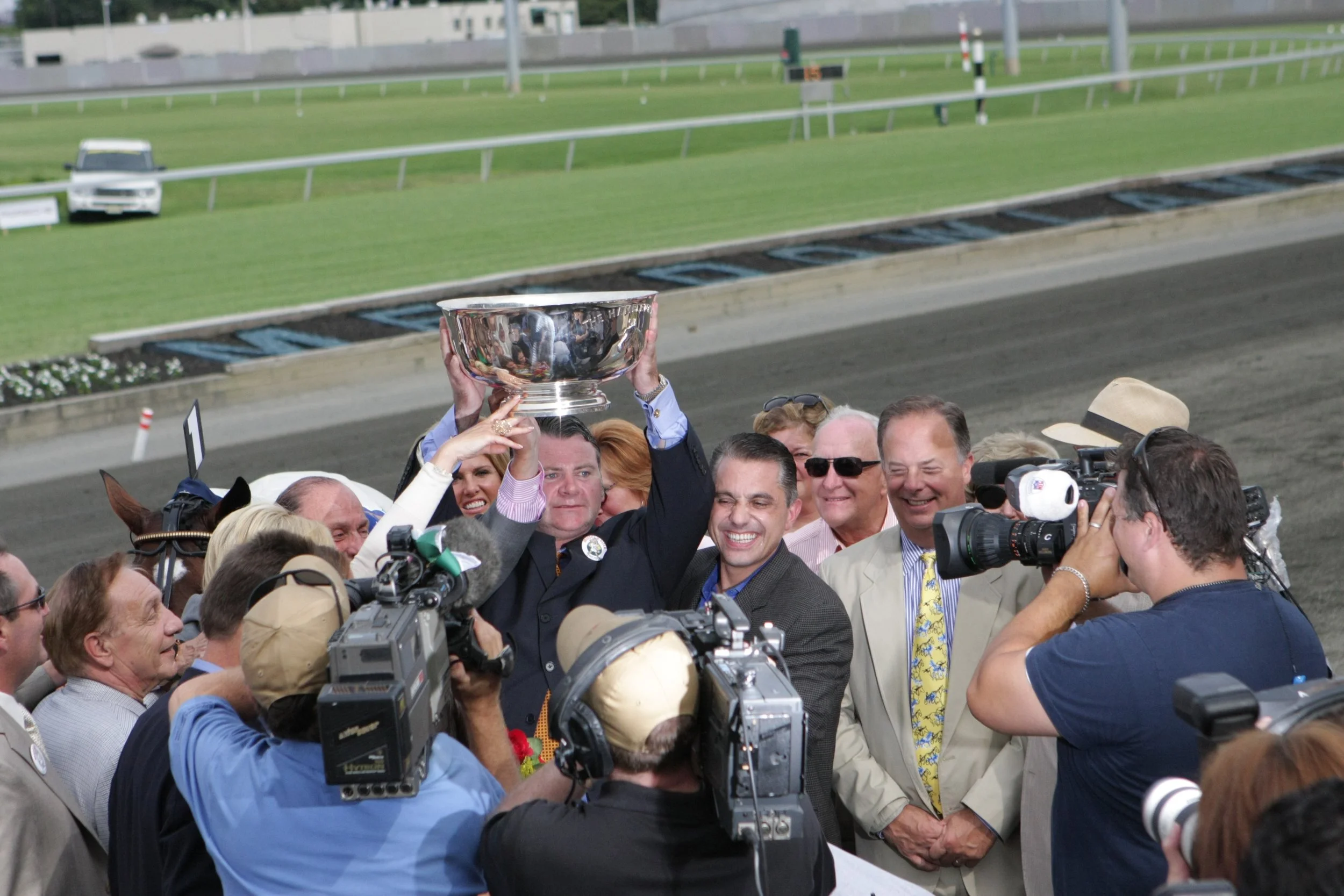
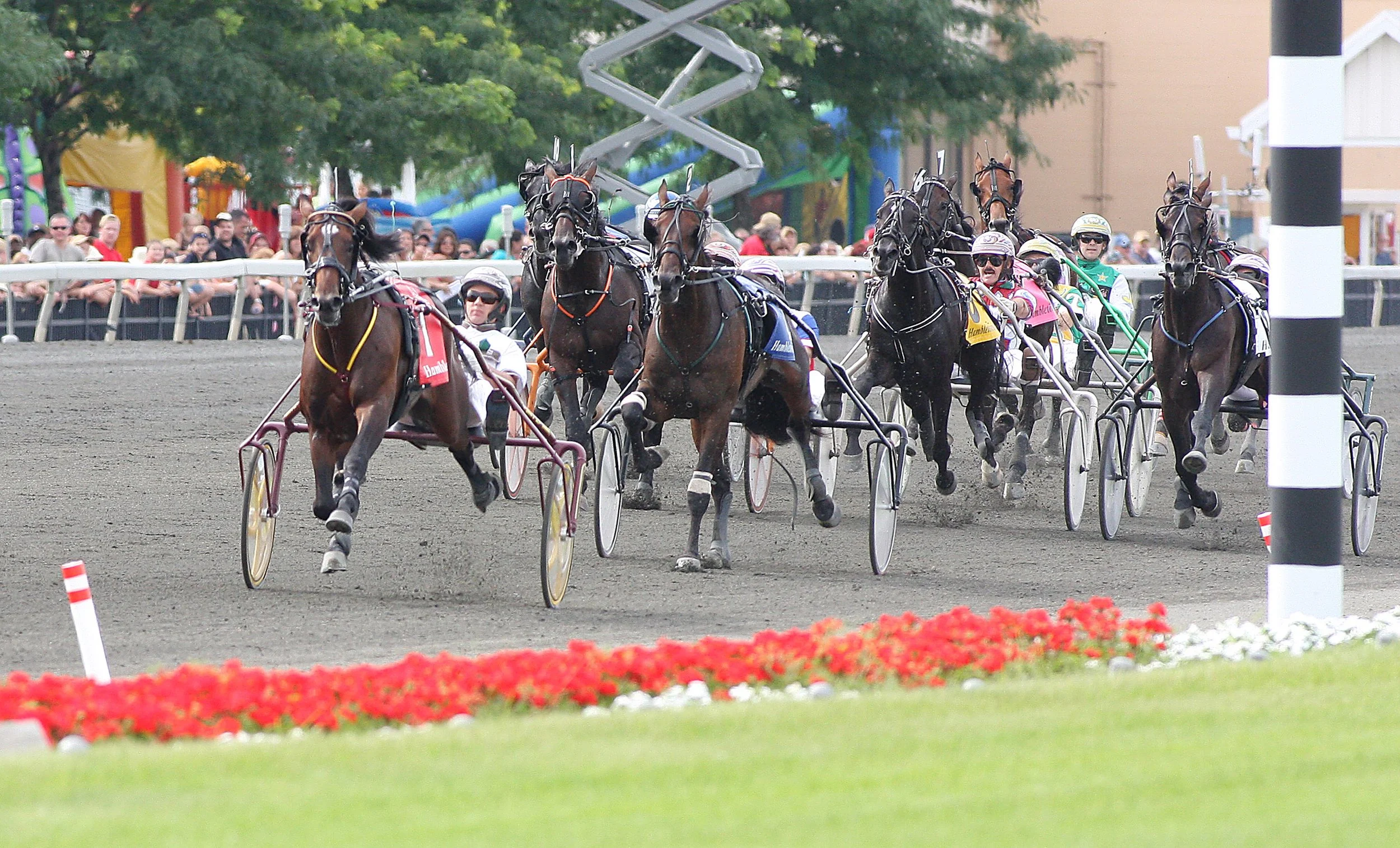
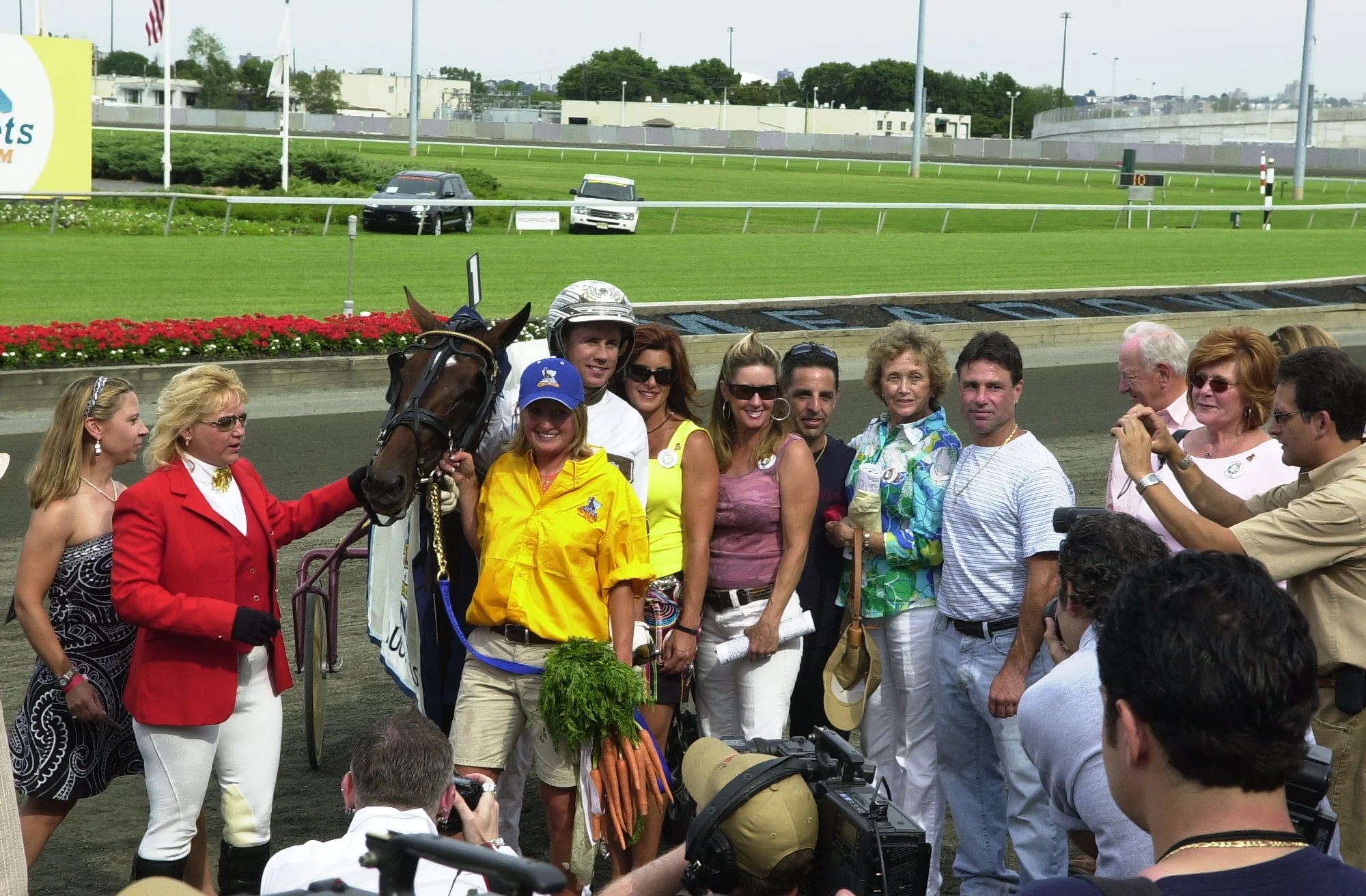
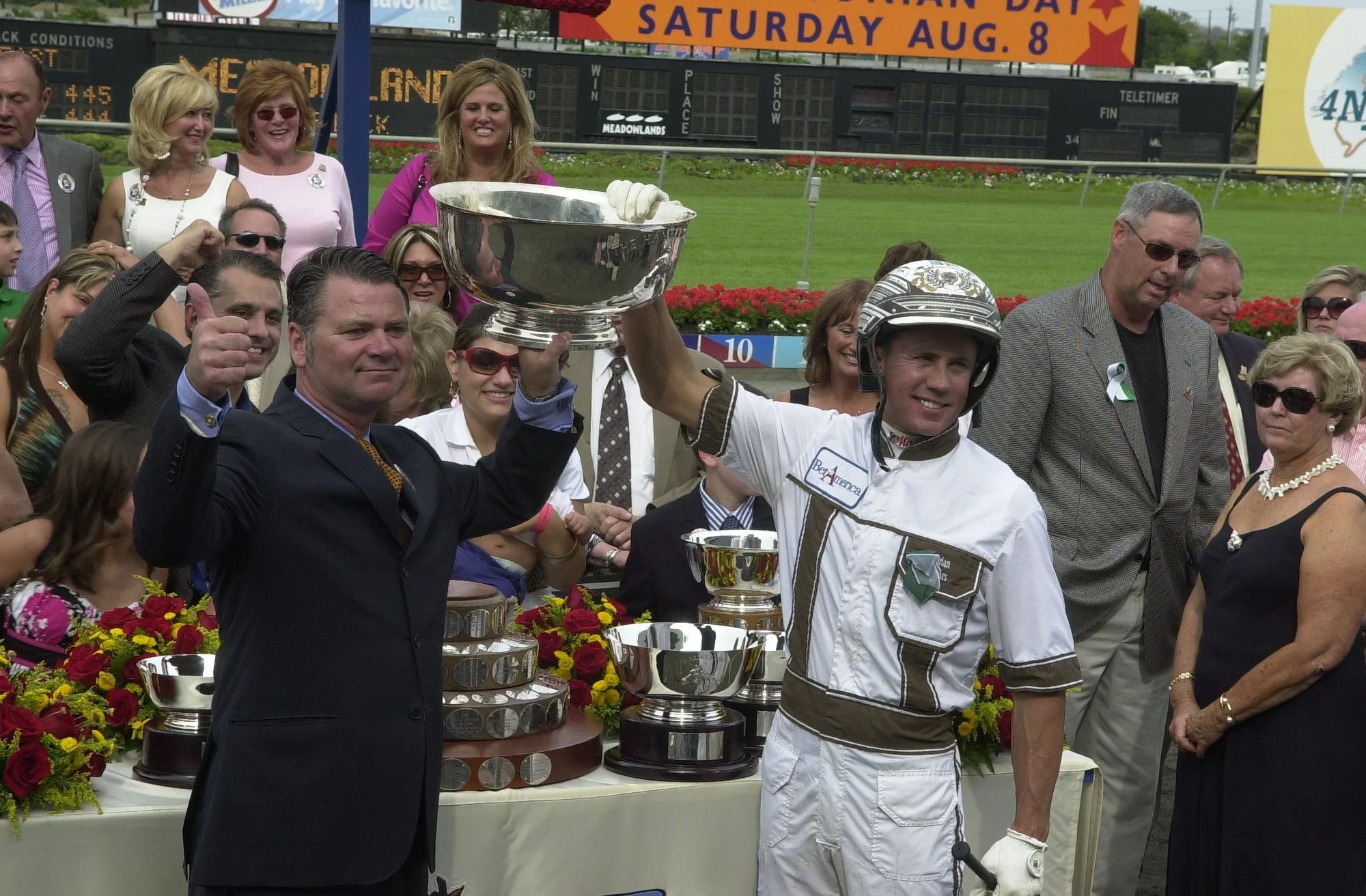

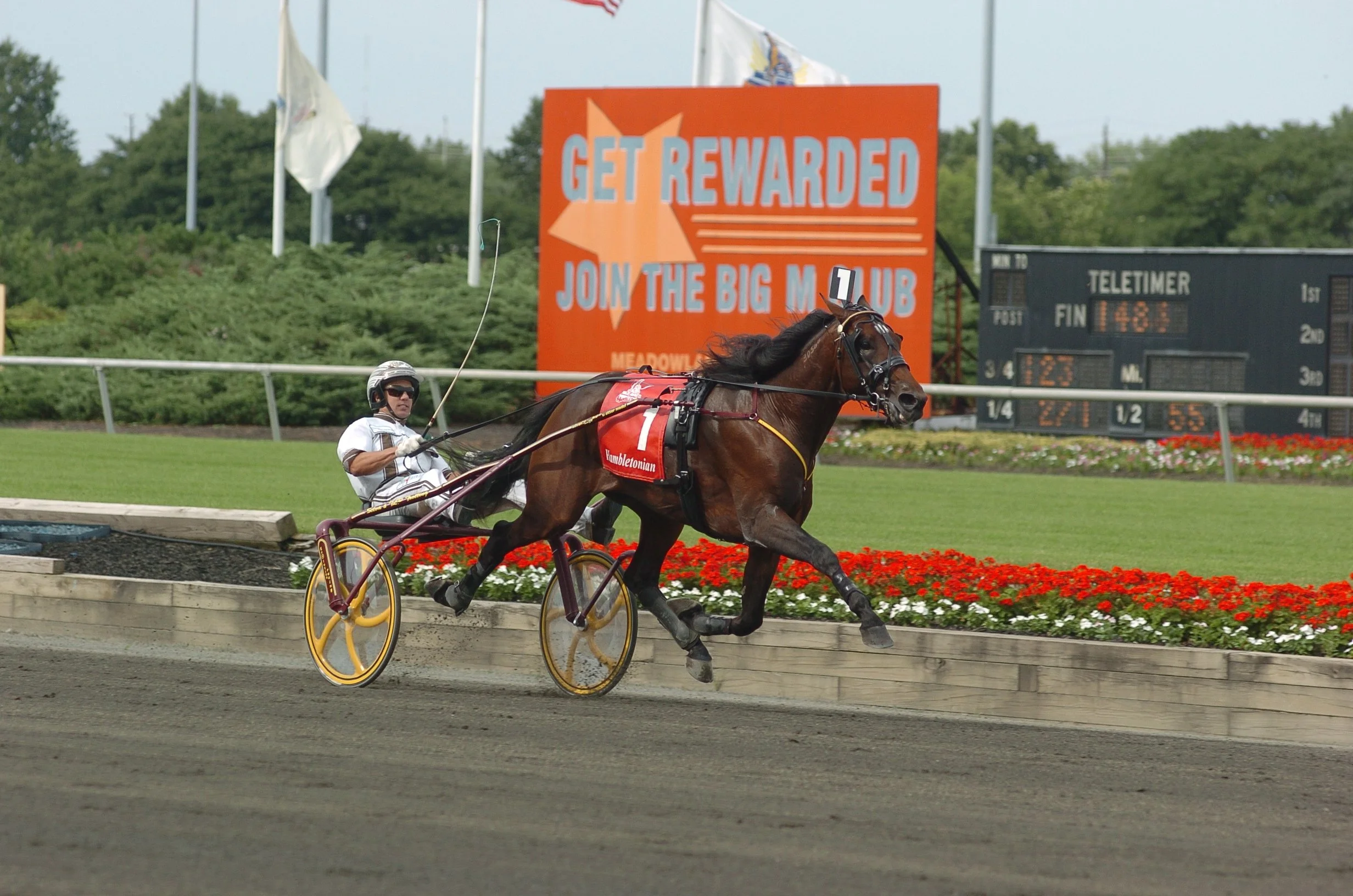
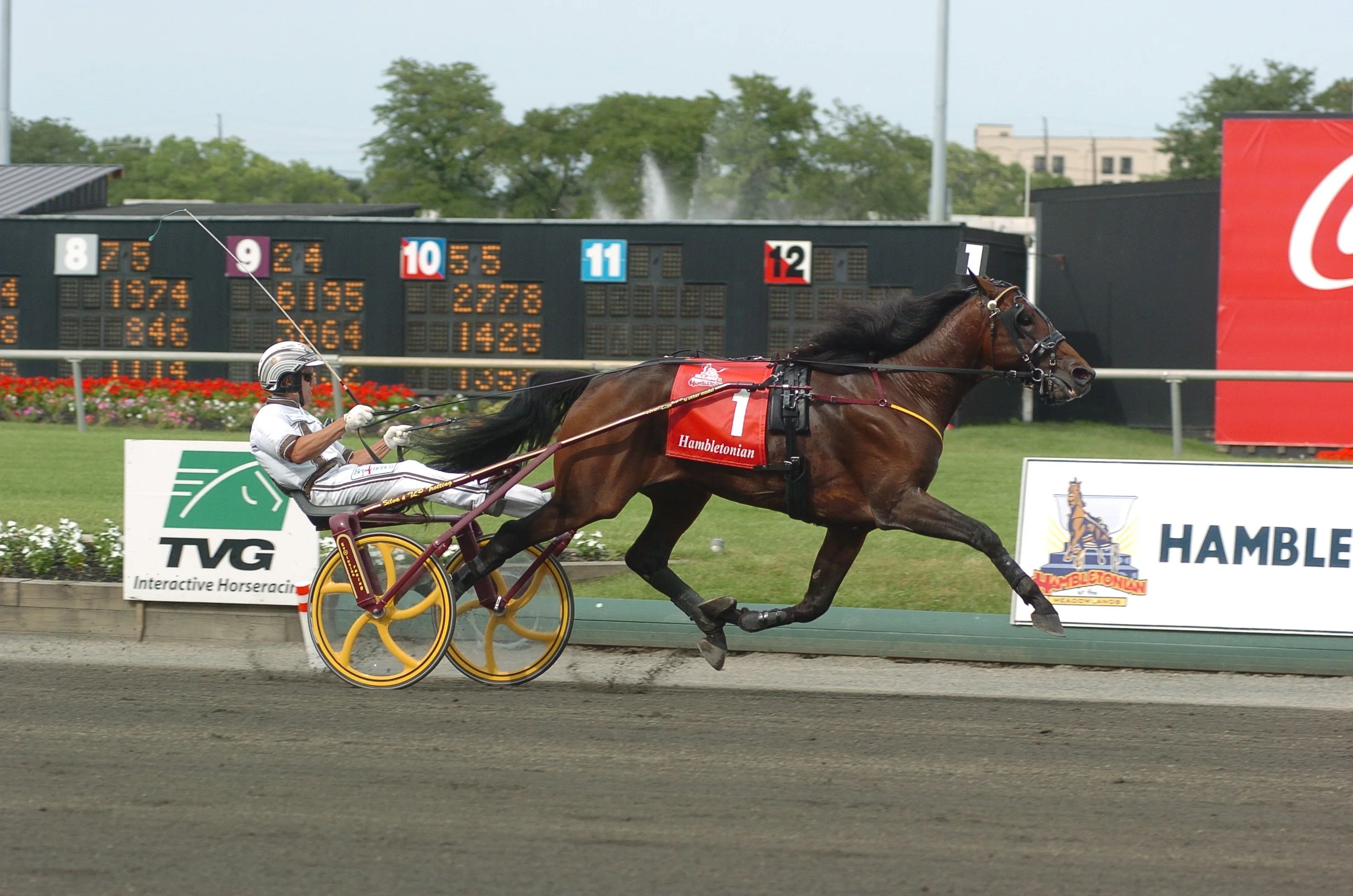
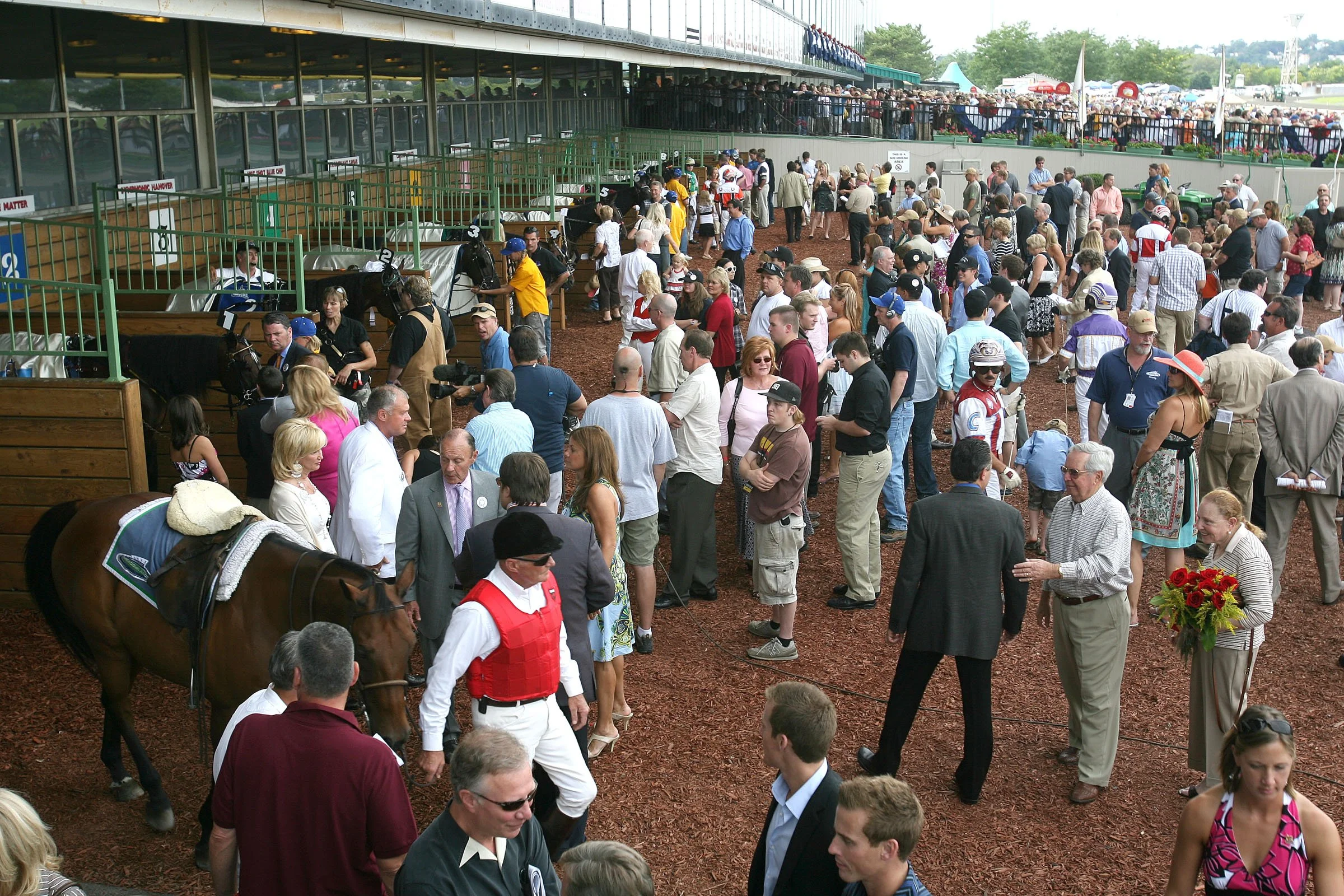
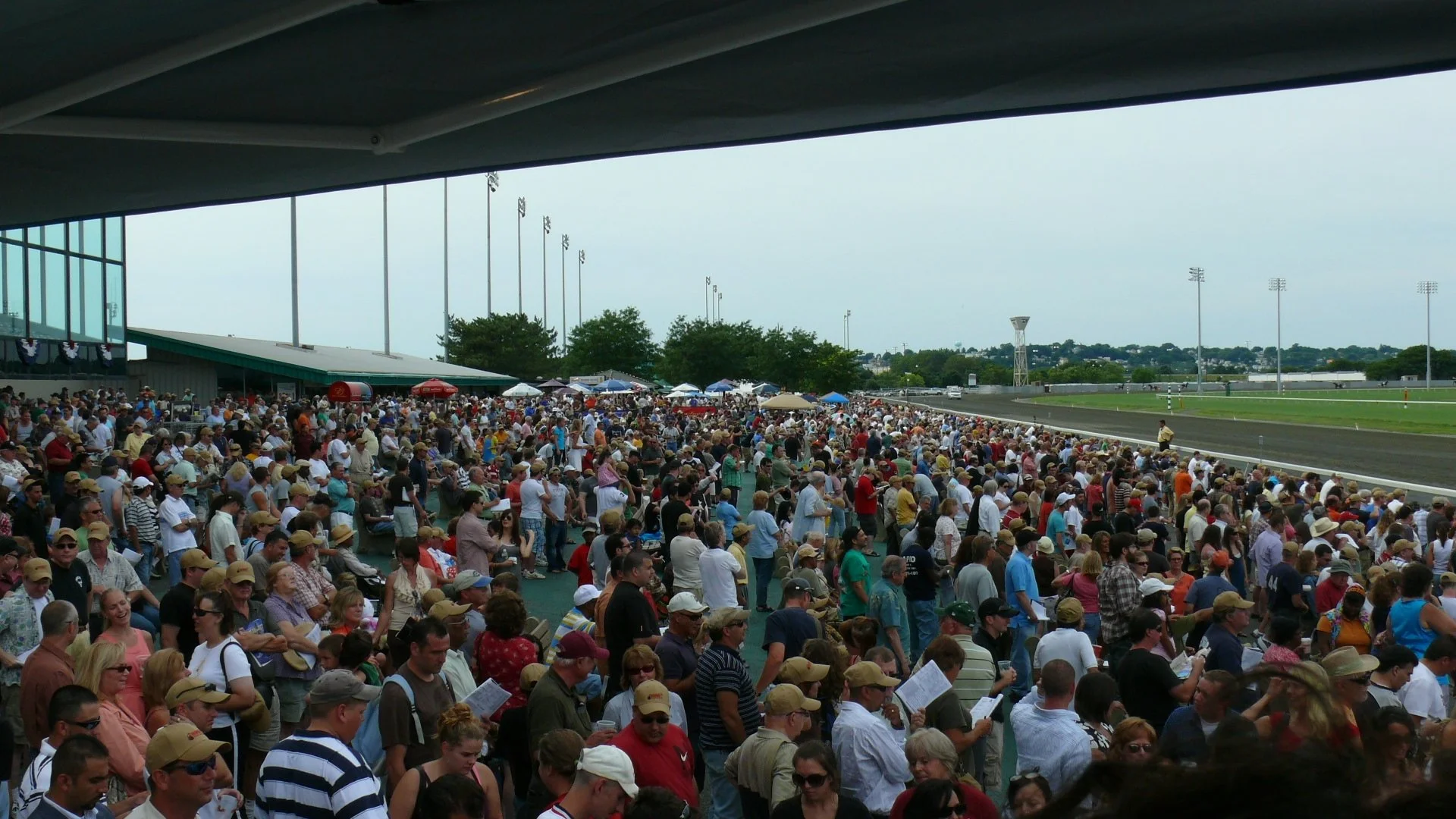
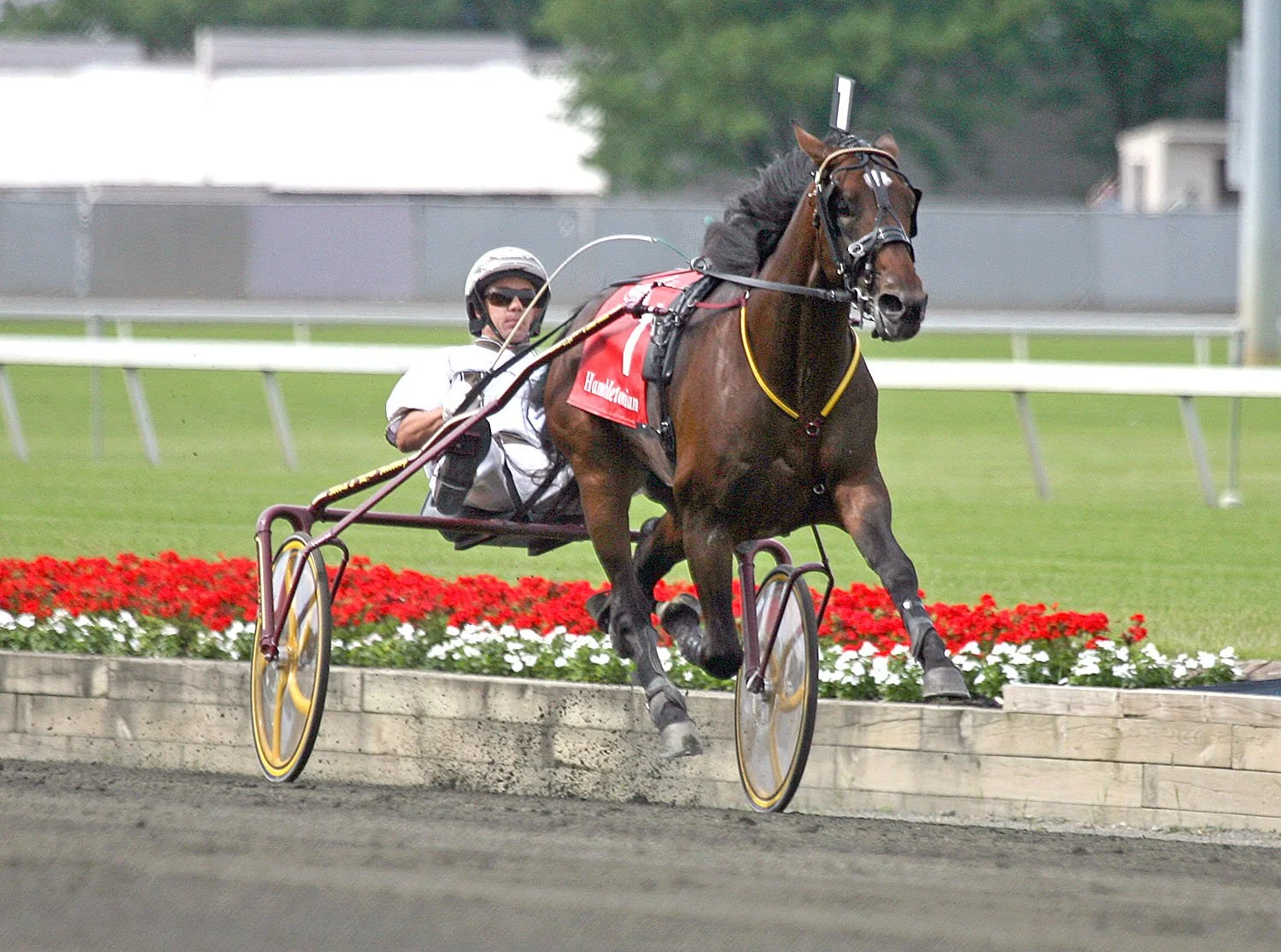
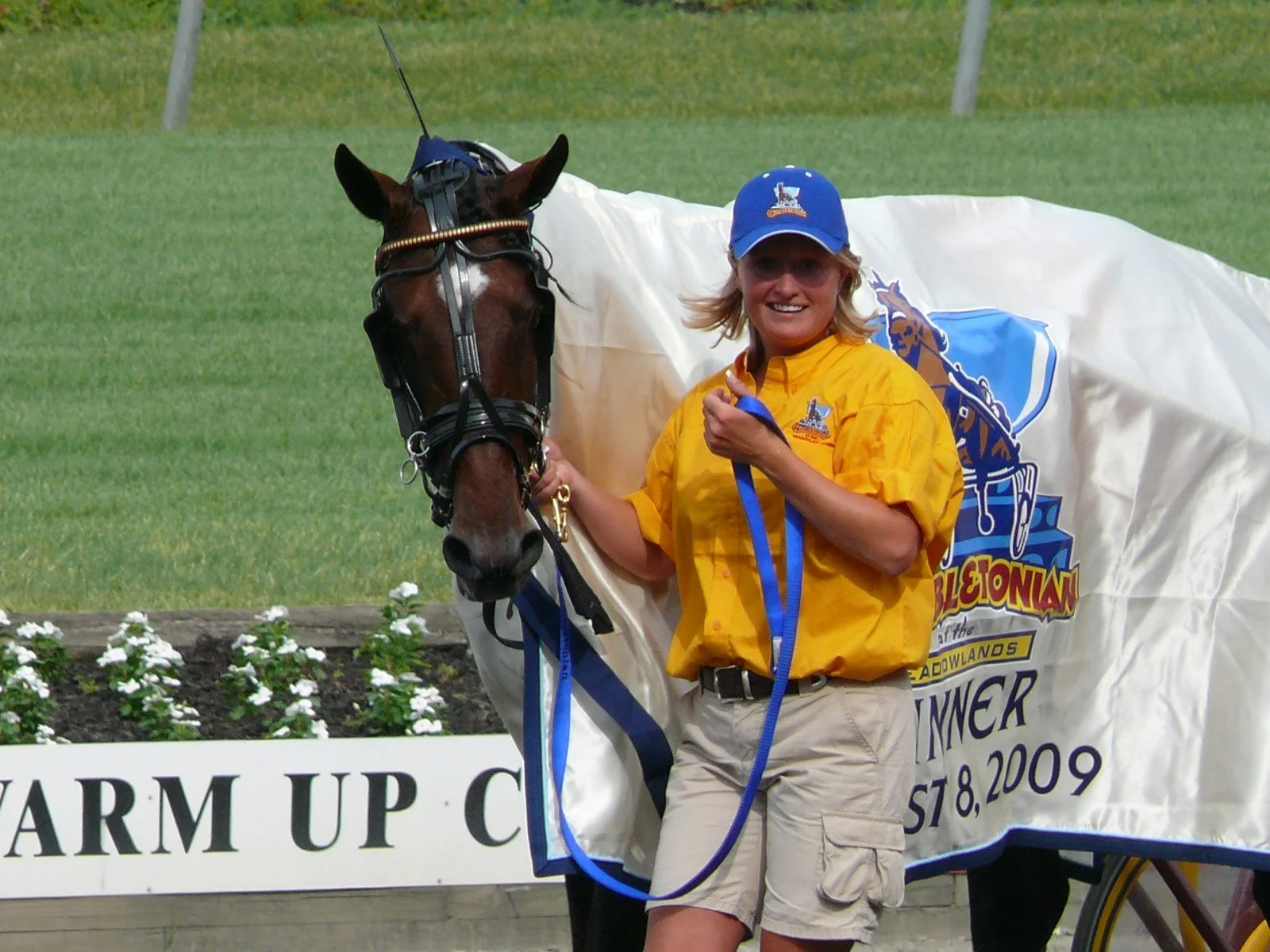
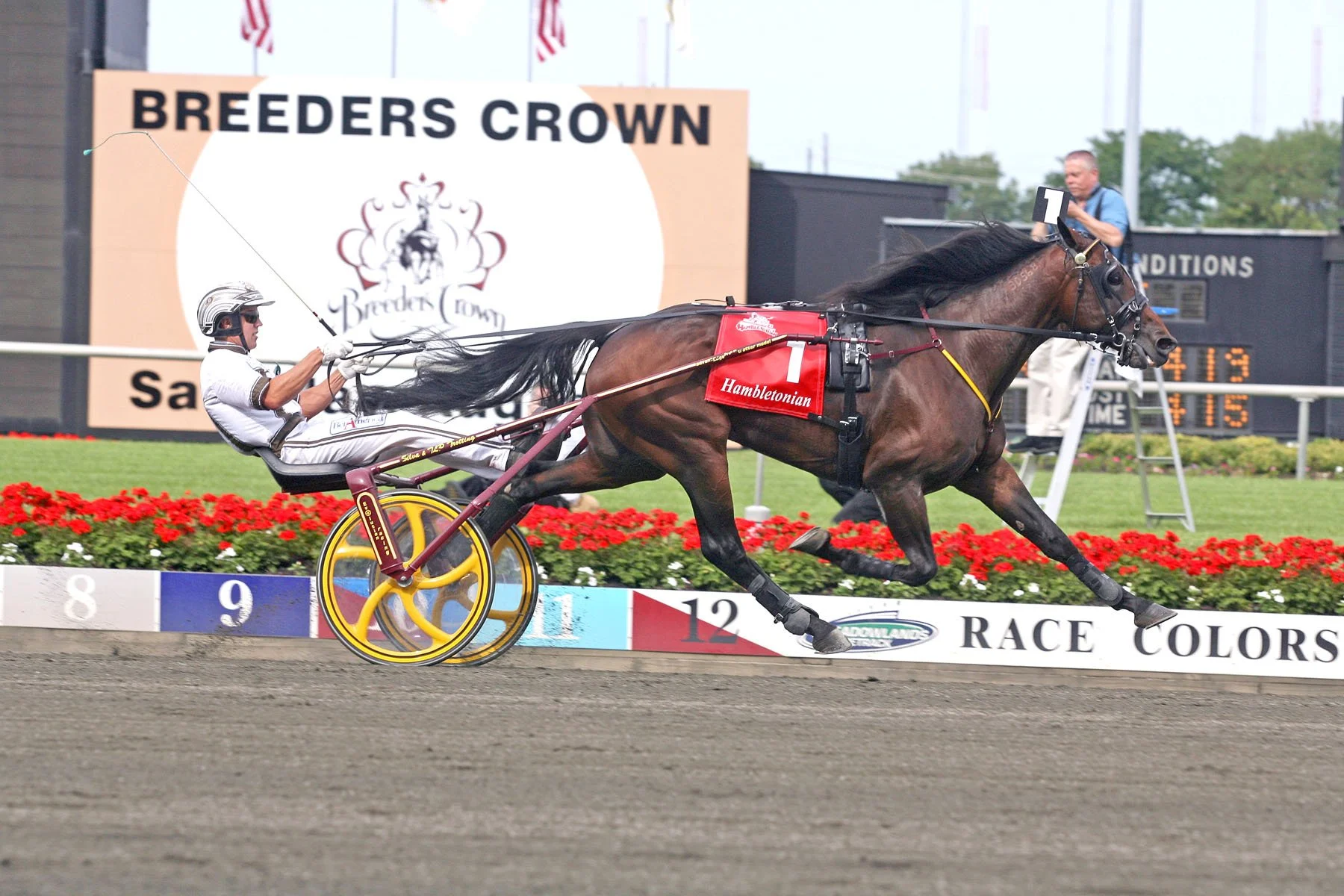
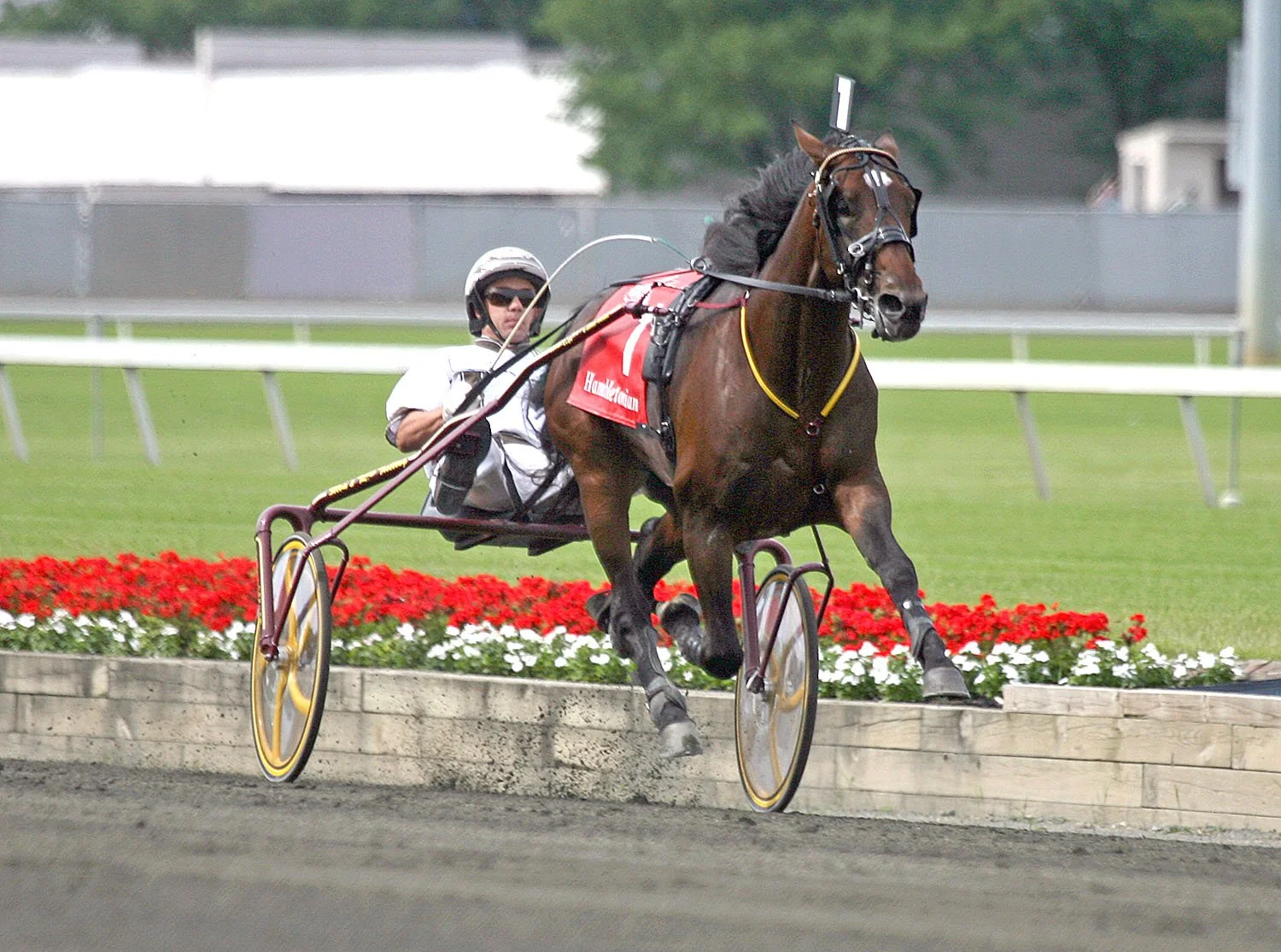
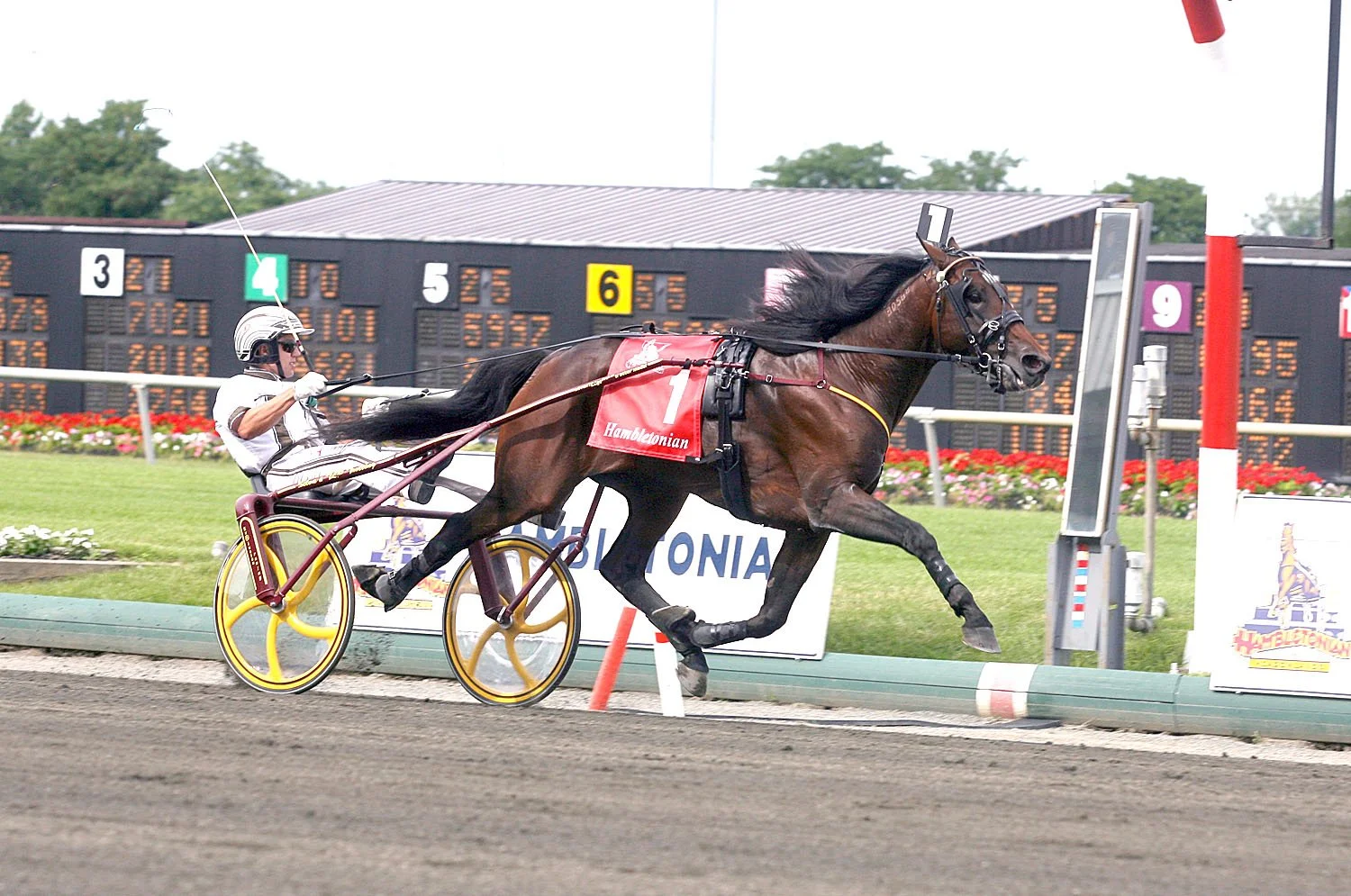
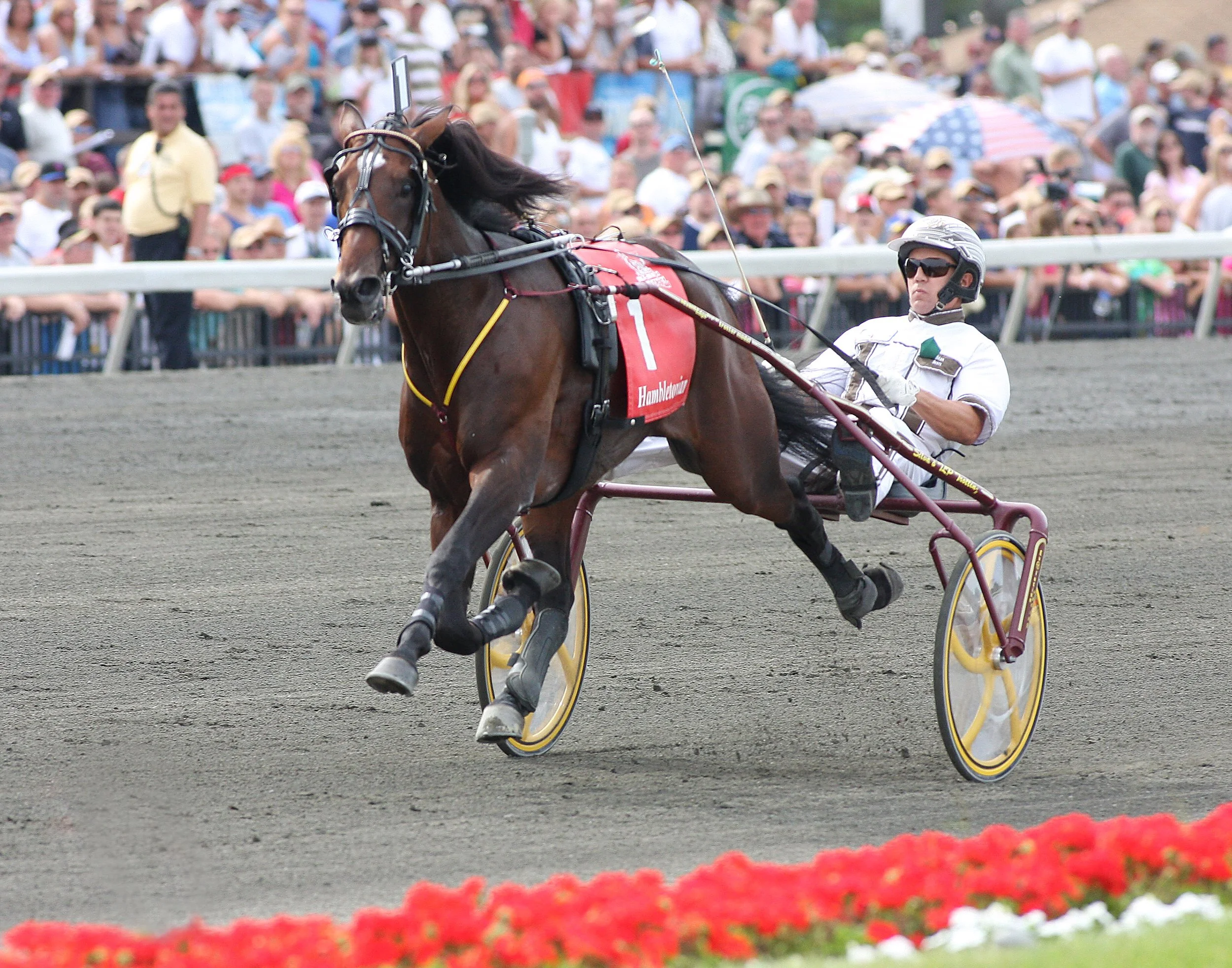
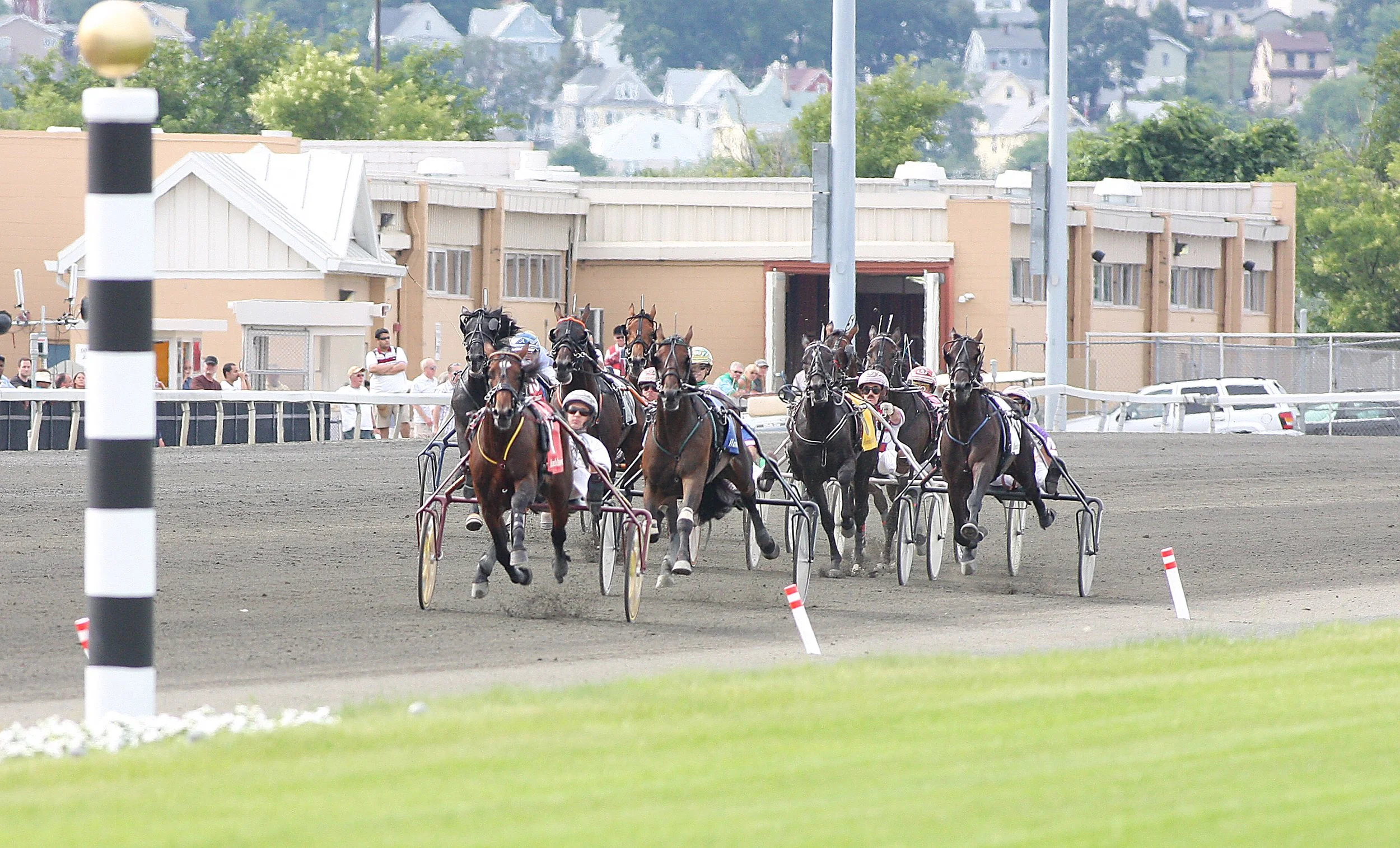
Media
Champions | 2000-2009
-
![]()
Yankee Paco
-
![]()
Scarlet Knight
-
![]()
Chip Chip Hooray
-
![]()
Amigo Hall
-
![]()
Windsong's Legacy
-
![]()
Vivid Photo
-
![]()
Glidemaster
-
![]()
Donato Hanover
-
![]()
Deweycheatumnhowe
-
![]()
Muscle Hill