1920s Hambletonian
1920s
World record · Stakes or track record
Goshen’s Pride
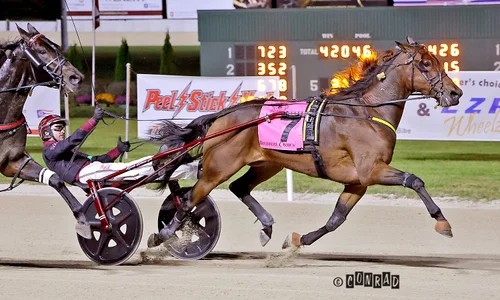
With a head of steam built up during a championship two-year-old season, the Hambletonian was all but conceded to Walter Dear in 1929. He won all six of his starts leading up to the big day in Lexington, the second year in which the Hambletonian was held a the historic oval. In two trips to the post on Hambletonian Day, Walter Dear was the best both times, and thus the coveted trophy was his. Walter Dear's owner, William Cane, also owned the fourth place finishing filly, Miss Woerner. After the Hambo, Walter Dear was sold at a big price to stand in Germany. He won the 1934 Prix D'Amerique and later disappeared when the Russian Army swept through Germany during World War II. Ther is no definitive word on what became of Walter Dear, though popular theories include him being smuggled back to the Soviet Union to improve the breeding stock. Others think the horse was secreted away to protect him, and may have died before the war was over. None of the theories have ever been proven.
The Hambletonian was postponed because of weather for the second time in three years and relocated to Lexington. The race date of October 8 is the latest the race has ever been contested. In an unparalleled accomplishment, horses prepared by Walter Cox (but dispersed to other barns because of the rules of the Lexington meeting) captured the first four monies in the summary placing: Walter Dear (Cox, 1-1); Volomite (Bill Leese, 2-2); Sir Guy Mac (Will Crozier, 3-7); and Miss Woerner (Harry Stokes, 8-3). The track rule allowed multiple entries from a trainer/driver’s stable to race uncoupled for wagering, but empowered the judges to designate the drivers on the other horses in the entry. Cox obviously wanted to name his own drivers, and the press and the public, from the accounts of the events, clearly understood that they were still Cox’s horses. The prior week, October 1, Cox’s "army" also took three of the first four monies in the Kentucky Futurity: Walter Dear (Cox, 1-1); Miss Woerner (Stokes, 2-2); and Volomite (Leese, 4-4). Walter Dear was the only winner that traced his paternal line to The Laurel Hall, a son of Peter The Great and a great great grandson of Hambletonian 10. He was also the first of the Peter The Great line in an era dominated by the Axworthy.
Lord Of Castleton
The year 1928 marked the first year that the name Castleton Farm appeared in the Hambletonian annals. The farm, outside Lexington, Kentucky, was owned by David Look at the time, and it would go on to become a leading breeder and owner of Hambletonian winners. The bay colt Spencer chased the best as a two-year-old; while he won a few stakes, it was Fireglow who was the top trotter among the juveniles. As three-year-olds, the two were again frequent foes until a frightful pile-up was caused by Fireglow in a race near Cleveland, Ohio. While Spencer quickly recovered from his injuries, Fireglow died two days afterward. Spencer prepped for the Hambletonian with a win and a second place finish in the Horse Review Stakes at Goshen before heading upstate to Syracuse for the big test. It was to be the high-headed, pure gaited Spencer’s shining day as he took both heats of the Hambletonian in stakes winning time. Spencer lived out his days as the premier stallion at Castleton Farm.
First of four Hambletonian winners owned by Castleton Farm. Castleton-owned fillies have also won the Oakes four times, including three of the first four years (1971, 1973, 1974). David Look, owner of Castleton, became the first breeder to raise and own a Hambletonian winner. New stake record in the opening heat of 2:02 1/2. Fireglow, pronounced by Walter Cox the greatest trotter he had ever trained, had been all but conceded the trophy when he died two weeks before the race from a mysterious poisoning following the frightful spill at North Randall Park outside of Cleveland. Some observers held Cox responsible for the accident in that race and suspected retribution for it was behind the horse's death. Spencer, a champion two-year-old of 1927, struggled in his return to the races the following year. His first start was the aforementioned Rainy Day Stake, which ended in a wreck. Though he won a heat of the Review at Goshen, he went into the Hambletonian winless in his sophomore year. Also sidelined due to injuries in that spill at North Randall was Spencer's trainer/driver Lon MacDonald, who engaged Bill Leese to drive the eventual winner. With only one start (1929) to his credit, MacDonald would never drive in another Hambletonian. He died two years later.
The Speed Fountain
Hambletonian lore is rife with tales of horses that enter the race in anonymity and are bedded down that night as immortals. Iosola's Worthy is a mare of just that description. A June foal, Iosola's Worthy was brought along slowly by Ben White as a two-year-old. Her lone victory came in a small stake at the Lexington Trots. She was sold over that winter by her breeder Fred Field of Brockton, Massachussetts, to E.J. Merkle of Columbus, Ohio. Spring came, and with it, steady improvement by Iosola's Worthy, who placed progressively better in each race she entered. She outlasted all the contenders in a four heat Horse Review Futurity and several other races leading up to the Hambo. The first filly to win the Hambletonian, Iosola's Worthy handled that task in straight heats and her $56,538 in career earnings made her the leading female money earner until 1930. Sold that fall to Walnut Farm for $10,700, she became the sole mare of her era to produce 2:00 performers by three different stallions.
After five days of rain at Syracuse, Hambletonian No. 2, which was originally scheduled for August 29, was moved to Lexington and raced the second week of the Grand Circuit meeting on September 27. Iosola’s Worthy was the first of 13 fillies to win the Hambletonian. Six fillies won the Hambletonian in the first twelve editions. New stake record in the second and final heat of 2:03 3/4. Childs drove the winner for trainer Ben White. White drove the filly Kashmir, probably the favorite had the race been contested at Syracuse as scheduled. A month later, when the race was staged at The Red Mile she was not a factor because of "bad manners," finishing last in the placing (7-7). White would have to wait six more years to win his first of four Hambletonians, a milestone he shares with Bill Haughton and Stanley Dancer. In the initial two years of the Hambletonian, the Walnut Hall stallion Guy Axworthy sired the first two money winners in the summary (as well as third money winner in 1927). The brother of the winning driver Marvin Childs, Frank Childs trained the winner of the 1959 Kentucky winner, Tomy Lee. The trophy for the 1927 race, a 3-foot tall urn, was among $70,000 worth of silver stolen in a burglary in 1979 in Granville, Ohio. A few months later the stolen silver was recovered in the Ohio River. The trophy is now in the collection of Merkle’s grandchildren. Heavy rain in Syracuse forced the organizers to move the event to Lexington.
the last shall be first
Horse owners are renowned for their optimism and in the case of Guy McKinney, it was owner Harry B. Rea’s optimism that carved him a unique niche in the annals of harness racing, that of the very first horse to win the Hambletonian. A $925 yearling, Guy McKinney developed a critical illness shortly after his purchase. He recovered and trained for a two-year-old career with only three starts in which he never figured. Harry B. Rea ignored the colt’s past futility on the racetrack and made the January 1, 1926 nominating payment. The colt responded to this show of faith with flair — he put together an unbeaten string of wins to carry him to the Hambo. On Hambletonian Day, Guy McKinney continued that skein with a straight heat victory. From there, he won several other stakes, including the Kentucky Futurity, amassing $68,742 in single season earnings, a mark that stood until 1949. Guy McKinney changed hands at auction in the fall of 1926, with the fledgling Hanover Shoe Farm the winning bidder at $12,000. He was turned over to trainer Tom Berry for the specific purpose of breaking the 1:59½ record. On Thanksgiving Day in 1930, Guy McKinney set a new standard of 1:58¾ in Phoenix, Arizona, which stood until 1938.
By offering to add $8,000 to the purse, Syracuse, New York won the bidding to host the inaugural Hambletonian over Kalamazoo, Michigan and Atlanta, Georgia. Kalamazoo bid $5,000; Atlanta offered $3,000. Winless in five starts as a 2-year-old (40-1 in the winter book), Guy McKinney came into the race undefeated at three and was the post time favorite at 3-2 in the pools. The trophy for the first three years was the Onondaga Hotel Cup. Legendary New York Mayor Jimmy Walker presented the cup for the inaugural race, and noting Ray's green jacket said, "Well, you've got the right colors anyway." The purse for Hambletonian No. 1 was $73,451.32, equivalent to $668,114 in 1999 dollars. That was a record purse until 1950. The Meadowlands added $569,987 to the 1998 Hambletonian. The total individual payments for the first Hambletonian were $960 including a starting fee of $500; the total fees for the 1999 Hambletonian Open are $16,925 of which $15,000 is the starting fee.